Why a 3,900-square-kilometer iceberg broke apart
Shifting ocean currents in the Southern Ocean may have caused the giant iceberg A68a to break apart.
A68a, with a surface area of 3,900 km2, was the largest piece of iceberg A68, which calved from Antarctica's Larsen C Ice Shelf in 2017. In a study published in the journal Science Advances on Oct. 19, a team of experts at Princeton University used satellite images and data to look back at December 2020, when the iceberg went through two breakup events, and to investigate their cause.
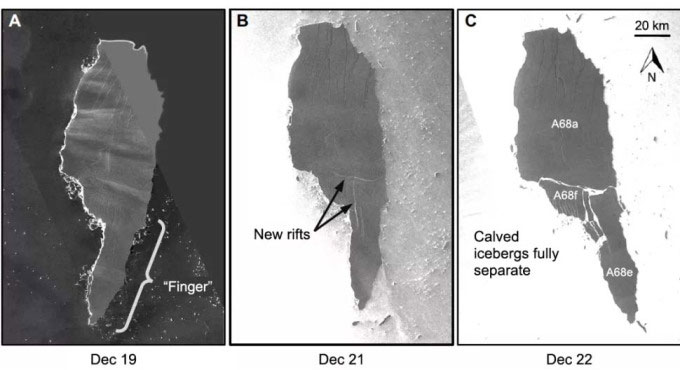
Satellite images show the changes in iceberg A68a and the two breakup events it underwent in 2020. (Photo: Science Advances).
After drifting past the island of South Georgia, A68a began to crack, with a large chunk breaking off because the bottom of the iceberg dragged along the seafloor. However, the second breakup puzzled experts, because the iceberg was floating in deep, open water at the time.
"Usually, icebergs break up because they run aground on the seafloor, causing pieces to break off. But in this case, after looking at ocean current data, we noticed that the finger-like part of the iceberg appeared to overlap a stretch of current that was stronger than the others. So it seemed reasonable to suspect that this created enough stress to break the iceberg apart", explained Alex Huth, the study's lead author and a researcher in the Atmospheric and Oceanic Sciences (AOS) Program at Princeton University.
The scientists hypothesized that the second breakup was caused by "shifting currents", and that the change in currents led to part of the iceberg breaking off, something that had never been documented before. To test the hypothesis, they assessed how external forces such as ocean currents and wind act on the iceberg.
By building a simulation of A68a, the team found that when an iceberg sits where a very strong current meets a much weaker one, the bonds between its parts begin to fracture. In addition, the iceberg's finger-like shape may also have contributed to the breakup, because it made the ice mass long enough to straddle two currents.
By studying the breakup of A68a, Huth and his colleagues believe they can better understand the role icebergs play in Earth's system and how they interact with external forces.
"Icebergs account for roughly 50% of the ice lost from Antarctica, forming when they break off from the ice sheet. As they drift, they also carry meltwater far away from the ice sheets. This can affect ocean circulation by stratifying the water column, and add iron to the ocean, which in turn leads to increases in phytoplankton", Huth said.
New cave discovered in Vietnam's former Hà Giang province
A new cave, Sán Tớ, has been found in Mèo Vạc in northern Vietnam's former Hà Giang province, about 5 km from the town center and easy for visitors to reach.