

Blue dragons wash up on Australian beaches
Blue dragons and other strange-looking creatures have washed up on beaches in eastern Australia.
Marine science student and photographer Lawrence Scheele was lucky enough to come across what he calls the rare "Blue Fleet" at Long Reef Beach, north of Sydney.
The final-year marine science student has been tracking the "Blue Fleet" – most notably blue dragons, officially known as Glaucus marginatus – which usually drift in remote parts of the ocean, carried by northeasterly winds.
Scheele followed these fascinating creatures from North Queensland at the start of summer until they drifted onto Sydney's northern beaches in February.
A video posted on the marine scientist's Instagram account earlier this month shows the prized collection of "Blue Fleet" creatures on the beach at Long Reef: alongside the blue dragons were other animals such as bluebottles and blue buttons (Porpita porpita).
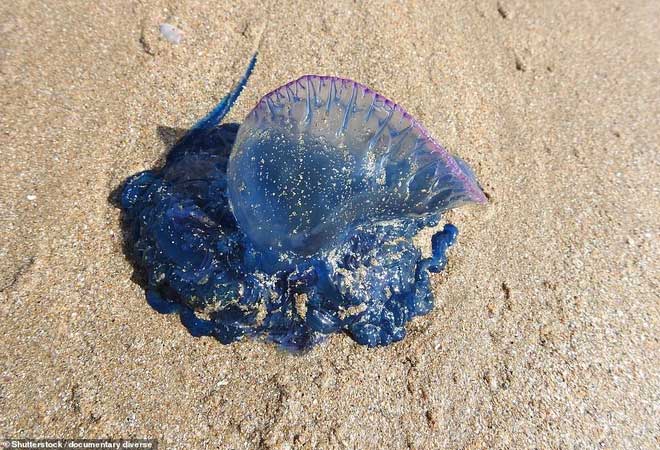
Bluebottles are not life-threatening to humans, but their stings are very painful. (Photo: Lawrence Scheele).
"I just had a visit from hundreds of these beautiful creatures called Glaucus marginatus, not to be confused with their cousin Glaucus atlanticus. In summer, strong winds blow these 1 cm creatures ashore," Scheele wrote on Instagram.
Both species Scheele mentioned are small sea slugs known as blue dragons and look very much alike, but Glaucus marginatus is smaller, growing to about 1.3 cm, while its cousin reaches up to 3 cm.
These creatures belong to an order of animals known as nudibranchs – a group of about 3,000 species of brightly colored, shell-less mollusks.
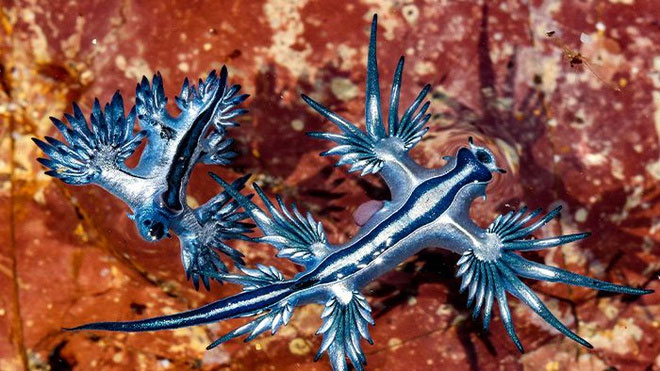
The blue dragon – officially known as Glaucus marginatus – can release venom when touched. (Photo: Lawrence Scheele).
They feed on other small invertebrates in the ocean. The species can be found in the Atlantic, Pacific and Indian oceans, according to the marine conservation nonprofit Oceana.
Though these creatures are nowhere near as big as the dragons of fantasy, they can still do considerable harm. Blue dragons feed on the stinging siphonophore known as the "Portuguese man o' war" and store venom from their prey to use on their next meals, according to Oceana.
As a result, when people touch these tiny slugs, they can release that venom and deliver a sting that can be even more harmful than a man o' war's.
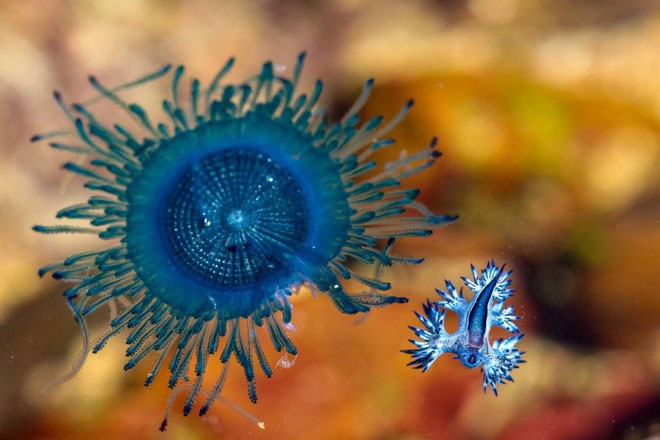
A blue dragon and a blue button (Porpita porpita). (Photo: Lawrence Scheele).
Of the "Blue Fleet", bluebottles appear to be the best known. They are not life-threatening to humans, but their stings are very painful.
Meanwhile, the blue button (Porpita porpita), which is also venomous, usually does not cause pain but can irritate the skin. It has structures that let its body float on the water's surface, so it is easily pushed along by currents and wind.
