Mọc vân ám: the traditional Tết delicacy of old Hà Nội fading into the past
"Mọc vân ám" is a signature dish of the traditional cuisine of old Hà Nội, Vietnam's capital. It demands great care and connoisseurship in both preparation and cooking to create a distinctive dish with a superb, unique flavor.
Vietnamese people have always taken pride in a culinary culture steeped in tradition. As time goes by, more and more delicious dishes appear, yet some foods remain etched in memory, and whenever people recall them, they long to rediscover those old flavors.
The old village of Bát Tràng, on the outskirts of Hà Nội, is famous for its dried squid and bamboo shoot soup, served to "wash away bad luck" and pray for good fortune on the offering trays for the Kitchen Gods (ông Công ông Táo) festival and on the 30th day of Tết. But few people still remember another delicacy that has gradually faded into the past: mọc vân ám.
Mọc vân ám: the quintessence of old Hà Nội cuisine
It can be said that mọc vân ám embodies the essence and soul of the cuisine of old Thăng Long, the former name of Hà Nội. The elaborate care and expertise in every step of making this dish reflect the refined talent of Hà Nội people.
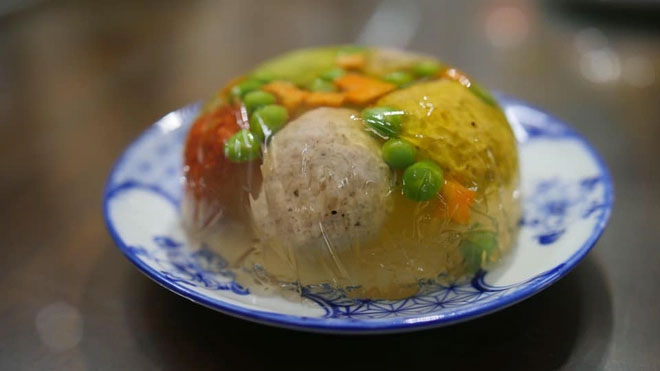
Mọc vân ám sounds poetic, but it is actually a kind of jellied meat.
Mọc vân ám is like a white cloud wrapping around jewels of many colors inside. In reality, it is a layer of set pork-skin aspic covering five-colored meatballs that symbolize the balance of Yin and Yang and the Five Elements. How do cooks create those colorful meatballs, and what does this dish have to do with the ancient theories of Yin-Yang and the Five Elements?
It is also a kind of jellied meat, but unlike the ordinary version, making mọc vân ám takes a great deal of effort. From carefully selecting ingredients to coloring the meatballs, cooking them and pouring the mold, every step requires the meticulous skill of the cook. The finished mọc vân ám has a transparent outer layer (a broth simmered from bones and pork skin) that, like a covering cloud (vân ám), enfolds the colorful pork-paste meatballs inside.
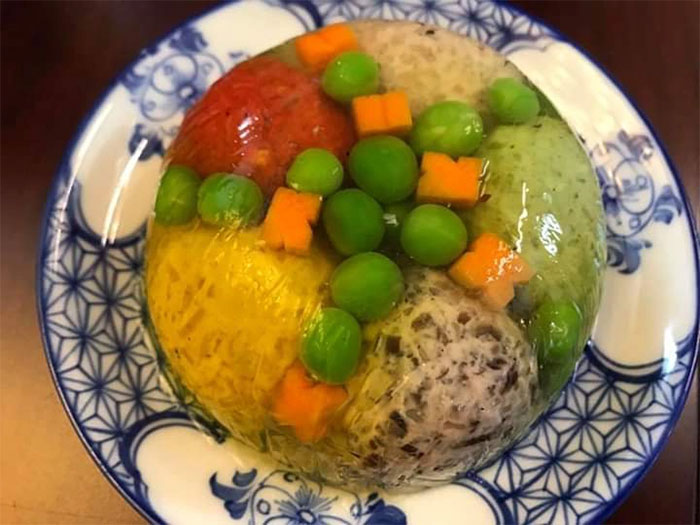
Mọc vân ám, a traditional Tết delicacy steeped in the ancient theory of the Five Elements.
Perhaps because of this complexity, this traditional Tết delicacy has disappeared from feast trays amid today's busy pace of life. Few people can still cook it with its authentic old taste. It is believed that, beyond cooking technique, anyone who makes good mọc vân ám must have a deep understanding of cuisine and a profound love for their homeland.
Cooking mọc vân ám is a test of devotion to cuisine. People today are truly busy; many families are still working until the afternoon of the 30th day of Tết, leaving little time to make mọc vân ám, which demands meticulous attention at every step. Some families make jellied pork, others choose jellied meatballs, and some simply order a ready-made feast tray for convenience, since there is no time to "linger" over such an elaborate dish.
Making mọc vân ám is truly elaborate and painstaking...
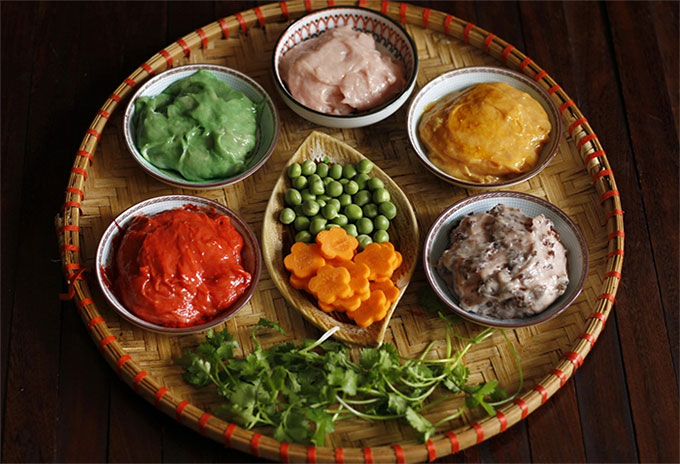
Old Hà Nội cooks were refined in every gesture and skillful at coloring food with natural ingredients: red from gac fruit pulp, green from pandan leaves, yellow from gardenia seeds, black from soaked and finely minced shiitake mushrooms and wood ear mushrooms, and a pale ivory white from raw pork paste. All easy-to-find ingredients, right? In fact, however, the green color in the old days came not from pandan leaves but from the natural green of mảnh cộng leaves.
Mảnh cộng, also called bìm bịp or xương khỉ: in traditional medicine, this leaf is described as sweet and neutral in nature and is believed to support liver detoxification and clear heat, although it is not a proven treatment. (Photo: Bùi Thủy).
Raw pork paste used as the base for the meatballs is not simply ground meat; it must be raw pork paste mixed with pork skin scraped clean of fat in a certain ratio, finely minced, and combined with white wood ear mushroom, white pepper and a few other seasonings, kneaded until springy, and only then divided into portions for coloring.
Once colored, the meatballs are steamed separately by color, never steamed together and never boiled.
The aspic is even more demanding. It must be made slowly and calmly, without hurrying, because the aspic decides whether the mọc vân ám becomes a true "quintessence" or not. The aspic should be clear and only faintly translucent, like crystal, enfolding the colorful meatballs so that they remain clearly visible. If the aspic is cloudy and lumpy, the dish loses much of its appeal.
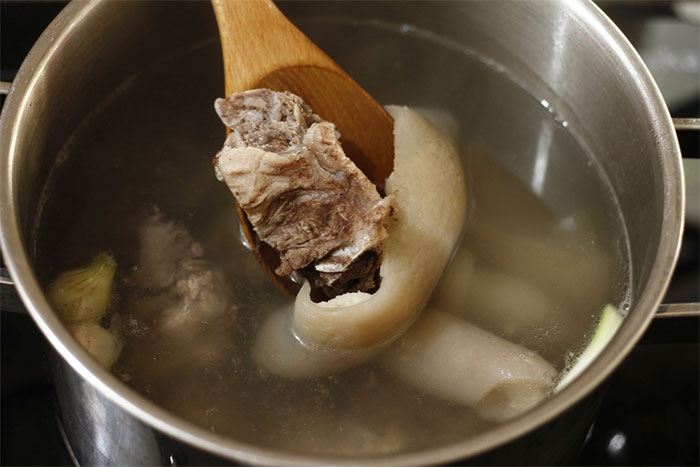
Simmering the pork-skin broth requires careful control of the heat and timing so it does not turn cloudy. (Photo: Bùi Thủy).
Pork skin is rich in natural collagen, so it must be simmered until very tender over medium heat. The skin is scraped clean of fat and rubbed with salt water, fresh lime and ginger juice to clean it and remove unpleasant odors. Next, it must be blanched in hot water to wash away all impurities. Only then is the pork skin put into cold water along with ginger and grilled shallots and a little salt.
The aspic must be simmered over low to medium heat; if it boils vigorously, the broth will turn milky white and spoil the dish. The scum must be skimmed off continuously until the broth thickens slightly and the skin starts to fall apart, at which point all the skin is removed. The broth is then left to settle so the clear liquid can be collected.
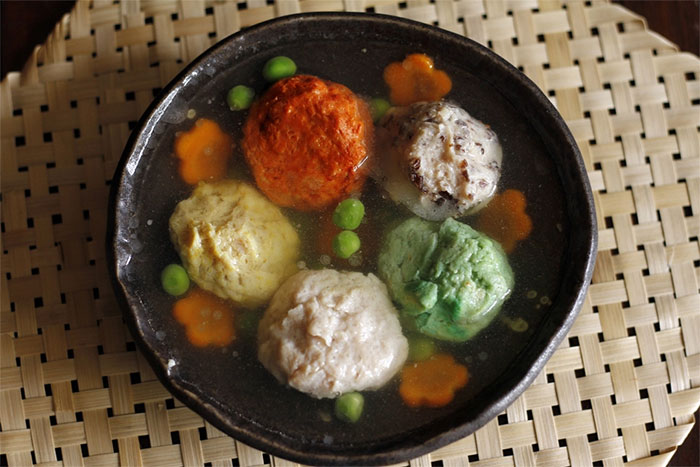
The five-colored meatballs are steamed separately before being placed in small bowls and covered with the pork-skin broth. (Photo: Bùi Thủy).
The pork skin and pork bones used for the broth must come from good, naturally raised pigs, not ones fattened with growth stimulants. Mọc vân ám is set in small bowls that fit neatly onto a plate, not in large bowls. Instead of cooking oil, the inside of each bowl is coated with a very thin layer of liquid lard so the jelly can be turned out onto the plate more easily. Peas and carrots carved into round-petaled flowers, blanched in boiling water, are placed in first. Five meatballs of five colors are arranged alternately, then the pork-skin broth is gently poured over them so the dish gradually sets. To serve, the bowl is turned upside down onto a plate and placed on the offering tray or the feast tray for guests.
...but rich in meaning
A small, neat, round plate of colorful mọc vân ám carries considerable meaning when placed on the Tết feast tray of Hà Nội families. It is a dish with no fixed recipe or precise measurements; its essence lies in the culinary experience of old Hà Nội, which produces the most balanced flavor.
A dish made with great dedication
Why is mọc vân ám so meaningful on the Tết feast tray? First of all, because of the dedication poured into every step. Each stage must be meticulous and refined. For example, setting the jelly is easy: just buy gelatin and save a whole lot of time. But then the jelly turns mushy when exposed to air, and there is no longer an intact, beautifully rounded five-colored cloud.
Many people also wonder: green is easy, so why not blend pandan leaves or spinach and strain out the juice for green color? But the green of mảnh cộng leaves is quite different; by comparison, the substitutes fall short, and the dish is no longer a top-quality one. Yet now that mảnh cộng leaves cannot be found in the city, some people simply make do.
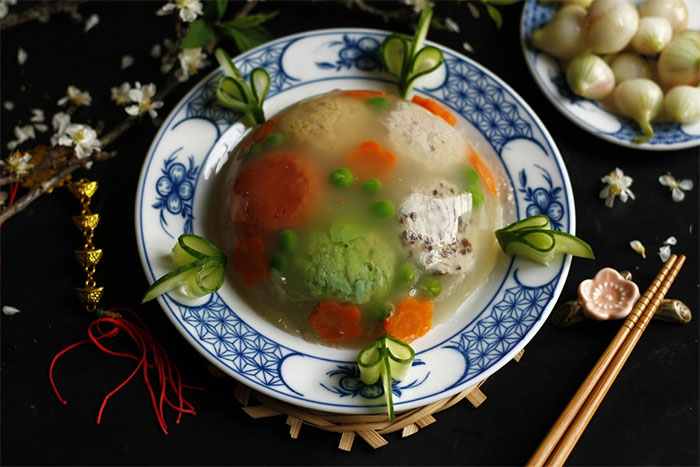
Because it is so elaborate to make, mọc vân ám, the Tết delicacy, has been lost to the past, and its old flavor is hard to recreate. (Photo: Bùi Thủy).
A dish that gathers the essence of the universe
It sounds as remote as the cosmos, but its meaning for human life is very close. The traditional mọc vân ám is delicious and precious because its five meatballs in five different colors symbolize the Five Elements: Metal (the ivory white of raw pork paste), Wood (the green of mảnh cộng leaves, now replaced by the easier-to-find pandan leaves or spinach), Water (the black of minced shiitake and wood ear mushrooms), Fire (the red of ripe gac fruit pulp) and Earth (the yellow of gardenia seeds).
The Five Elements theory, which expresses the movement of life, is harmoniously applied to cuisine. It is also a philosophy of the ancient Vietnamese symbolizing the passage of time through the four seasons: Spring (Wood), Summer (Fire), Autumn (Metal), Winter (Water), and the Tứ quý (the last month of each season, belonging to Earth). The round bowl of mọc vân ám (Heaven) placed on a square plate (Earth) symbolizes the balance of Yin and Yang. Placed on an oval plate, it resembles a gold ingot of wealth; isn't that a symbol of good fortune?
This symbolizes the wish and aspiration for a full and complete life, for everything to go as desired, and for wealth and prosperity. Mọc vân ám on the traditional feast tray is also the heartfelt offering of descendants to their grandparents and ancestors, imbued with filial devotion and reverence for life (hiếu sinh) and with the principle of living in harmony with nature to achieve happiness.