"Mystery creature" in Vietnam's waters identified by scientists as a new species
A new species found in Vietnam has caught the attention of scientists.
A new discovery
Hidden beneath the clear blue waters off Vietnam's coast lies a "strange" creature. It went largely unnoticed until scuba-diving scientists took a closer look. In the end, they concluded it was a new species.
According to a study published June 16 in the Journal of Marine Science and Engineering, researchers surveyed a number of marine organisms in Hạ Long Bay, a UNESCO World Heritage Site in northern Vietnam, during a series of dives.
While looking around a "semi-dark" area, the scientists spotted a large sponge. Moving around shallow rocks and coral reefs, they collected eight sponges of this same kind.
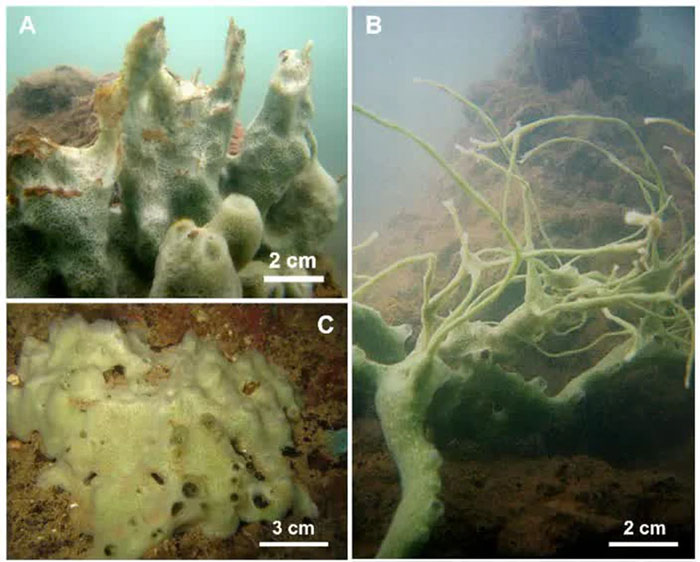
The newly discovered sponge species in Vietnam.
After careful examination, the researchers identified a new sponge species and named it Cladocroce pansinii.
According to the study, Cladocroce pansinii is "generally quite large" and tube-shaped. Living in an area of the bay sheltered from harsh weather, the sponges grow to about 20 cm. Their shapes vary widely, but most are "pale blue".
Photos show several Cladocroce pansinii specimens. One is taller, with many thick tubes. Another is longer, with thin branches, almost like a creeping vine. A third, slightly yellowish sponge is shorter and wider.
Sponges thrive in many climates and oceans, from the tropics to the poles, and can be found at all latitudes. They live from the intertidal zone down to the deepest parts of the sea, including dimly lit sea caves. More than 5,000 sponge species exist worldwide, varying in shape, color, size, structure and age. Their lifespans can range from a few months to twenty years or more.
Among the sponges harvested and used by people, the highest-quality ones come first and foremost from warm seas, especially the Mediterranean, the Aegean and the Red Sea. However, only about 12 of the 5,000 sponge species are used commercially.
The discovery of the new sponge adds another entry to the "dictionary" of Vietnam's biodiversity and helps scientists better understand tropical marine life.
Significance of the discovery
The researchers said Cladocroce pansinii was named after Maurizio Pansini to honor "his fundamental contribution to sponge taxonomy."
The new species was distinguished based on its body shape and DNA.
After identifying the new species, the researchers realized that some sponge specimens previously found in Hawaii and Thailand had been misidentified and were actually Cladocroce pansinii. According to the study, these misidentified sponges were "light blue, light gray and purple."
The research team included scientists Marco Bertolino, Carlo Cerrano, Giorgio Bavestrello, Do Cong Thung, Laura Núñez-Pons, Francesca Rispo, Jana Efremova, Valerio Mazzella, Daisy Monica Makapedua and Barbara Calcinai.
During the surveys, the researchers also discovered a new "shaggy" purple sponge species in Indonesia, recorded another sponge species in Indonesia for the first time, and provided updated descriptions of several known sponge species.
The researchers said: "Our work increases knowledge of species distribution along iconic Indo-Pacific hotspots and inspires research on marine biodiversity."
Hạ Long Bay lies along Vietnam's northern coast, about 160 km east of Hanoi.

Vietnam's “invisible” fish that is rarer than gold
Before 1995, a single ghost pipefish was caught by chance off Nha Trang, Vietnam. The species has never been seen there again.
Rare giant triton snail found off Vietnam after 20-year absence
A giant triton weighing over 2.6 kg was found by a fisherman off Cù Lao Chàm, near Hội An (now Đà Nẵng), after a 20-year absence.
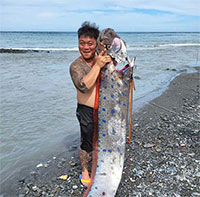
Man reels in giant 6-meter, 130-kilogram oarfish
After a 40-minute struggle, a man in Taiwan hauled a giant oarfish nearly 6 meters long and weighing 130 kg ashore.

Orcas attack two racing boats off Gibraltar
A pod of orcas rammed two boats competing in The Ocean Race in the Strait of Gibraltar on June 22, 2023, forcing the crews to slow down.
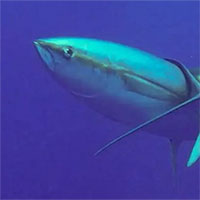
Tuna rub against sharks to get rid of parasites
Tuna often rub against sharks rather than their own kind, because sandpaper-like shark skin offers a suitable surface for scraping off parasites.