Rare giant triton snail found off Vietnam after 20-year absence
A giant triton snail weighing more than 2.6 kg has been found by a fisherman in the waters off Cù Lao Chàm, an island cluster off Hội An (now part of Đà Nẵng city) in central Vietnam, after a 20-year absence.
On Aug. 21, Nguyễn Văn Vũ, deputy director of the Cù Lao Chàm Marine Protected Area Management Board, said the triton, which weighed more than 2.6 kg and measured 44 cm long, had been released back into the sea. It was caught by fisherman Trần Văn Cử, who lives in Bãi Ông hamlet in Tân Hiệp island commune, then part of Hội An city.
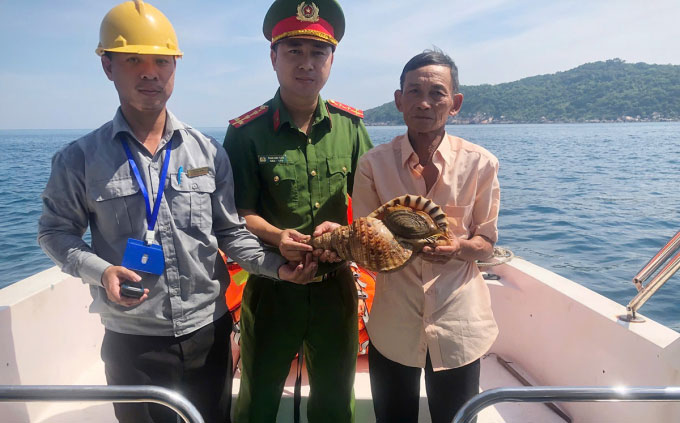
Mr. Cử and local authorities release the triton back into the sea. (Photo: Cù Lao Chàm Marine Protected Area Management Board).
According to Vũ, the management board had not recorded any tritons in the waters around Cù Lao Chàm since 2004. "The fact that local people found a triton reflects the results of marine conservation at Cù Lao Chàm in recent years," he said.
Earlier, on Aug. 19, Cử caught the triton while fishing with a gillnet inside the Cù Lao Chàm Marine Protected Area. He knew it was a rare species because the protected area's management board had run awareness campaigns about protecting it.
Local residents said tritons used to be found in the sea around Cù Lao Chàm. Because the snails are large, they were easy to spot when diving. People caught them to eat or sell, and after that the animals were no longer seen. Today, catching, trading or eating protected species such as the triton is illegal in Vietnam and can lead to criminal prosecution.
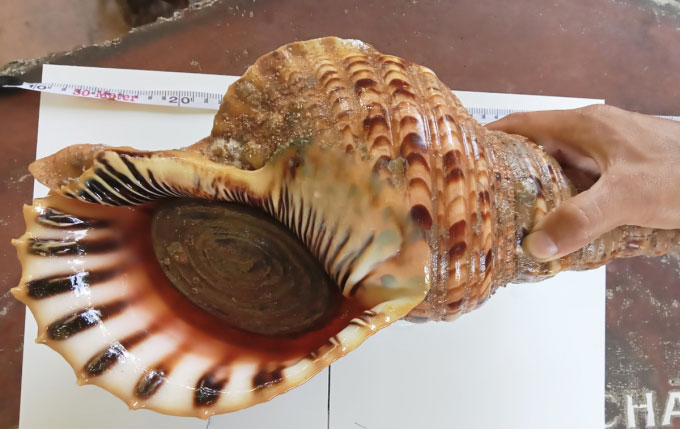
The triton weighed more than 2.6 kg and was 44 cm long (Photo: Ngọc Diên).
The giant triton has the scientific name Charonia tritonis, and is also known in Vietnamese as the "queen snail" or "empress snail". Its shell is cream-colored with many dark or light brown markings, and prominent spiral ridges run from the aperture to the tip. It lives on soft bottoms in the subtidal zone and along coral reefs, sometimes at depths of 20 - 30 m.
In Vietnam, tritons (Charonia) are found mostly in waters around islands such as Lý Sơn (Quảng Ngãi province), Hòn Mun and Hòn Tre (Khánh Hòa province), as well as in coral reef areas. The giant triton is now listed in the Vietnam Red Data Book as a rare species in need of conservation and protection. It is a prized species with high value for handicrafts, and its numbers are relatively low. The triton is currently heavily overexploited, with stocks depleted everywhere, including juveniles, and it is classified at threat level V (an economically valuable species that may be threatened with extinction).
The triton's main food is the crown-of-thorns starfish (Acanthaster planci), which in turn feeds on coral and threatens the survival of coral reefs. The triton therefore plays an extremely important biological role in protecting coral reefs.
According to Vietnam's Directorate of Fisheries, under the Reef 2050 Plan, the Australian government has invested AUD 568,000 in research on breeding the giant triton, a natural predator of the crown-of-thorns starfish. The Australian Institute of Marine Science has been researching and rearing triton larvae so they can grow into juveniles and adults, in order to further complete biological research on the species.
Man reels in giant 6-meter, 130-kilogram oarfish
After a 40-minute struggle, a man in Taiwan hauled a giant oarfish nearly 6 meters long and weighing 130 kg ashore.
Orcas attack two racing boats off Gibraltar
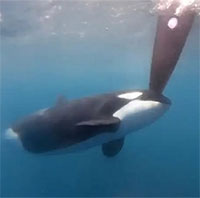
A pod of orcas rammed two boats competing in The Ocean Race in the Strait of Gibraltar on June 22, 2023, forcing the crews to slow down.
Tuna rub against sharks to get rid of parasites
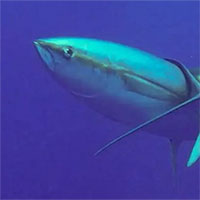
Tuna often rub against sharks rather than their own kind, because sandpaper-like shark skin offers a suitable surface for scraping off parasites.