Rare footage of a newly identified deep-sea jellyfish species
The Monterey Bay Aquarium Research Institute has announced the discovery of an unusual species of crown jelly in the genus Atolla.
The deep-sea jellyfish Atolla is one of the most common creatures in the dark depths of the ocean. Its bright red bell is fringed with tentacles, one of which is much longer than the rest.
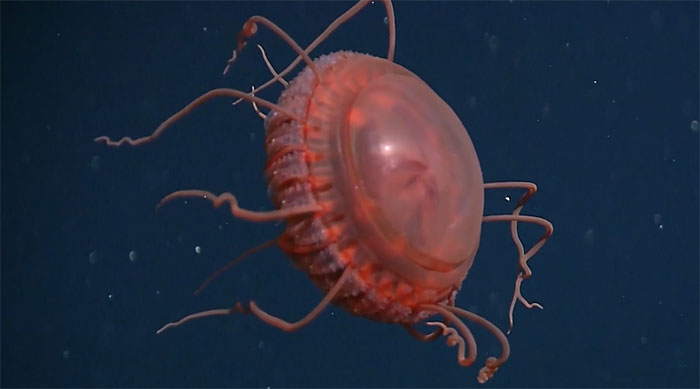
Fifteen years ago, the Monterey Bay Aquarium Research Institute (MBARI) spotted a jellyfish that looked like Atolla but lacked the genus's signature extra-long tentacle, and it began to draw scientists' attention.
After more than a decade of searching and collecting specimens, the team now has enough detail on the animal's morphological and molecular features to describe it as a new species in the journal Animals.
"We named this species Atolla reynoldsi in honor of Jeff Reynolds, the Monterey Bay Aquarium's first volunteer, in recognition of the 4.3 million hours that he and other volunteers have contributed to the aquarium over the past 38 years," said Dr. George Matsumoto, a senior researcher at MBARI.
Rare footage of Atolla reynoldsi. (Video: MBARI)
Atolla reynoldsi is relatively large compared with other Atolla species. The largest specimen the team collected measured 13 cm in diameter, making it one of the largest members of the genus.
Like most deep-sea crown jellies, Atolla reynoldsi has a small bell encircled by a deep groove. The domed part of the bell is separated from the margin by thick segments called pedalia. The new species has a distinctive stomach shaped like a Greek cross.
"Although information is still incomplete, Atolla reynoldsi is clearly distinct, both molecularly and morphologically, from all 10 described species of Atolla", Matsumoto emphasized.
In addition to Atolla reynoldsi, the team found two other jellyfish believed to be new members of the genus Atolla, provisionally called Atolla A and Atolla B, but there is not yet enough information to confirm them.
"All three species - Atolla reynoldsi, Atolla A and Atolla B - should probably be placed in a new genus because of their distinct stomach morphology and lack of a long tentacle, but until further research is completed, we are keeping them in the genus Atolla", Matsumoto added.