A sand road in the sea off central Vietnam links 3 islands, and is best seen at two times each day
Many visitors are amazed to find a special road right in the middle of the open sea, one that lets them walk to several different islands.
When people think of beaches or islands, most picture clear blue water lapping at fine white sand, lined with tall coconut palms or casuarina trees. Few know, however, that some places hold another very special kind of landscape. These are known as "sea paths" (thủy đạo), or put more simply, roads of sand that rise above the water. Thanks to these paths, visitors can even travel between islands on foot, without needing a boat.
In the waters off central Vietnam there is one such "sea path". It links three islands: Hòn Bịp, Hòn Ó and Hòn Quạt. The path in question is known as the "Điệp Sơn sea path" in Khánh Hòa province, south-central Vietnam.
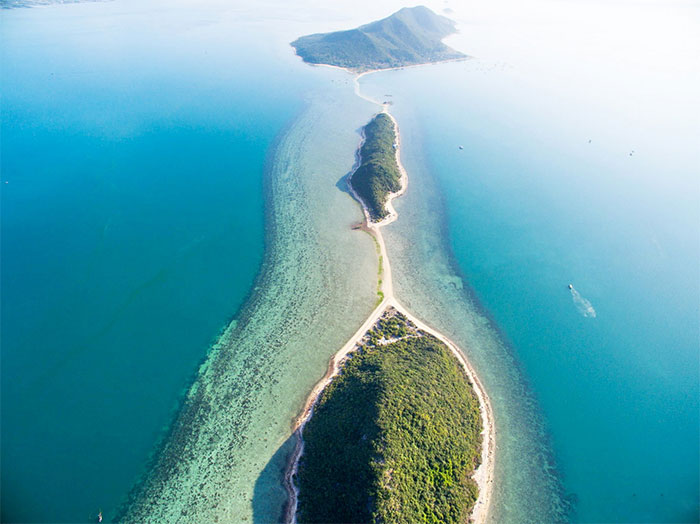
The sand road linking the three islands of Hòn Bịp, Hòn Ó and Hòn Quạt (Photo: To Quoc newspaper)
To experience the sea path, visitors first need to get to Điệp Sơn island. Unlike the bustling seaside city of Nha Trang, Điệp Sơn is considered to have kept its unspoiled scenery. That makes it a good fit for travelers who love peace and quiet and want to immerse themselves in nature.
A road likened to a "precious gem" of Southeast Asia
In the past, when such roads in the middle of the sea came up, many travelers would immediately think of another famous spot, one outside Vietnam: the road connecting the islands of Jindo and Modo in South Korea. This path, which comes and goes with the tide, is one of the most popular attractions in the "land of kimchi".
Reportedly, between around March and June each year, the road appears twice, each time for only about a week, when the tide drops to its lowest level.

The road in the sea, which appears only rarely each year, draws large crowds of tourists in South Korea (Photo: Korea Tourism)
The Điệp Sơn sea path has similar features. According to the Vietnam National Authority of Tourism, it is a natural sandbar, a few hundred meters long and only about 1m wide. Visitors who want to experience this special path also need to pay close attention to timing.
According to local residents and visitors who have walked it, at around 6 a.m. every day, as the tide goes out, the sandbar slowly emerges from the clear blue waters of the Khánh Hòa sea. As visitors step onto the sandbar, the water seems to part to either side, making way for them.
There is also another ideal time window for seeing and walking along the Điệp Sơn sand road: between about 3 p.m. and 6 p.m. each day. When the tide is out, visitors can also explore coral rock beds and a remarkably rich tidal-flat ecosystem.
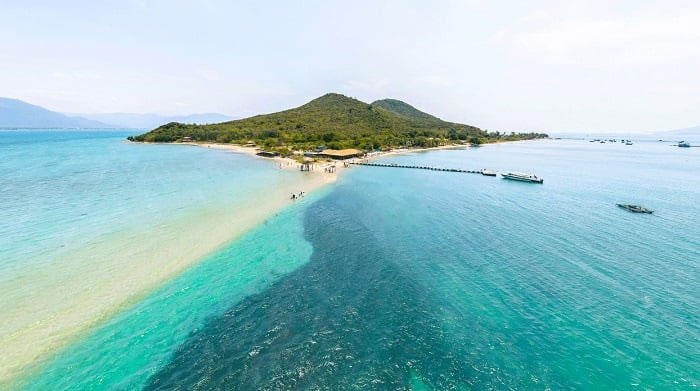
Photo: Vinpearl
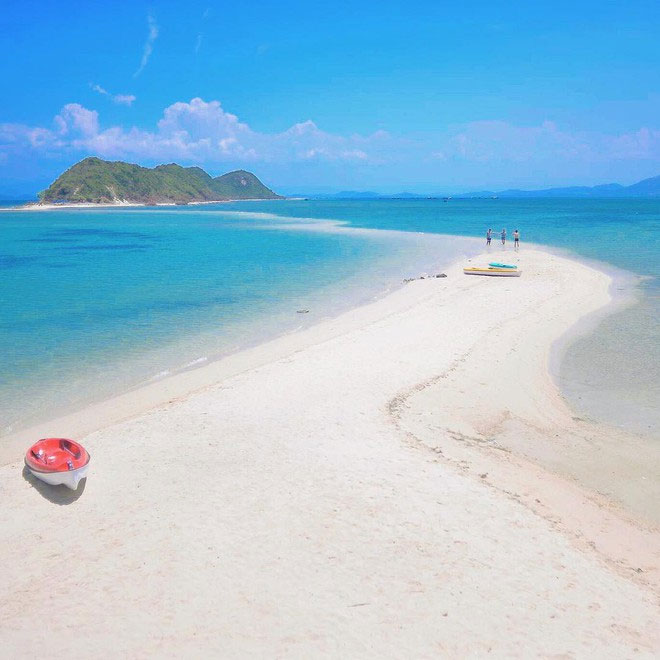
The sandbar rising above the water lets visitors "walk in the middle of the sea" (Photo: Shipbuilding Industry Magazine)
Walking along the sea path is sure to be an exciting and unique experience, and a highlight for anyone visiting Điệp Sơn island. A foreign travel blogger with the account name Calvincu, after walking the Điệp Sơn sea path, shared: "Walking on this road is incredibly enjoyable, mixed with excitement and a little fear as you step out into the vast ocean. You can watch to your heart's content as schools of small fish swim playfully on both sides, every now and then see fish leaping out of the water, or raise a hand to wave at a boat gliding past."
Many other visitors have also compared the Điệp Sơn sea path with the famous road in South Korea, saying its beauty is in no way inferior, and that it could even be called a "precious gem" of Southeast Asia that deserves to be better known.
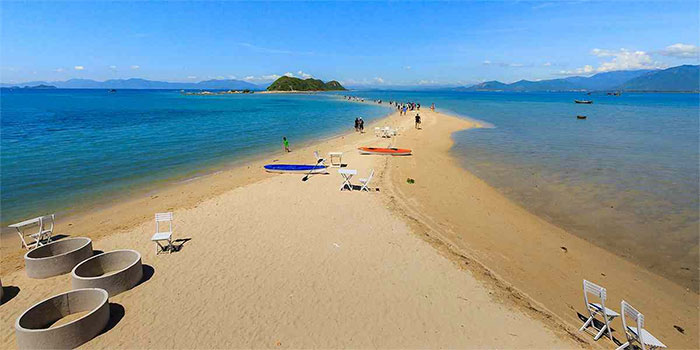
Photo: Vinpearl.

Man reels in giant 6-meter, 130-kilogram oarfish
After a 40-minute struggle, a man in Taiwan hauled a giant oarfish nearly 6 meters long and weighing 130 kg ashore.

Orcas attack two racing boats off Gibraltar
A pod of orcas rammed two boats competing in The Ocean Race in the Strait of Gibraltar on June 22, 2023, forcing the crews to slow down.
Tuna rub against sharks to get rid of parasites
Tuna often rub against sharks rather than their own kind, because sandpaper-like shark skin offers a suitable surface for scraping off parasites.

US lobsterman catches giant lobster believed to be over 100 years old
Maine lobsterman Jacob Knowles shared a video of a giant lobster, believed to be more than 100 years old, that he caught and released.

Live 3-meter giant squid washes up on a beach in Japan
A live giant squid stranded on a beach in Japan has drawn attention from locals and scientists, as living specimens of the species are extremely rare.
Rare footage of a newly identified deep-sea jellyfish species
MBARI scientists have described Atolla reynoldsi, an unusual new species of deep-sea crown jelly that lacks the genus's signature long tentacle.