

Vi Kim Ngọc: The gifted woman who devoted herself to drawing mosquitoes
A gifted artist with a deep grasp of the science and its technical demands, she produced drawings that were both scientifically precise and genuinely artistic.
Dreaming of a life in research
Vi Kim Ngọc was known not only for her beauty but also for being intelligent and eager to learn. After her marriage, she persistently pursued her dream of becoming a researcher. She took a specialized training course in parasitology at Hanoi Medical University (Trường Đại học Y Hà Nội), and after graduating she was kept on at the university as a laboratory technician.
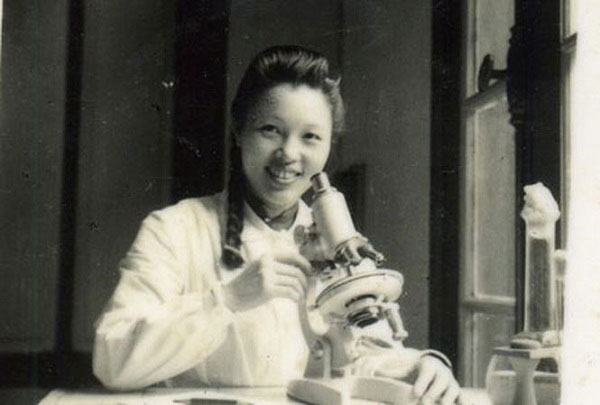
Vi Kim Ngọc.
Besides supervising practical classes in the Department of Parasitology, she was a woman of remarkable skill and talent. One of her main jobs was drawing different kinds of mosquitoes to illustrate lectures. Because she could draw, and draw beautifully, and also understood the science and its technical requirements, her drawings were both scientifically accurate and artistic. Some of them were used in textbooks.
The Department of Parasitology was divided into several sub-disciplines (helminths; fungi; protozoa; malaria; insects and arthropods), of which insects and arthropods was considered the most difficult, because it demands meticulous, detailed observation and a high degree of accuracy. Professor Đặng Văn Ngữ, head of the department, put Ngọc in charge of all technical work for the insect and arthropod group.
According to Professor Phạm Huy Dũng, former deputy director of the Health Strategy and Policy Institute (Viện Chiến lược và Chính sách Y tế), one of the most effective features of the practical sessions Vi Kim Ngọc led was that she always linked the specimens to theory and to real-world problems. Using the specimens, she guided students to recall the theory their teachers had covered in lectures and what they had explained during lab work.
He gave the example of preparing specimens of Anopheles mosquitoes. Normally the work consisted only of mounting the specimen, identifying the species and classifying it by its antennae, body and so on. But beyond these basics, Ngọc would often talk about where the mosquitoes typically live, how they breed and the harm they cause to people.
In those days, teachers would divide Ngọc's drawings among groups of students, who took turns examining and discussing them. Or the drawings were enlarged and hung on the board to illustrate the lecture. Nearly every practical session on mosquitoes relied on them. Associate Professor Phạm Văn Thân was once taught by Vi Kim Ngọc how to draw, how to lay out proportions on the paper and how to combine colors harmoniously. Thân said: "Aunt Ngọc's drawings were so meticulous that we grew impatient and couldn't do it. We could only draw a general outline of a mosquito, not the fine detail she managed."
Creator of a visual dictionary of mosquitoes
To carry out her role running the technical work of the insect and arthropod group, Ngọc had to plan mosquito-collecting trips so that she could prepare specimens and make enlarged drawings of the insects. Completing a single mosquito drawing involved many stages, starting with preparation: drawing up a research plan, choosing the target species, and learning about the features, shape and behavior of the mosquito to be caught. Next came collecting the mosquitoes in different localities.
The department organized mosquito-catching teams, and Ngọc went out either with students or with technical staff. On each team, one person served as bait while another caught the mosquitoes. The bait had to endure deep, itchy bites without daring to move for fear the mosquitoes would fly away. Some insects lived in buffalo, cattle and pig sheds, and Ngọc and her colleagues had to go and catch those themselves, too.
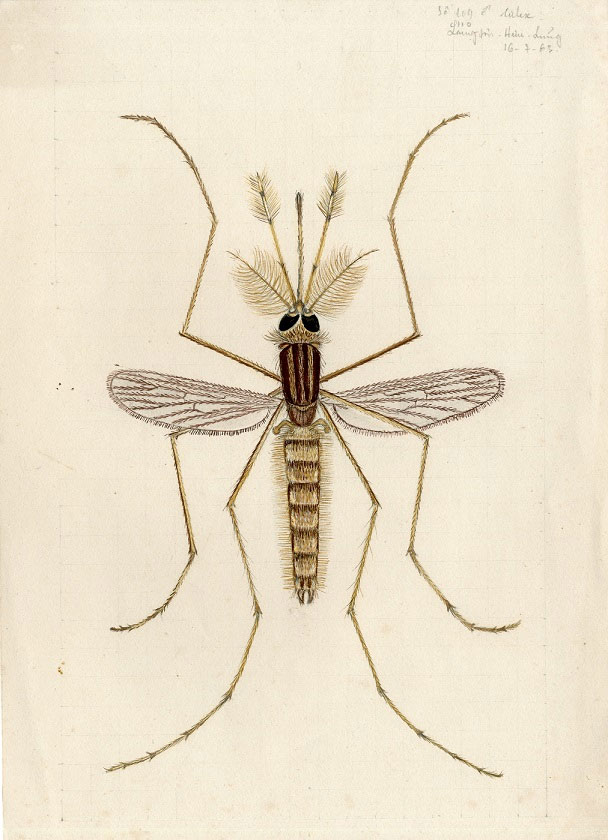
Culex mosquito No. 109 (male), caught in Hữu Lũng, Lạng Sơn province in northern Vietnam, drawn by technician Vi Kim Ngọc in July 1963.
The mosquitoes had to be identified within 24 hours. To ensure accuracy, Ngọc drew while looking through a microscope, on paper ruled into a pencil grid. Her pens and pencils had to have fine, slender tips. She also chose colors carefully so that they were scientifically accurate and visually appealing. Completing one drawing typically took Vi Kim Ngọc about one to two weeks of focused work. Look closely and you can see the care and precision in every stroke, rendered so vividly that the drawings look almost like photographs.
Perhaps the most time-consuming stage was coloring each tiny detail of every drawing. As Ngọc completed each type of mosquito, such as Aedes, Culex, Mansonia and Anopheles, the collection became something like a visual dictionary. Whenever mosquitoes were brought back, they could be examined under the microscope and compared with the drawings to identify them.
Associate Professor Phạm Văn Thân, former head of the Department of Parasitology at Hanoi Medical University and one of her students, recalled: "Back then, Aunt Ngọc drew mosquitoes with great elaboration; it wasn't simple like it is now. Because each drawing took a long time to finish and was rolled up and unrolled many times, the preparation had to be careful. Especially for drawings on large sheets, she would usually paste the paper onto a piece of mosquito-net fabric brushed with glue, so that the drawing wouldn't crumple and would last longer. Some drawings traveled a lot on work trips and were even used for teaching away from the university, yet they never tore. Not everyone can produce such lifelike images. It takes expert knowledge, an artist's hands and perseverance. The drawings had to be accurate down to every black spot on the mosquito's back, the length of its legs, the color of each body part...".
According to Phạm Văn Thân, Vi Kim Ngọc's drawings are not mere pictures; they carry the soul of a deeply dedicated specialist. That is why they have always been treasured and preserved. They were also professional reference materials that he and the department's staff used continuously throughout their careers.
On every finished drawing, technician Vi Kim Ngọc wrote a detailed caption: the type of mosquito, its sex, where and when it was caught, and when it was drawn. According to Thân, illustrated drawings made lessons livelier, gave students a more vivid visual aid during practical classes, and could be kept for a long time.
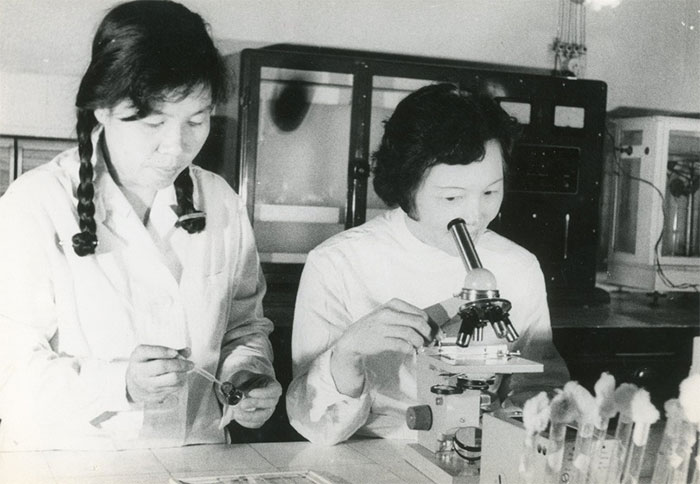
Technician Vi Kim Ngọc (with short hair) at a microscope in 1967.
Vi Kim Ngọc's collection of mosquito drawings comprises 44 drawings, along with three handwritten documents describing the features and structure of each type of mosquito. She drew them on cardstock cut to A4 size. Each drawing was carefully wrapped in a sheet of A3 paper folded in half. All were kept in a blue folder whose cover bears the words "External morphology," written by Vi Kim Ngọc herself. After 50 years, the covers are frayed at the edges and curled at the corners, and the drawings have yellowed, but they remain sharp and finely detailed.
Today, with the development of modern technology, students no longer use Vi Kim Ngọc's drawings in practical classes, but they remain precious assets bearing the imprint of a historical period in the training and teaching of the Department of Parasitology in particular, and of Hanoi Medical University in general.
The collection of mosquito drawings that Vi Kim Ngọc began in 1963 has now been donated to the Heritage Center of Vietnamese Scientists (Trung tâm Di sản các nhà khoa học Việt Nam). Phạm Văn Thân, a student who worked closely with her throughout her career, hopes the materials will be well kept and preserved, and that their scientific value will continue to be put to use.
