Vietnamese scientists' 3D concrete printing technology
3D concrete printing is a new and rapidly developing technique that allows structures to be built by automatically printing out concrete panels. However, a major obstacle for this technology is developing new materials suitable for 3D printing.
Nearly 80% faster construction, 20% lower cost than conventional rough construction, the ability to build structures with complex artistic designs, and less construction waste are among the strengths of the 3D printing technology mastered by Vietnamese scientists.
Building houses with 3D printing
3D concrete printing in construction is the process of forming three-dimensional objects (building elements) by depositing layers of material on top of one another, shaped under computer control to produce an object previously drawn in CAD (Computer-Aided Design) software. A distinctive feature of 3D printing is that it can create objects of virtually any shape, quickly and without the need for formwork.
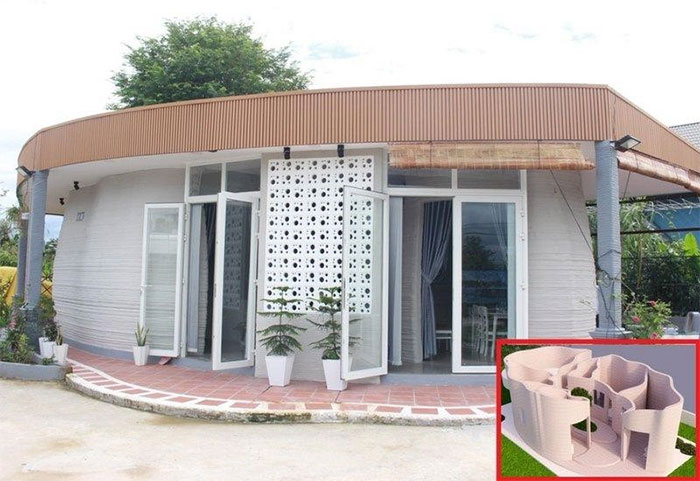
A beautifully shaped concrete house built in Ho Chi Minh City.
The biggest obstacle for 3D concrete printing is developing new materials for the process. For that reason, a team of scientists at Ho Chi Minh City University of Technology (Trường Đại học Bách khoa, part of Vietnam National University – Ho Chi Minh City) carried out the science and technology project "Research on 3D-printed concrete technology for construction works" with the aim of applying a new type of 3D-printable concrete to the construction of houses.
Associate Professor Trần Văn Miền, the project's principal investigator, said the team wanted to create a 3D-printable concrete material for use in two areas: printing walls for civil buildings and shaping decorative building facades.
The team therefore focused on producing a 3D-printing concrete mix using a set of raw materials including PC50 cement, class F fly ash, silica fume (SF), polypropylene (PP) fibers, sand, water, a viscosity-modifying admixture (VMA) and a superplasticizer.
According to Associate Professor Trần Văn Miền, the materials used to make 3D-printed concrete are characterized by fine aggregate (the maximum aggregate particle size is generally no more than 5mm) and a high binder content. As a result, the rate of shrinkage and the shrinkage-induced tensile stress in the early stage (1 to 3 days after a component is printed) are significantly greater than in conventional normal-weight concrete.
Consequently, most 3D-printed concrete is prone to cracking in components at an early age. For 3D-printed concrete to extrude well and build up layer by layer, the mix needs the lowest possible viscosity without segregating, while having a high static yield stress.
Test results showed that, besides changing the aggregate-to-binder (A/B) ratio and the water-to-binder (W/B) ratio to adjust the rheology of 3D-printed concrete, another approach is to vary the dosage of the superplasticizer together with that of the viscosity-modifying admixture (VMA). As the superplasticizer dosage increases, the rheological parameters of the concrete mix, such as plastic viscosity, static yield stress and dynamic yield stress, all decrease.
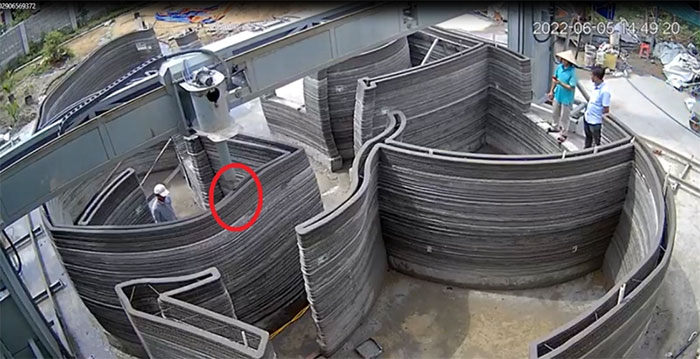
The materials used to make 3D-printed concrete are characterized by fine aggregate.
Building walls with complex shapes
According to Associate Professor Trần Văn Miền, a concrete mix that sets too slowly affects the construction process and the stability of the printed structure, so the setting time needs to be shortened. A setting time of no more than 12 hours suits construction work and ensures the stability of the printed structure during and after printing.
The bond strength between two layers of concrete depends on, and is proportional to, the compressive strength of the 3D-printed concrete. All of the successful concrete mixes had an interlayer bond strength above 1 MPa.
The standout advantage of 3D concrete printing is that it can form building envelope walls with complex shapes, for example curved or undulating walls, whether following a regular pattern or not.
The team successfully built two trial houses using 3D concrete printing: House 1 is 5m wide, 14m long and 4m high (with a living room, a dining room–kitchen and a bedroom); House 2 is 8.5m wide, 15m long and 3.8m high (with two bedrooms, a dining room–kitchen, a living room and a study; its walls are designed in the shape of rose petals and are 200mm thick, consisting of two wall layers, each designed to be 50mm thick).
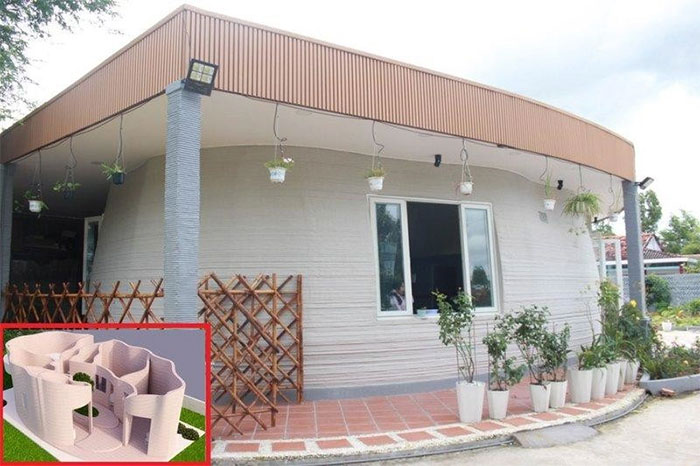
One advantage of this technology is the ability to form building envelope walls with complex shapes.
Because the houses were 3D-printed outdoors, construction depended heavily on weather conditions, which affect, for example, shrinkage and the risk of cracking in the concrete walls.
From the construction process, the team observed that if printing is carried out continuously and the concrete is properly moist-cured right after printing ends, the concrete walls show almost no cracking.
Conversely, if printing has to be halted because of a problem, vertical cracks appear in the concrete wall about 30 - 40 minutes later.
In terms of water resistance, 3D-printed concrete walls perform better than fired clay brick walls plastered with cement mortar on one side. The water permeability coefficient of the concrete walls is significantly lower than that of fired clay brick walls.
However, as with fired clay brick walls, water seeps through 3D-printed concrete walls mainly at the interface between two concrete layers. This means the interface between two layers is not dense enough and contains defects and pores large enough for water to pass through.
According to Associate Professor Trần Văn Miền, to improve the waterproofing of 3D-printed concrete walls in buildings, the team believes measures are needed to improve the homogeneity at the interface between two concrete layers.
On the other hand, the compressive strength of the concrete walls is nearly 30% higher than that of fired clay brick walls, so 3D-printed concrete walls could be designed as load-bearing walls rather than merely as enclosing structures.
In practice, applying 3D concrete printing in construction has advantages over conventional construction methods in terms of speed (nearly 80% faster) and construction cost (about 20% lower) when building the rough structure of the same building design. In addition, 3D concrete printing technology stands out for being able to build structures with artistic and complex designs that are virtually impossible with conventional construction, while significantly reducing construction waste and making use of solid waste (thermal power plant ash and slag, construction debris, gypsum, etc.). |