

Why is there no beef on the traditional Vietnamese Tết offering tray?
Traditional Lunar New Year (Tết) offering trays feature chicken, pork and more, but no beef dishes. The reason lies in Vietnam's wet-rice civilization.
Historian Dr. Hãn Nguyên Nguyễn Nhã, former director of the Vietnam Institute of Culinary Research and head of the "Vietnamese Kitchen – Kitchen of the World" project, explains that the custom of leaving beef off the traditional Tết offering tray stems from geography and history. Vietnam is a wet-rice farming country, and people did not slaughter buffalo or cattle because they were the main draft animals. A ban on eating buffalo and beef was issued under the Lý and Trần dynasties and remained in force until the Nguyễn dynasty.
He cites the book "The Statutes of the Nguyễn Dynasty" by Trần Viết Ngạc, whose records of dishes served to the king or used to entertain foreign envoys include none made with beef. The court's ritual offering feasts had only four beef dishes: fermented beef rolls (nem), stewed, roasted and boiled beef.
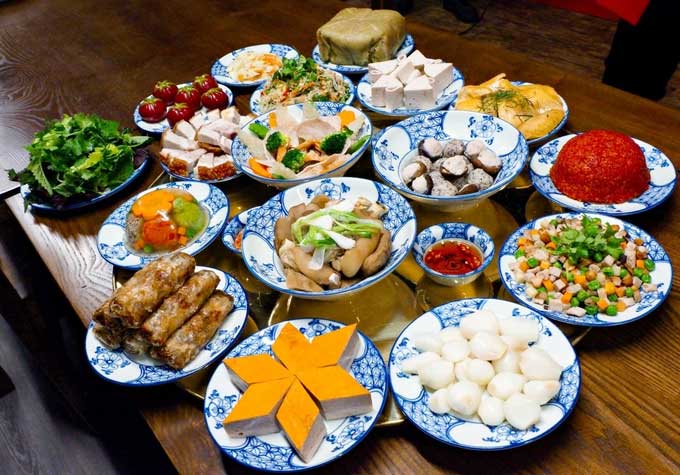
A traditional northern Vietnamese feast tray. (Photo: Nguyễn Phương Hải)
Beef dishes rarely appeared on feast trays of the past because the prevailing view on food at the time was "eat solidly, dress durably", favoring rice, vegetables and aquatic foods. Before Tết, households and villages customarily held a "đụng" (a shared pig slaughter) to prepare the feast, so nearly 70% of the dishes on a traditional tray were made from pork....
According to Dr. Nguyễn Nhã, beef dishes arrived in Vietnam during the French colonial period, cooked mainly for French soldiers. They began as beefsteak and beef stewed in wine... and were later adopted by Hanoians, who adapted them into snacks to suit local tastes. Because the traditional way of celebrating Tết is so long-standing, generations of Vietnamese have laid out boiled chicken, pork sausage (giò), bánh chưng (square sticky rice cake), bamboo shoot soup and the like on the offering tray. Later, some families added giò bò, a beef version of the pork sausage.
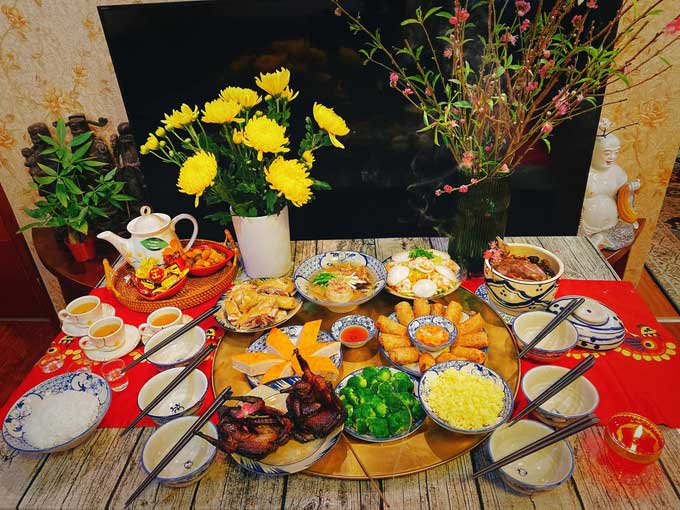
A modern Tết offering tray. (Photo: Nhung Ngô).
Today, with food much easier to buy, many families add palate-cleansing dishes such as pickled beef shank and shredded dried beef... but these are not placed on the ancestral altar. The traditional Tết offering tray remains most distinct in northern Vietnamese families, shaped by the region's farming heritage. At the same time, many families are moving toward a modern Tết and simplifying their feast trays.
For decades, the family of Ms. Đào Bích Loan in Hanoi's Old Quarter has laid out a traditional northern-style offering feast. Every year on the morning of the 29th of the last lunar month, she goes to the market to shop for the New Year's Eve offering tray. She buys chicken, fresh flowers, glutinous rice, gấc fruit... alongside bánh chưng, jellied pork, giò lụa (lean pork sausage), giò xào (stir-fried pork head cheese), glass noodles... prepared in advance. She said: "I learned how to make the feast from my elders; six generations have done it this way without changing anything. Only on the third day of Tết, when we burn the votive paper, do I switch the feast to bún thang."
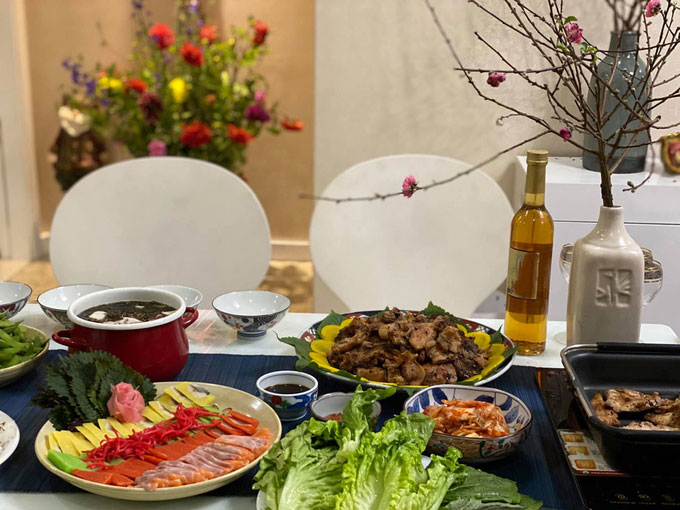
A modern feast tray prepared for the second day of Tết. (Photo: Vĩnh Quyên).
For chef Nguyễn Phương Hải, a descendant of a family that has lived in Hanoi for six generations, the Tết feast tray is a series of dishes prepared more formally and elaborately than everyday meals. He believes modern life has also changed how families think about preparing a traditional Tết tray. "Some young families even include new dishes or foreign dishes. But dishes they enjoy or that have only recently arrived... can all be offered with incense, as long as the descendants show reverence and gratitude toward their ancestors," Hải said.
