Meet Vietnam's one-of-a-kind snake with "whiskers"
In Vietnam lives a snake known for its bizarre appearance, with two "whiskers" sprouting from its snout. It is considered one of the strangest snakes in the world. This is the tentacled snake, scientifically known as Erpeton tentaculatum Lacepede.
The tentacled snake is native to Southeast Asia. It was formerly classified in the subfamily Homalopsinae of the family Colubridae. More recently, however, it has been placed in the family Homalopsidae, the Asian mud snakes. It is the only species in the genus Erpeton and is known for the two distinctive tentacles at the front of its mouth.
The tentacled snake is found in countries such as Thailand, Cambodia and Vietnam. Within Vietnam, it occurs in several southern localities, including the former provinces of Bình Dương and Bình Phước and the former Tây Ninh province, as well as the Tân Thạnh area of the former Long An province and the former Kiên Giang province.
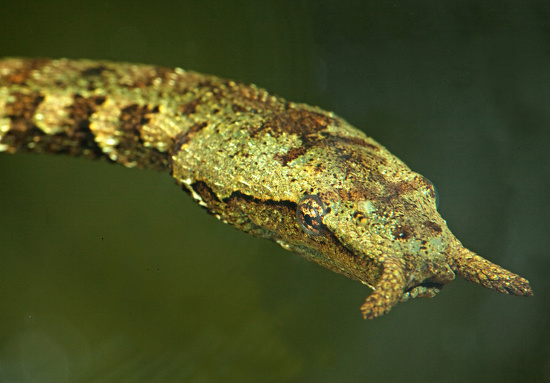
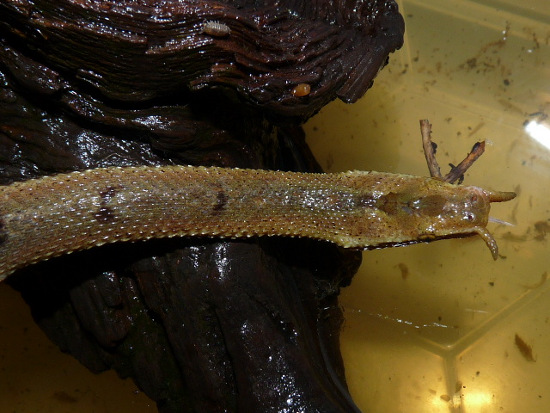
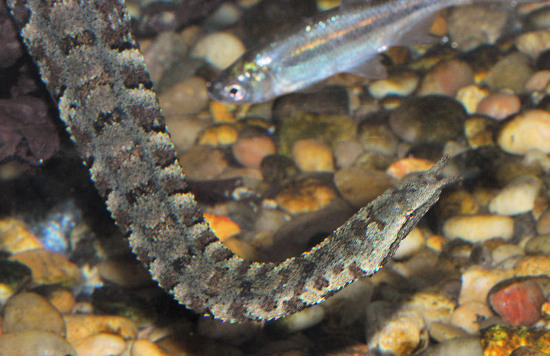
Each time it reproduces, the snake can give birth to between 5 and 13 young.
Because of its unusual appearance, the tentacled snake has been exported to many countries around the world as an exotic pet. In recent years, uncontrolled hunting and trade have left the species facing a serious decline in numbers.
It typically lives in murky water, such as lakes, rice paddies and slow-moving rivers, and it can inhabit fresh, brackish or salt water. Cambodia's Tonlé Sap lake, with its silt-rich waters and abundance of fish, is a prime example of the snake's ideal habitat.
According to Sinh vật rừng Việt Nam (Vietnam Forest Creatures), a Vietnamese wildlife database, the snake has a distinctively shaped head, its body scales are strongly raised and its belly is very narrow. Its coloration and patterning vary widely, most commonly with brown blotches along the body. In calm, acidic freshwater habitats, the upper part of the snake's belly is yellowish brown. Each time it reproduces, the snake can give birth to between 5 and 13 young, and each newborn measures 20 to 24 cm long and looks much like an adult.
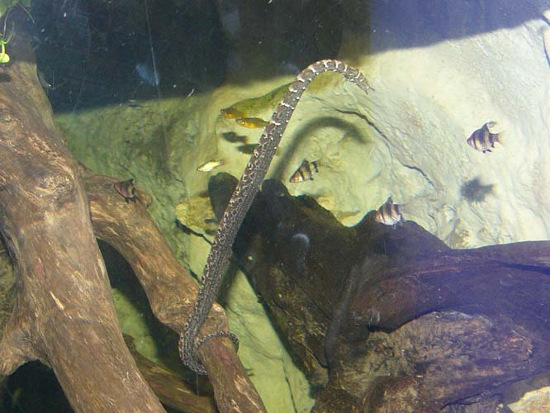
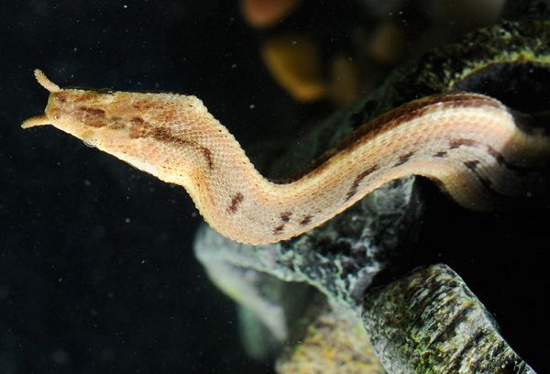
Their most striking feature is the pair of whisker-like tentacles on the tip of the snout.
The only snake known to anticipate its prey's reactions
The tentacled snake is fairly small, averaging 50 to 90 cm in length. Its most striking feature is the pair of whisker-like tentacles on the tip of its snout, which it uses to detect prey, especially fish. These sensory tentacles are highly sensitive, able to pick up any movement in the water so the snake can swiftly lunge at unlucky fish that swim past.
It hunts much like an angler: the tentacled snake lies still and waits for a fish to come close before striking. Its strike is incredibly fast, taking just 15 milliseconds to seize the fish. Yet even these lightning reflexes and surprise attacks are sometimes not enough, so the tentacled snake uses another clever trick. When it detects an approaching fish, the snake flexes part of its body to create a disturbance in the water, startling the fish into fleeing straight toward the danger: the snake's waiting mouth.
Although the snake is venomous, its venom is neither potent nor plentiful enough to pose a danger to humans. The few people who have been bitten by tentacled snakes felt only drowsy for a few hours, with no other serious symptoms.
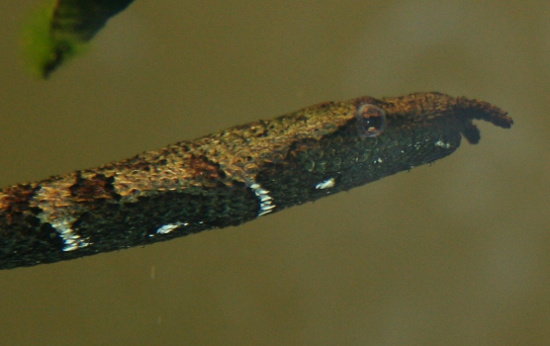
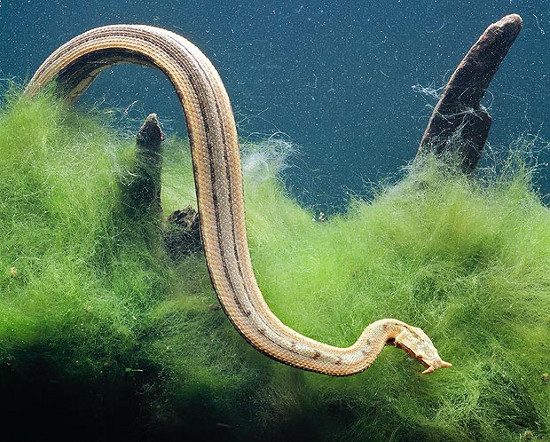
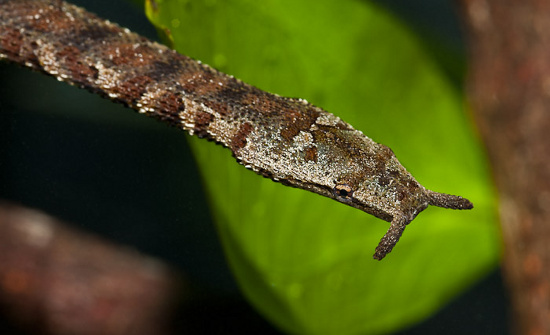
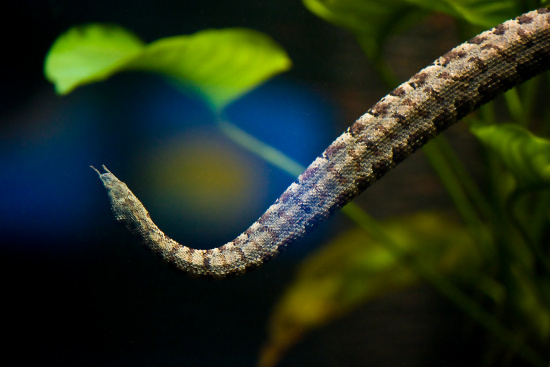
The young develop inside eggs retained in the mother's body and are born live in the water.
The tentacled snake can stay underwater for up to 30 minutes without surfacing for air. It moves rather clumsily on land. In the dry season, it often burrows into the mud in the evening to hide. The young develop inside eggs retained in the mother's body and are born live in the water. The tentacled snake is a specialized ambush hunter that usually stays completely motionless. Its tail anchors it in the water while its body curls into an inverted "J" shape. Its strike zone narrows in front of it and along part of the right side of its body. When a fish swims into this zone, the snake rapidly thrusts itself forward to catch it.
Of all snake species, this is the only one known to anticipate its prey's reactions and act accordingly. Like the elephant trunk snakes, it lives mainly in water but can also move onto land.

Hanoi's trams: Memories of a bygone era in Vietnam's old capital
Hanoians have long stopped hearing the clanging trams that once circled the city center. Today they live on only as a fond memory.

Vietnam's only museum not for the faint of heart
The Parasite Museum in Hanoi is the only place in Vietnam displaying hundreds of specimens of parasites that threaten humans.
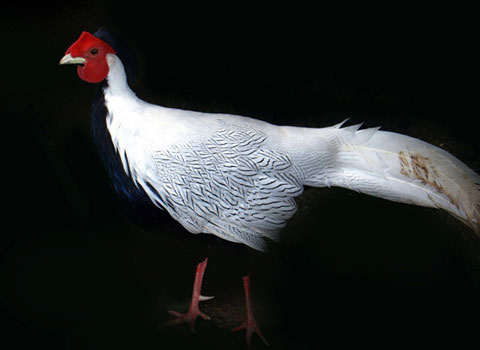
The beauty of Vietnam's wild pheasants and junglefowl
From the red junglefowl to the rare Edwards's pheasant, Vietnam is home to a striking variety of birds in the pheasant family.
The "deadly" beauty of Vietnam's rainbow-colored snake
Despite its small size and alluring colors, the red-necked keelback is a dangerous snake with fairly potent venom.

Remarkable photos of colonial-era Vietnam
Fascinating images of colonial-era Vietnam from J. P. Dannaud’s 1962 book “L’Indochine Profonde” (Deep Indochina).

Rare photos of old Hanoi through the lens of a French photographer
Rare photos of Hanoi in 1890–1895 from an album by Raphaël Moreau, a French photographer based in colonial-era Hanoi.