Strange Neptune-size exoplanet found to be denser than steel
An international team of astronomers has discovered a Neptune-size exoplanet that is denser than steel. They believe its makeup may be the result of a giant planetary collision.
Astronomers were astonished when they turned their gaze some 545 light-years away and found a truly unusual exoplanet.
The planet, TOI-1853b, has a radius 3.46 times that of Earth. It orbits its host star, an orange dwarf about 80% the size of the sun, once every 1.24 Earth days. Although its radius is modest, its mass is truly staggering: 73.2 times the mass of Earth. Neptune, by comparison, is only 17.15 Earth masses.
From that size and mass, the team calculated that TOI-1853b has a density of 9.7 grams per cm3. Neptune, by contrast, has an average density of 1.64 grams per cubic centimeter, while our own Earth comes in at just 5.51 grams per cubic centimeter. Iron has a density of 7.87 grams per cubic centimeter, and steel is similar.
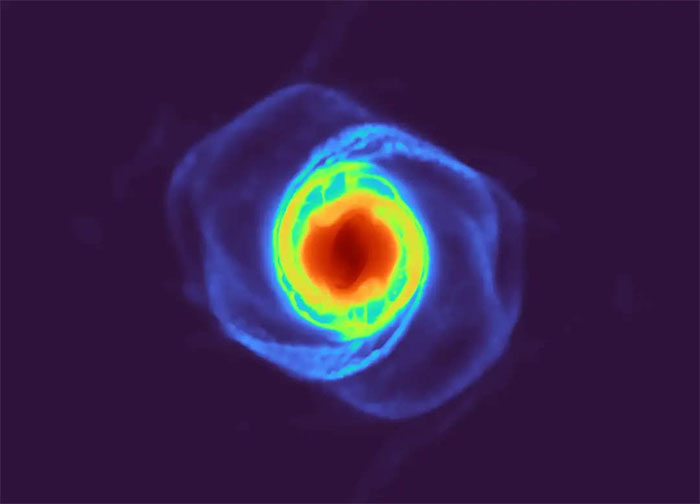
The exoplanet is the size of Neptune, but puzzlingly, it is 73.2 times more massive than Earth. For comparison, Neptune is 17.15 times more massive than Earth. That makes TOI-1853b "denser than steel," with a mass "almost twice as large as any other known Neptune-size planet." (Photo: Scitechdaily).
The density of TOI-1853b tells us that it must be made largely of dense material, with little in the way of an atmosphere.
To classify exoplanets, or planets orbiting stars other than the sun, astronomers rely on comparisons with the solar system. After spotting an intriguing object roughly the size of Neptune close to a dwarf star, they sought more detail from a range of ground- and space-based telescopes. Once they confirmed that what they were seeing was indeed a planet and not a star, they were left with one puzzle to solve: what could have given rise to such an unusual world.
The best explanation for its strange characteristics is a catastrophic collision. The new research was published in the journal Nature.
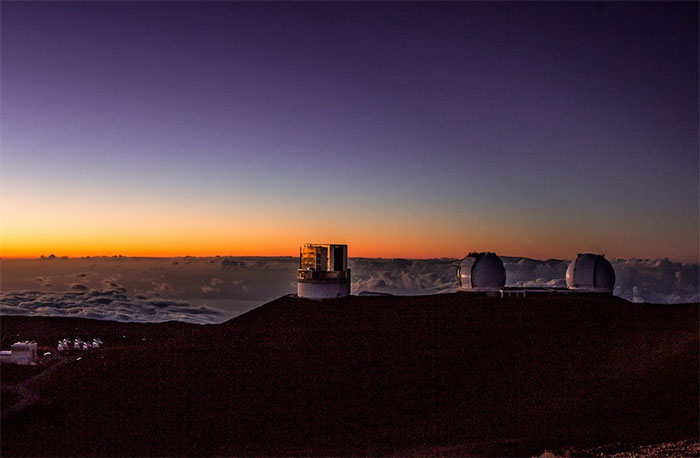
In the study, published Aug. 31 in the journal Nature, scientists led by Luca Naponiello of the University of Rome Tor Vergata propose that the planet is the product of collisions between planets. Such giant impacts would strip away some of the lighter atmosphere and water, leaving behind mostly rock. (Photo: Inverse).
More than 5,500 exoplanets have been discovered to date, and from them astronomers know that exoplanets come in a wide variety of sizes and compositions.
According to study co-author Phil Carter, a computational planetary scientist at the University of Bristol's School of Physics, exoplanets often have "no analogue" in our solar system.
The team ran simulations of collision scenarios to work out why this exoplanet, known as TOI-1853b, is so strange. The researchers concluded that TOI-1853b may originally have been a water-rich giant planet.
Associate professor and study co-author Zoë Leinhardt concluded: "We had never investigated such extreme impacts before, because they weren't something we expected. There is a lot of work still to do to improve the material models underpinning our simulations and to extend the range of extreme impacts we model."
Carter explained in a university statement that to lose its atmosphere and lighter ices and become the extremely dense world it is today, TOI-1853b would have had to be struck by another massive, planet-like body at a speed of 75 km per second.
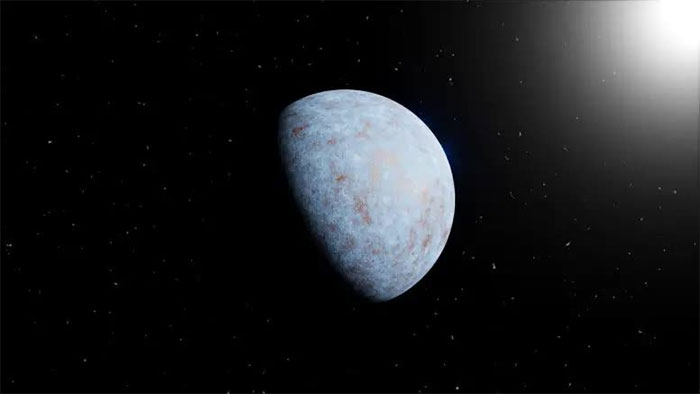
The planet provides new evidence for how common giant impacts are during planet formation across the galaxy. The discovery helps link theories of planet formation based on the solar system with the formation of exoplanets, and this extreme world offers fresh insight into how planetary systems form and evolve. (Photo: ZME).
"This planet really surprised us," Jingyao Dou, a study co-author and doctoral student at the University of Bristol, said in the statement.
The team plans follow-up observations to search for signs of an atmosphere around TOI-1853b and to analyze its composition, to determine whether the predicted collision scenario really took place.
The new work is also a testament to what modern telescopes can achieve. It was made possible by data from NASA's Transiting Exoplanet Survey Satellite (TESS) in space, as well as the Keck II telescope in Hawaii, the Gemini North telescope in Hawaii, the Southern Astrophysical Research Telescope in Chile and the Telescopio Nazionale Galileo in the Canary Islands.
Scientists search for the true nature of time and space
Researchers have uncovered a potential link between general relativity and quantum mechanics that could reshape our view of space and time.

9-year-old Malaysian boy wins NASA's Moon toilet design contest
Zyson's design uses only mechanical forces, with no electronic components, to reduce the chance of breakdowns in space.