Why the Lunar New Year has no '30th day of Tết' for 8 straight years from 2025
From 2025 onward, Vietnam will see eight Lunar New Years in a row without a "30th day of Tết": the New Year's Eve countdown will instead fall on the night of the 29th of the twelfth lunar month. Why does this curious pattern happen?
Checking the perpetual calendar reveals an intriguing pattern. Not only did the Lunar New Year of Ất Tỵ (Year of the Snake) in 2025 have no 30th day, but for the following seven years as well, the twelfth lunar month (tháng Chạp) will have only 29 days. In other words, for eight years in a row starting with the Year of Ất Tỵ, there will be no 30th day of Tết.
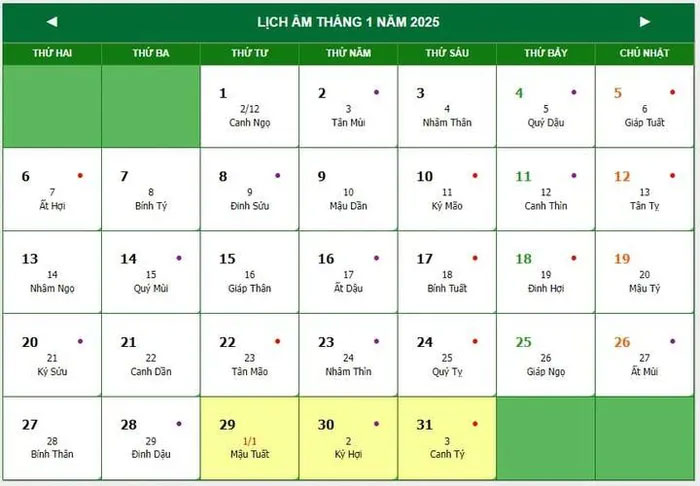
In 2025, there is no 30th day of the twelfth lunar month. (Photo: Lịch Vạn Niên).
Why does the twelfth lunar month have 29 days in some years and 30 in others?
Trần Tiến Bình, MSc, a former staff member of Vietnam's State Calendar Committee (Ban Lịch Nhà nước), later the Calendar Research Department of the Information and Documentation Center at the Vietnam Academy of Science and Technology (Viện Hàn lâm Khoa học và Công nghệ Việt Nam), and author of the book "Lịch Việt Nam thế kỷ XX-XXI" (Vietnamese Calendar of the 20th-21st Centuries), explains: The first day of a lunar month is the day when Earth, the Moon and the Sun line up, with the Moon turning its dark half toward Earth.
In folk tradition this was called the moonless day, or the day of the new moon (ngày sóc). Whichever day the new moon (the moment Earth, the Moon and the Sun are aligned) falls on, at any time from 0:00 to 24:00, that day becomes the first day of the lunar month.
A lunar month is simply the interval between two new moons. Its length varies only between 29.27 and 29.84 days, averaging 29.53 days, and calendar makers round it to either 29 days (a "short" month) or 30 days (a "full" month). As a result, some years have no 30th day of the twelfth lunar month.
It is quite common for several consecutive years to have, or not have, a 30th day of Tết. For example, for eight straight years from 2014 to 2021, the Lunar New Year always had a 30th day. Then came 2022 (Nhâm Dần), preceded by a short twelfth month, while 2023 (Quý Mão) and 2024 (Giáp Thìn) once again had full twelfth months. Next comes a run of eight years in which the lunar year ends on the 29th of the twelfth month.
Bình gives an example of how the timing of the new moon affects Tết: in 1968, Vietnam celebrated the Lunar New Year one day before China because Vietnam's calendar is based on the GMT+7 time zone, while China uses GMT+8.
December 31, 1967, corresponded to the first day of the twelfth lunar month in both the Vietnamese and Chinese calendars, but the new moon occurred at 23:29 on January 29, 1968, Vietnam time, so the twelfth month in the Vietnamese calendar had only 29 days (a short month). In Beijing time, that moment was 0:29 on January 30, which was the 30th day of the twelfth lunar month. That is why the first day of the Lunar New Year of Mậu Thân in 1968 arrived in Vietnam one day earlier than in China.
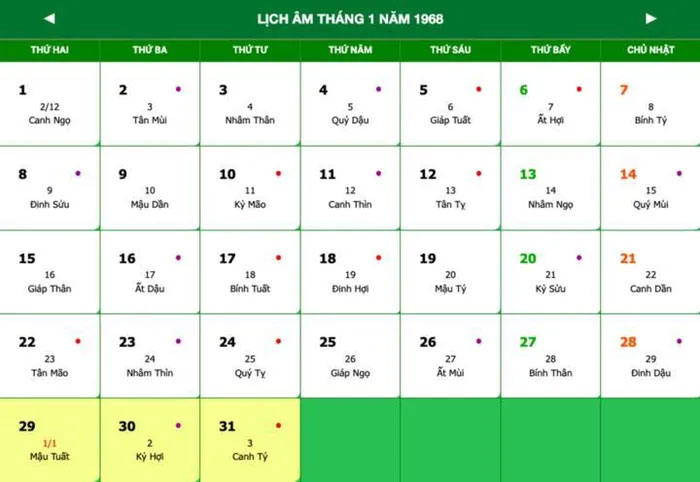
In 1968, Vietnam welcomed the new year right after the 29th of the twelfth lunar month, while China still had a 30th day of Tết.
No 30th day of Tết from 2025 to 2032: why?
According to the perpetual calendar, the Year of Giáp Thìn ends on the 29th of the twelfth lunar month, corresponding to January 28, 2025. The New Year's Eve moment of Ất Tỵ arrives as the last second of the 29th of the twelfth month of Giáp Thìn passes. The first day of Tết falls on January 29 in the Gregorian calendar.
Ất Tỵ marks the start of a run of eight consecutive lunar years whose twelfth month has only 29 days, lasting until 2032. Only at the Lunar New Year of Quý Sửu in 2033 will we see a 30th day of Tết again. The absence of the 30th day for so many years has left many people wondering whether there is some rule behind the phenomenon.
As mentioned above, whether the twelfth month of a given year has 29 or 30 days is not an arbitrary choice by calendar makers but is based on determining the moment of the new moon. According to Bình, years without a 30th day of the twelfth month do not follow any fixed pattern, because calculating the calendar from the motions of celestial bodies and the Moon is extremely complex. The Moon is perturbed by the gravitational pull of the Sun, Earth and many other planets, so the timing of the new moon, which determines short and full months, also fluctuates without any fixed cycle.

For eight years in a row from 2025, the Lunar New Year will have no 30th day of Tết.
So to the question of why the Lunar New Year has no 30th day for eight years in a row from 2025, the only answer we can give is that in those years, the new moon ending the twelfth month falls on the 29th. Why it falls on the 29th for so many consecutive years is something even calendar makers cannot explain.
An error of just a few tens of seconds by an observatory can turn a short month into a full month, or vice versa. Even China's Purple Mountain Observatory made such mistakes in a calendar publication released in 2002. On September 28, 2057, the new moon falls at 23:59; on September 4, 2089, at 23:57; and on August 7, 2097, at 23:59. But because astronomers miscalculated by a few tens of seconds, the new moon was pushed into the following day, changing the length of the month.
Bình says that because the lunar calendar is so hard to predict, it is not feasible to compile a rule for which years have a full 30-day twelfth month. Each year's calendar depends on precise calculations for each specific moment. For instance, from 2033 to 2037 the twelfth months are full, from 2038 to 2040 they are short, and in 2041 there is a full twelfth month again.

Why is Hà Nội's Thê Húc Bridge painted red and facing the sun?
The Thê Húc Bridge in Hà Nội is painted red because the color symbolizes the sun, life, good fortune and happiness.

Why do Pitbulls, the "king of fighting dogs," so often lose to venomous snakes?
Other dogs can often overpower venomous snakes, but Pitbulls frequently pay a heavy price in such fights. Their aggressive nature is to blame.
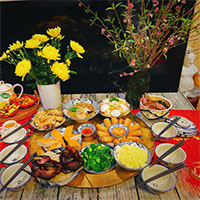
Why is there no beef on the traditional Vietnamese Tết offering tray?
Traditional Tết offering trays feature chicken and pork but no beef. The reason lies in Vietnam's wet-rice farming civilization.