Why is Hà Nội's Thê Húc Bridge painted red and facing the sun?
The Thê Húc Bridge is one of the iconic landmarks of Hà Nội, the capital of Vietnam. It was built in 1865, during the reign of Emperor Tự Đức of the Nguyễn dynasty.
The person credited with building the Thê Húc Bridge is the scholar Nguyễn Văn Siêu (1799-1872), one of the most celebrated poets and intellectuals of the Nguyễn dynasty. After the bridge was completed, Nguyễn Văn Siêu named it Thê Húc, meaning "where the light rests" or "gathering of radiance."
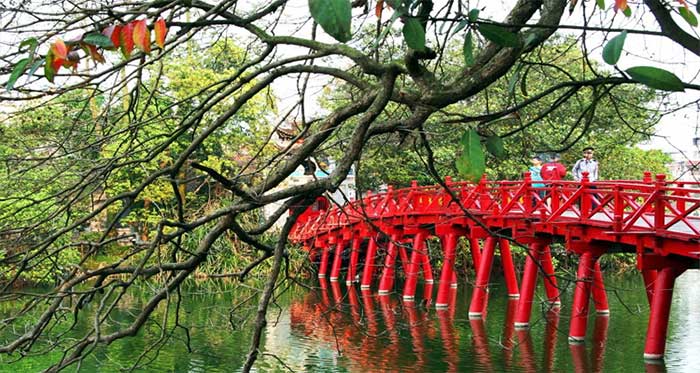
The bridge is painted red, symbolizing the color of the sun, of life, good fortune and happiness
Nguyễn Văn Siêu had the Thê Húc Bridge built to connect the shore with Ngọc Sơn Temple, which stands on an islet in Hoàn Kiếm Lake in central Hà Nội. Ngọc Sơn Temple is now part of one of Vietnam's special national relic sites.
The original bridge had 15 spans and 32 round wooden pillars arranged in 16 pairs, with a plank deck and railings painted dark red; the name "Thê Húc" was gilded. Because it had deteriorated badly, the old bridge was demolished in 1952 and a new one was built to the same design, but with a steeper arch. The 16 rows of piles were kept. The cross beams and longitudinal beams were cast in concrete, while the deck and railings remained wooden.
The Thê Húc Bridge faces east, toward the rising sun. It is painted red, symbolizing the color of the sun, of life, good fortune and happiness, according to East Asian tradition.
In 1865, Nguyễn Văn Siêu led the restoration of Ngọc Sơn Temple in Hà Nội. On Ngọc Bội Hill (formerly known as Độc Tôn Hill), he had a stone tower built, its top shaped like an upturned writing brush and its body engraved with three characters, Tả Thanh Thiên ("writing on the blue sky"). Today it is commonly known as the Pen Tower (Tháp Bút).
Nguyễn Văn Siêu authored many valuable works, such as Phương Đình thi loại, Phương Đình văn loại, Phương Đình dư địa chí, Địa dư toàn biên, Chư kinh khảo ước, Chư sử khảo thích and Tứ thư bị giảng. His writing expresses a strong pride in his country and people. Many of his poems depict the charming scenery of Hồ Gươm (Hoàn Kiếm Lake), West Lake, the Nhị River (Red River), the Tô Lịch River and Đống Đa Mound. Photo: Portrait of Nguyễn Văn Siêu.

Why do Pitbulls, the "king of fighting dogs," so often lose to venomous snakes?
Other dogs can often overpower venomous snakes, but Pitbulls frequently pay a heavy price in such fights. Their aggressive nature is to blame.