How to grow moth orchids in pots
How to plant a newly bought moth orchid is something many people want to know. The guide below walks you through the simplest way to grow moth orchids.
The moth orchid can stay in bloom for three to four months, or even six months with careful care. It is regarded as a symbol of noble, upscale beauty in interior decoration.
Moth orchids are among the longest-lasting of all orchid blooms. Today, moth orchids are hugely popular with ornamental-plant enthusiasts and widely grown. To get the plant to flower and keep its blooms fresh for longer, growers need to pay attention to the fairly demanding planting and care techniques this ornamental requires.
Moth orchids have some of the longest-lasting flowers of any orchid and bloom readily under many different conditions. In European countries, the moth orchid has long been regarded as a gift of love. It also symbolizes purity and prosperity.
The moth orchid is neither flamboyant nor heavily fragrant, but with its refined grace it draws every eye wherever it blooms, thanks to the noble elegance of its flowers. In Eastern feng shui, the moth orchid brings good fortune and prosperity to the household, and in Japan it is said to be associated with the imperial family and regarded as a symbol of wealth.
That is why placing a pot of moth orchids in the home at the new year is meant to symbolize abundance, wealth and prosperity in the year ahead. But how do you get a pot of orchids to bloom as beautifully as you would like? It is quite simple if you follow these planting and care steps:
How to grow moth orchids in pots
Guide to growing moth orchids
A flower of the mountain forests
In fact, growing and caring for this wild flower is not as difficult as many people think. Moth orchids (scientific name Phalaenopsis) belong to one of the largest families in the plant kingdom, the orchid family Orchidaceae, and are native to Southeast Asia, the Philippines and Australia. In deep forests, these plants typically cling tightly to trees or to rocks. They have large, broad, fleshy leaves and arching flower spikes bearing many blooms. A plant usually has 5 to 10 leaves and many white roots.
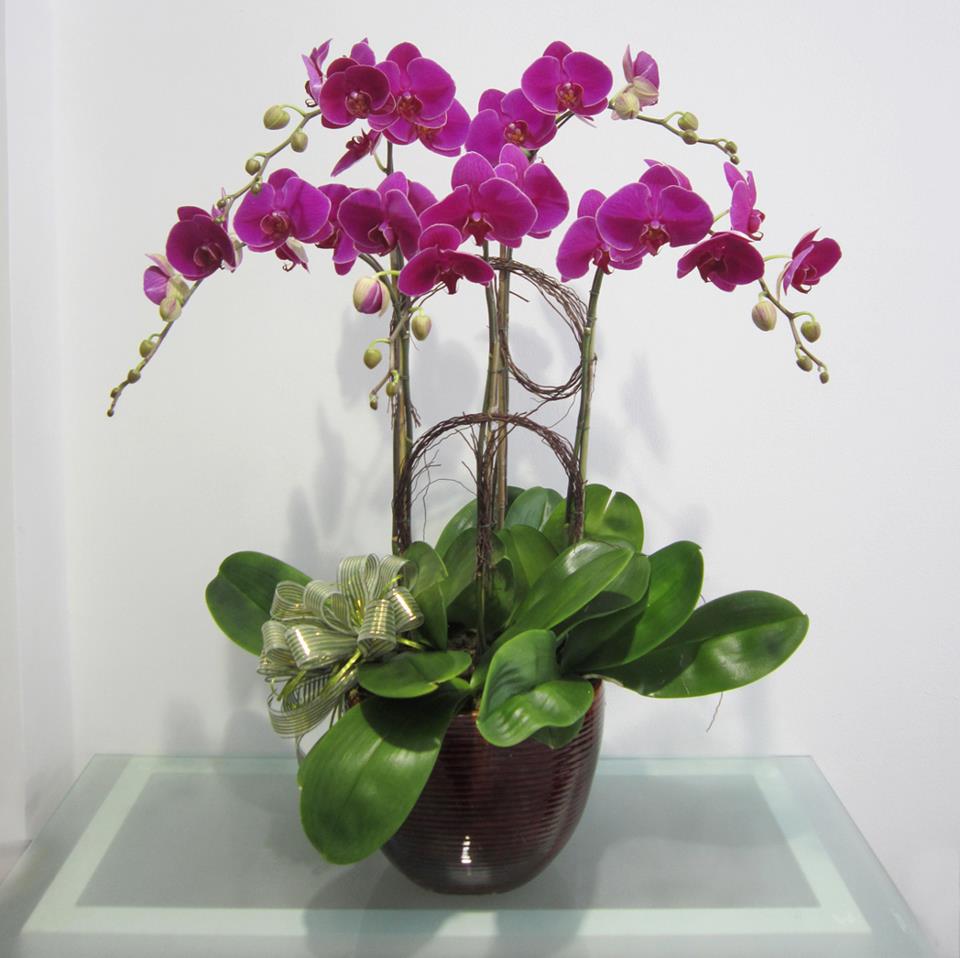 Growing moth orchids is not as difficult as many people think
Some species have flower spikes bearing large, round blooms. Others have short spikes with brightly colored flowers in white, pink or yellow, or petals mixed with stripes, edges or spots. Beyond these species, a large number of hybrids adapt better to artificial conditions than to the natural environment. One key feature of the moth orchid: under cultivation, its flowers last about three months. Some other species and hybrids stay fresh even longer, and some varieties can flower year-round. The orchid flowering season runs from December to the end of May.
Moth orchids come in many shapes and sizes. Growers can put each plant in its own pot or group several plants together in one pot. A standard pot can hold several plants, and with proper care they can flower within two years.
Light and temperature requirements
Moth orchids need light to grow well. Indoors, place the plant near a bright window but out of direct sunlight. Growers can also use artificial grow lights, which should be positioned above the plant and switched on for at least 12 to 16 hours a day. In a greenhouse, the plants should be shaded with cloth, especially in summer.
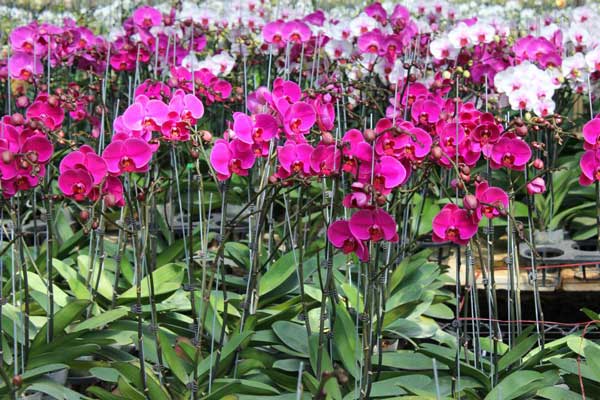 To get a pot that looks the way you want and blooms for a long time, growers need to follow a few basic techniques
This orchid needs daytime temperatures of 18-29°C and nighttime temperatures of 13-18°C. In autumn, night temperatures should be kept below 16°C for three consecutive weeks for flower spikes to start forming. Sudden changes in temperature and humidity are a common cause of bud drop.
Humidity and watering
Moth orchids need 50-80% humidity . If the surrounding humidity is lower, growers can use a cover to reduce water loss from the plant. Another precaution is to keep the plant on a tray filled with gravel or pebbles and water. Make sure the plant always sits on the gravel or pebbles and does not touch the water. Watering is very important for this plant and should be done carefully.
 Moth orchids come in a wide range of colors
In summer, the plant should be watered about every 2-3 days, while in winter, once every 10 days or so is enough. The best time to water is around midday, since the leaves will dry out by evening. Water left sitting on the leaves can cause them to rot, so the best approach is to adjust watering to the season while also considering the plant's needs and the growing medium used (common media include bark, perlite, tree fern fiber and charcoal).
Fertilizers and pesticides
Fertilize more often in summer and while the plant is actively growing. In winter, the plant takes up fewer nutrients. Always water the plant thoroughly before fertilizing. A balanced fertilizer such as NPK 14-14-14 is best. Plants that are flowering should be given a formula higher in phosphorus (10-30-20%).

Growers can adjust the flowering time as they wish
Moth orchids are very attractive to pests such as bud borers, mites, aphids and snails. Pests clinging to the leaves should be removed with soapy water or pesticide, after which the leaves should be wiped clean with a soft cloth.
Encouraging flowering
Moth orchid flowers usually fade about three months after opening. Once they have faded, growers can make the plant bloom again by cutting off the entire flower spike, which works very well if the spike is old and has turned brown. If the spike is still green, however, just cut it back above a node. The section removed should be about 10-12 cm long, which can help the plant produce a new branch within 2-3 weeks.
Providing good air circulation
Compared with other orchids, ventilation is absolutely essential for moth orchids. It is a key factor in preventing rot and many of the fungal diseases common in this orchid. The better the airflow, the fewer diseases the plant gets, because it helps the plant dry quickly after watering. Too much airflow, however, can easily dehydrate the plant. So aim for moderate ventilation that keeps the leaves dry; this depends on where the pot is placed and the space around it.
Repotting
Moth orchids are very long-lived, so they will need repotting. There are two reasons a plant needs a new pot: either it can no longer grow in its current pot, or the growing medium has broken down and no longer lets in enough air for the roots to grow well. Repotting can be done once every one or two years, and the best season for it is spring.
As the roots spread they cover the pot and the medium inside it, filling the gaps between the roots, so there should be no empty space between the medium and the roots. The base of the stem should sit just slightly below the surface of the medium. After repotting, keep the plant in the shade and water it after 3 days.
Caring for moth orchids after Tết
After Tết, when most of the flowers on the spikes have faded, the best way to help the plants survive and recover quickly is to separate the arrangement into individual plants to pot up and care for.
Moth orchids displayed for Tết are usually grouped together in large pots to create spectacular arrangements. After the holiday, however, busy households often forget them or do not look after them properly, so many of the plants die, stop growing or gradually wither, either because their owners pay little attention or because they do not know how to care for them once the flowers have faded.
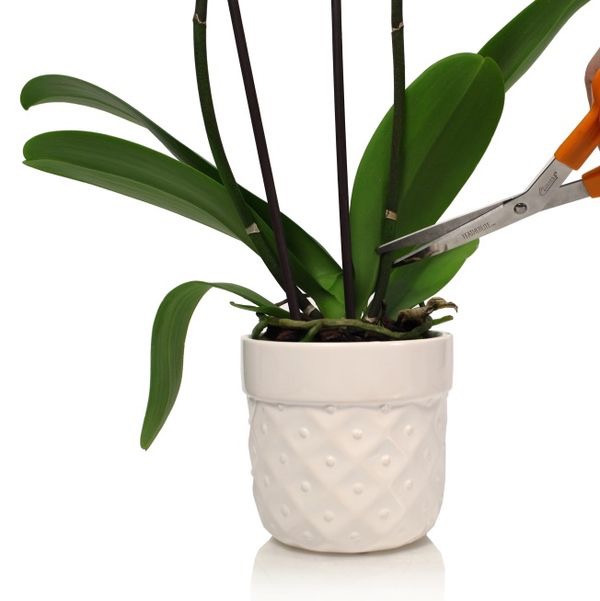
Use scissors to cut off the flower spikeabout 3 cm above the last dormant node on the spike. Do not cut too close to the base of the spike, as this can easily bruise or break the leaves and allow rot to spread into the stem. The remaining dormant node on the spike can produce a plantlet: dab a little Atonic onto a piece of medical cotton, place it on the node for about a week, then remove it, and a plantlet may appear after 1-2 months.
- For leaves with minor disease, where less than a third of the leaf has yellowed, try to save the leaf by cutting out the damaged part with a razor blade or a very sharp knife.
- Leaves that are badly diseased, with widespread signs of fungus or mites on the underside, should be removed completely.
Next, deal with the base and roots: Examine the roots. Most commercially grown moth orchids are planted in sphagnum moss, and around Tết, heavy watering by growers or owners, along with transport and the metal stakes used to train the flowers, causes many roots to rot. Remove the plastic pot.
- If the roots are still fresh and green with only a little rot, try to keep the root ball intact: use clean scissors to cut off all the rotten roots, leaving the healthy green ones. Dab lime paste, nail polish, a plant wound sealant or 502 superglue onto all the cuts, place the whole root ball in the pot and tie the base of the plant firmly so it does not wobble. Fill around the pot with fungicide-treated tree fern fiber and pat it down lightly so it is fairly firm, without covering the base, so you can watch how the roots develop.
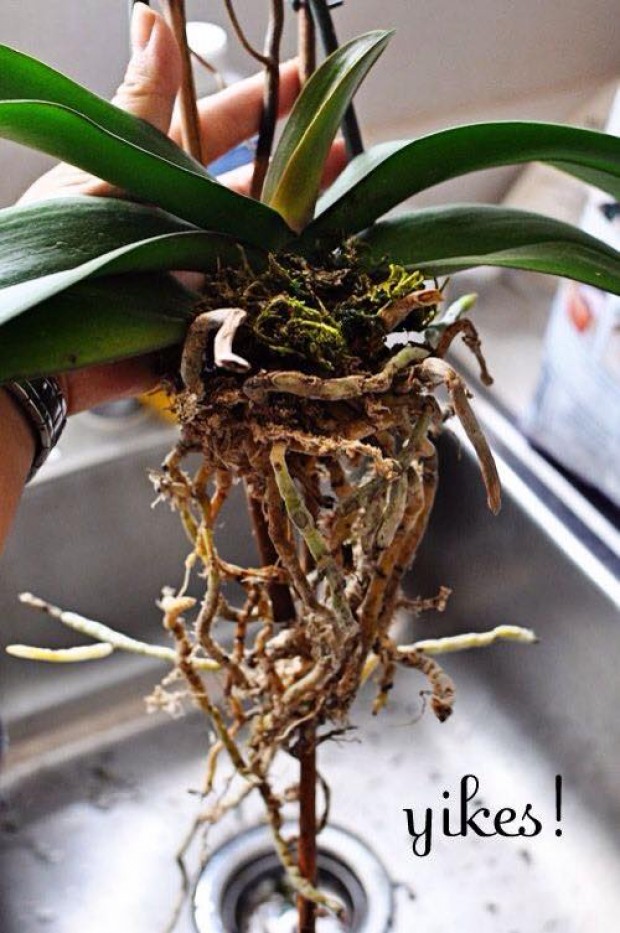
- If the roots are badly damaged, remove all the sphagnum moss from the root ball, then cut off every rotten or broken root. Dab lime paste or glue on the cuts, and put a few pieces of styrofoam at the bottom of the pot.
With almost all its roots cut away, the plant will struggle to stand upright in the pot. Place a rectangular block of styrofoam right under the base of the plant and set the plant on it. Tie string around the base and anchor it securely to both sides so the plant does not wobble when you pick up the pot.
- Keep the plant in a cool spot, completely sheltered from rain, and let it dry for about three days before giving the whole pot one thorough watering.
- Mix B1 fertilizer or a growth stimulant such as Atonic or K/H ... very dilute, at 1/2 teaspoon per 20 liters of water, and mist the plant daily.
- After about 1-2 weeks, new roots will emerge; once the young roots have grown into the medium, add another layer of growing medium.
- After 1-2 months the plant will be growing steadily again, and you can resume normal fertilizing and watering.
The meaning of moth orchids
In Eastern feng shui, the moth orchid represents luck, fortune, luxury and prosperity. In European countries, it is seen as a symbol of passionate love. The moth orchid also represents feminine beauty, evoking perfection and allure.
What is more, keep a pot of moth orchids in the home because the flower also symbolizes fertility. That is why moth orchids are always a popular choice for Tết displays when spring arrives. Moth orchids of different colors each carry a different meaning.
White moth orchids
Pure white says something about what the white moth orchid means. It can be seen as a symbol of beauty and elegance, while also bringing wealth and prosperity to the household.
The white moth orchid also stands for a smooth new beginning and makes a wonderful gift to express sincere, loving feelings toward someone dear as you move toward the future together.
Red moth orchids
Red has always been the color of passionate, burning love, like a flame lighting up a couple's hearts. Red also expresses power and alluring conquest. If you want to show the depth of your love, choose a vivid red moth orchid as a gift and let the flower speak for you, both meaningful and romantic.
Yellow moth orchids
Yellow is the color of brightness and prosperity. The yellow moth orchid signifies a life of plenty and a good new beginning. With its refined beauty, it also makes a very meaningful gift to welcome spring at Tết. You can give these orchids to loved ones, friends, colleagues and customers.
Purple moth orchids
The purple of the moth orchid stands apart from other flowers because the grace of each petal gives it a splendid, proud, mysterious and irresistibly attractive beauty. Purple is the color of fidelity and loyalty, and the purple moth orchid is also a symbol of royalty. A purple moth orchid is an excellent gift for your boss, since the flower's meaning conveys your respect and admiration.
Blue moth orchids
Blue moth orchids have a very special and rare color, so they are a little harder to grow. Blue represents the sky and the sea, evoking a sense of peace with a hint of spiritual values. That is why blue moth orchids are often suited to tranquil places such as pagodas.
Orange moth orchids
Though not as fiery as red, as dazzling as yellow or as soft as pink, the orange moth orchid brings warmth like the golden sunlight of late afternoon. Orange represents youthful energy, vitality, enthusiasm and playful humor. If you want to send optimistic wishes full of youthful positive energy, an orange moth orchid is the right choice.
Pink moth orchids
Pink is a beloved color that conveys a fresh gentleness; not as vivid as red, it brings a pleasant, harmonious feeling. The pink moth orchid is a gift of joy and happiness, symbolizing a beautiful, idealistic love that is gently romantic. Express your faithful heart by sending that message with a pot of pink moth orchids!

Students use a fungal preparation to induce agarwood in Aquilaria trees
Forestry students in Vietnam developed a fungal preparation and drilled Aquilaria crassna trees to induce agarwood formation.

Vietnamese scientists' 3D concrete printing technology
Vietnamese scientists have built houses by 3D printing concrete, cutting construction time by nearly 80% and rough-build costs by about 20%.