Students use a fungal preparation to induce agarwood in Aquilaria trees
Students at Vietnam National University of Forestry (Đại học Lâm nghiệp) have developed a biological preparation and drilled holes in Aquilaria crassna trees to induce agarwood formation.
Hoping to stimulate agarwood formation as an alternative to manual and chemical methods, students Nguyễn Hoàng Anh, Nguyễn Anh Dũng and Nguyễn Đức Nam set out to select several fungal strains from the wild to create a biological preparation.
Starting in July 2020, under the supervision of Dr. Nguyễn Thị Hồng Gấm, the team selected five fungal strains capable of stimulating agarwood formation: Penicillium, Aspergillus, Trichoderma, Fusarium solani and Mucor. In the laboratory, these strains proved to be good producers of the extracellular enzymes cellulase and pectinase. The team isolated them and successfully created a biological preparation capable of stimulating agarwood formation.
In an 8-month trial at an agarwood plantation in Hương Khê (a former district of Hà Tĩnh province in north-central Vietnam), the team recorded agarwood formation at 100% of the drill holes, with resin-infused zones measuring 2.2 x 36 cm. The resulting wood was dark black and had a fragrant, sweet, clean agarwood scent.
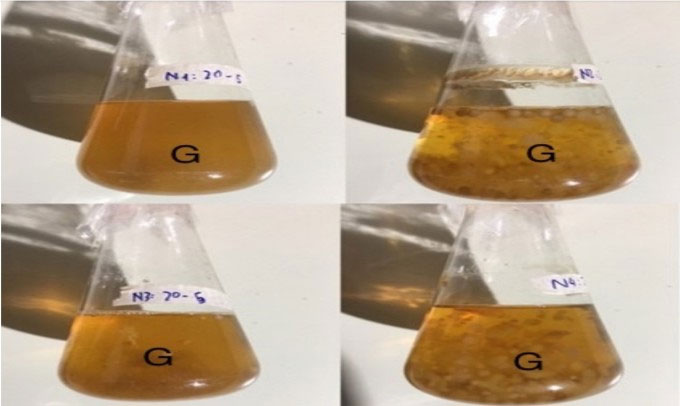
The biological preparations for boosting agarwood formation were blended by the team in the laboratory. (Photo courtesy of the interviewee)
There are currently several ways to induce agarwood, both manual and chemical. Team leader Nguyễn Hoàng Anh said that producing agarwood naturally through manual techniques is simple and easy but has a low success rate. Chemicals are more effective and can produce a lot of agarwood in a short time, but they leave behind toxic chemical residues. This kind of agarwood is also less popular with consumers. Inoculating fungal strains that stimulate agarwood formation directly into the trunk is therefore considered promising, with advantages such as a high success rate and no toxic chemical residues in the product.
According to Hoàng Anh, the microorganisms can synthesize many kinds of enzymes that break down the compounds making up the wood cells of Aquilaria crassna. As a result, the tough wood-cell structure is gradually broken down from the outside in. A characteristic of the tree is its ability to synthesize compounds in areas where cells have been damaged. "Wounding the trunk and infusing the biological preparation at that spot makes the tree's agarwood formation more efficient," Hoàng Anh said. The team is ready to transfer the technique for making the preparation to businesses so the research can be applied in production.

A drill hole producing agarwood in Hà Tĩnh, made with the team's biological preparation. (Photo courtesy of the interviewee)
Dr. Nguyễn Thị Hồng Gấm of the Institute of Forestry Biotechnology (Vietnam National University of Forestry) said "the team's research is quite methodical and can be applied right away." The fungal strains occur naturally and are isolated and multiplied to stimulate agarwood formation more effectively. However, the drawback of the biological method is that it takes a long time to induce agarwood, and the yield per tree is not large.
Agarwood is currently divided into two main types: natural and artificially induced. Artificially induced agarwood forms as a result of human intervention. Typically, Aquilaria crassna trees 7 to 10 years old are chosen to be drilled and inoculated. It then takes about another 5 years for the tree to produce agarwood. Like natural agarwood, induced agarwood must also go through processes of formation and accumulation.
In Vietnam, Aquilaria crassna grows wild, scattered through forests from north to south, and is concentrated in the former provinces of Kon Tum (now part of Quảng Ngãi), Kiên Giang (now part of An Giang), Quảng Nam (now part of Đà Nẵng city) and Quảng Bình (now part of Quảng Trị), as well as Đà Nẵng, Hà Tĩnh and Phú Quốc island. Hà Tĩnh alone had about 3 million Aquilaria crassna trees by 2020, spread over 3,000 hectares at an average density of 1,000 trees per hectare, grown by more than 9,000 households.
Vietnamese scientists' 3D concrete printing technology
Vietnamese scientists have built houses by 3D printing concrete, cutting construction time by nearly 80% and rough-build costs by about 20%.