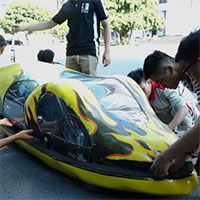
Vietnamese students build a lifebuoy that finds people in distress on its own
Two students at the University of Technology and Education (Đại học Sư phạm Kỹ thuật), part of the University of Danang (Đại học Đà Nẵng) in central Vietnam, have built a lifebuoy that finds people in distress on its own, using GPS-based communication between the buoy and a wristband.
The device was developed by Trần Văn Phúc and Đặng Thành Sơn, fourth-year students in the Faculty of Electrical and Electronic Engineering, who began work on it in August 2022. Their aim was to create a smart buoy that uses technology to replace traditional lifebuoys in the search for people in trouble in the water.
Team leader Trần Văn Phúc said the smart buoy is fitted with a GPS device that communicates with a wristband worn by the user. The wristband sends out a signal that lets the buoy actively locate the person in distress and head to them without anyone steering it.
Trần Văn Phúc presents the device at a fishing port in Đà Nẵng. (Video: courtesy of the interviewee)
The U-shaped buoy is made of composite fiber and can be hung on the side of a boat or on the bank of a lake or river, held in place by an electromagnetic latch. Two electric motors mounted at the tail of the buoy give it a top speed of 20 km per hour. The user's wristband carries a pressure sensor and a GPS locator to pinpoint the position of the person in distress.
When someone falls into the water and a preset threshold is reached, the pressure sensor sends a signal to the control circuit. The buoy is also equipped with GPS. The two GPS signals are sent to a central control circuit, which compares the positions and activates the nearest buoy. That buoy then releases its electromagnetic latch and makes its way to the person using their GPS position.
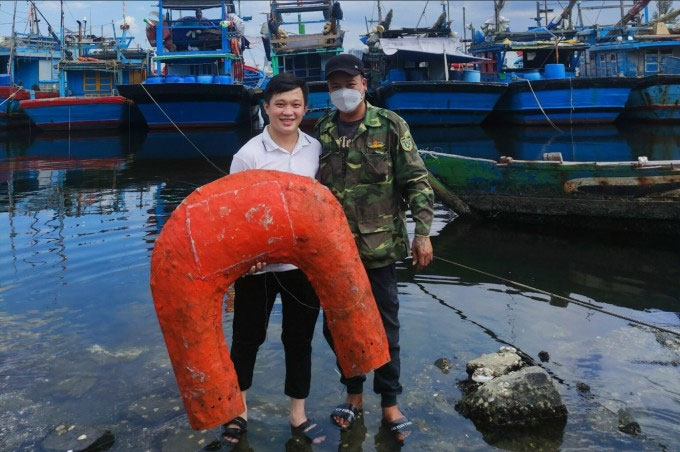
The team tested the lifebuoy at a fishing port to learn about fishermen's needs. (Photo: courtesy of the interviewee).
In July, the team took the device to a fishing port in Đà Nẵng to assess how well it worked. Fishermen were given wristbands and dipped them in the water to test whether the system would be triggered. The device reached people in distress within a 180-meter radius in two minutes, in conditions with small waves and light wind.
Rescue equipment must be highly ready for use whenever an incident occurs. For that reason, Phúc and Sơn built a mobile app that manages all of the buoy's information, such as its location, operating status, battery life and the phone numbers of local emergency services. This helps ensure the device is always ready to work properly when needed.
However, according to Phúc, at sea the GPS signal is received with a delay, which affects rescue performance. To address this, the team plans to test radio-wave communication. In addition, the current motors struggle to maintain speed at sea when conditions are affected by high waves and strong winds. The team plans to invest in more powerful motors so the buoy can operate reliably in the marine environment.
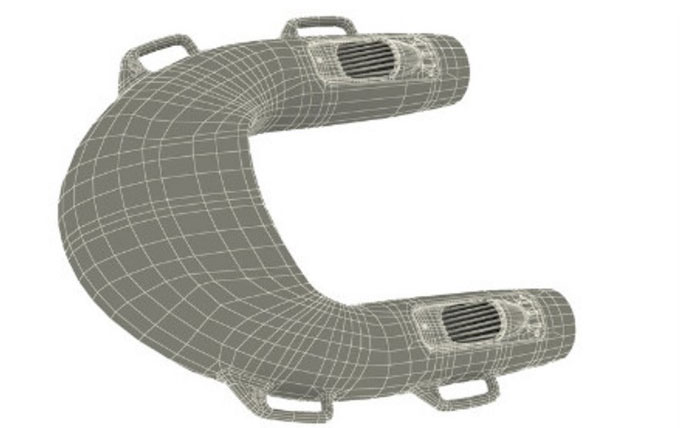
The team's design for the active lifebuoy. (Photo: courtesy of the interviewee).
Đỗ Hoàng Ngân My, who holds a master's degree and lectures in the Department of Control and Automation Engineering Technology at the University of Technology and Education (University of Danang), praised the team's idea. The team has created a smart buoy capable of active rescue with a high degree of automation and no need for a human operator. However, the research has so far been tested with only one buoy, not a system of multiple buoys. The team will therefore need to build a shared monitoring model for a whole multi-buoy system to ensure readiness and accuracy in operation.
My also said the device needs to be tested many more times in scenarios as close to real life as possible, so that the buoy's design and features can be adjusted to suit different rescue environments.
Students use a fungal preparation to induce agarwood in Aquilaria trees
Forestry students in Vietnam developed a fungal preparation and drilled Aquilaria crassna trees to induce agarwood formation.
Vietnamese scientists' 3D concrete printing technology
Vietnamese scientists have built houses by 3D printing concrete, cutting construction time by nearly 80% and rough-build costs by about 20%.
Vietnam trials growing temperate essential-oil plants
Peppermint, lavender, rosemary and other temperate plants are being trial-grown in Vietnam to be acclimatized and processed into essential oils.