

Nearly 200 prehistoric artifacts unearthed in caves in northern Vietnam
Archaeologists from the Vietnam Academy of Social Sciences (Viện Hàn lâm Khoa học Xã hội Việt Nam), working with the museum of the former Bắc Kạn province in northern Vietnam (now part of Thái Nguyên province), have carried out survey excavations at Nậm Lù cave (Hoàng Trĩ commune) and at Thẳm Pán and Thẳm Un 2 caves (Quảng Khê commune, in the former Ba Bể district). They uncovered nearly 200 archaeological artifacts, mostly stone tools, bones and pottery, dating back roughly 8,000 to 10,000 years.
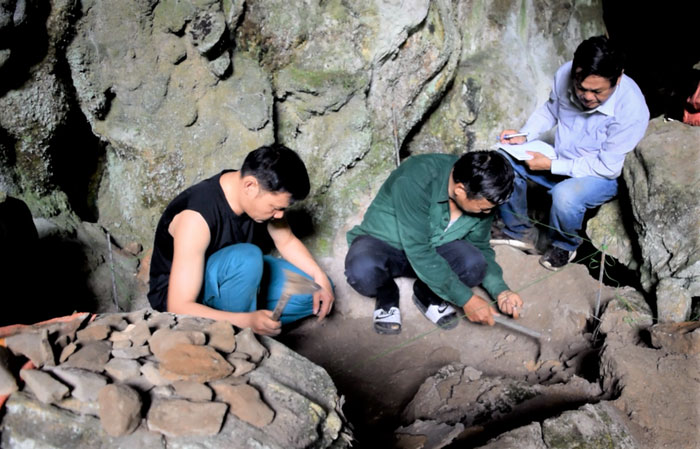
Survey excavation at Thẳm Un 2 cave. (Photo: VNA).
According to Associate Professor Dr. Trình Năng Chung of the Vietnam Academy of Social Sciences, traces of prehistoric people were found in almost all of the caves. The artifacts were mixed with mollusk shells and animal bones and teeth. Pottery was found in the surface layer. In the excavation pits, the archaeologists also found the remains of two ancient hearths, but no traces of burials have been found so far.
The team found a flat, oval stone with a hole drilled through its narrower end. The round hole is 0.4cm in diameter. The archaeologists believe it may have been an ornament threaded on a cord and worn around the neck. Artifacts of this kind are still quite rare at prehistoric sites in Vietnam. Although no ground tools have been found yet, the discovery of a grinding slab in the pit shows that the ancient inhabitants knew the grinding technique. The presence of many hammerstones, raw pebbles, flaked stones and flakes shows that tools were made on site.
Almost all of the stone tools were made from river and stream pebbles. The types of tools recovered from the pit are characteristic of the Early Neolithic, including discoidal tools, oval tools, short axes, bifacial choppers, scrapers, knives made from large flakes, hammerstones, grinding slabs, pestles and grinding stones...
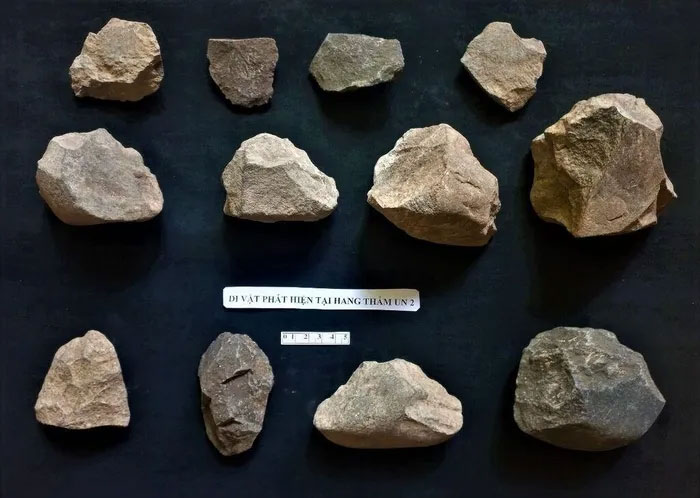
Stone artifacts at Thẳm Un 2. (Photo: VNA).
The archaeologists collected many fragments of animal bones and teeth. Analysis of the animal remains has provisionally identified wild boar, monkeys, porcupines, junglefowl, bamboo rats, deer and more… The mollusk remains are mainly the shells of stream snails, land snails, mussels and clams, along with a few plant remains such as Canarium nut stones and tamarind seeds... The abundance of animal bones and teeth, mollusk shells and plant remains shows that hunting and gathering played an especially important role in how the prehistoric people here obtained food. The presence of grinding stones and pestles is evidence that food was usually processed near the hearth.
The pottery found on the cave surface consists of sherds from many different vessel types. The clay body was tempered with a little plant material and fired at a fairly high temperature, giving thin, hard walls; the vessels were made on a turntable and decorated with fine cord-marking, incised patterns of short parallel straight lines, and impressed rows of small adjoining circles. Some sherds bear black soot marks on the outside, suggesting they were used for cooking. Based on the manufacturing technique and decoration, these sherds can be identified as characteristic of Metal Age pottery, dating to about 3,000 to 2,500 years ago.
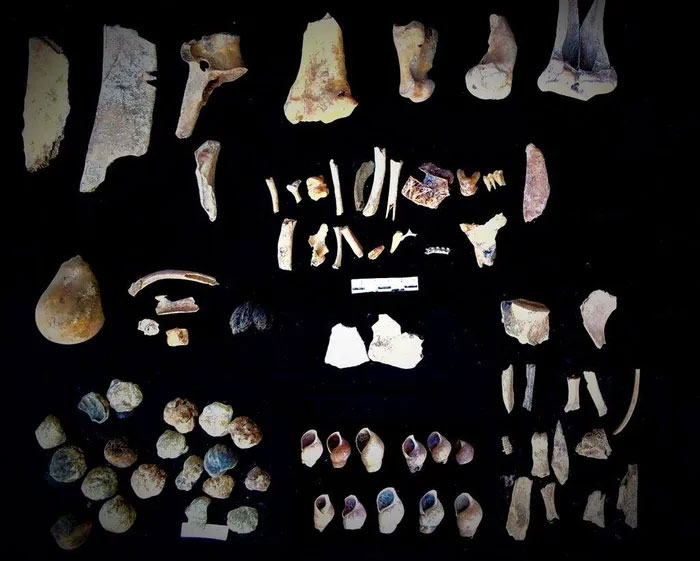
Animal bones and teeth and snail shells. (Photo: VNA).
Associate Professor Dr. Trình Năng Chung said that, based on an overall study of the artifacts found in the caves and on the structure and age of the cultural layers, researchers provisionally believe that Thẳm Un 2 cave was a dwelling site for many generations of prehistoric people. The earliest inhabitants belonged to the Early Neolithic, 8,000 to 10,000 years ago. For a long period of several thousand years, the site was unoccupied. Then, about 3,000 to 2,500 years ago, Metal Age people came to live here for a short time, leaving traces in the form of pottery. The Thẳm Un 2 site holds great historical, cultural and scientific value.
Thẳm Un 2 cave sits about 20m above the foot of the mountain. Its large, arched entrance faces east, slightly to the south. In front of the entrance lies a large valley with a stream running through it. The cave floor covers about 100 m2. Most of it receives natural light, which made it very favorable for prehistoric habitation.
Specialist agencies plan to carry out survey excavations at the Nậm Lù and Thẳm Pán cave sites in the near future.
Deer antler found in Vietnam may be a 2,000-year-old musical instrument
A 35-cm antler fragment, likely from a sambar or hog deer, found along the Mekong River may be one of Southeast Asia's oldest stringed instruments.
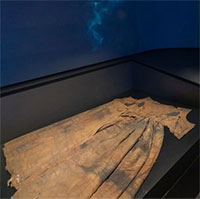
Silver wedding dress found in 17th-century shipwreck
A silver wedding dress embroidered with heart motifs may have belonged to a woman from the very top of 17th-century European society.
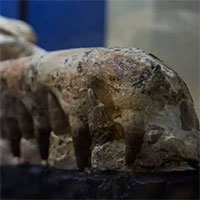
Prehistoric sperm whale skull unearthed in Peru's Ocucaje Desert
The complete skull, with teeth and jaws intact, had lain in the Peruvian desert for around 7 million years.
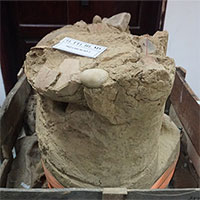
Thousand-year-old jar burials found in irrigation reservoir bed in Vietnam's Quảng Ngãi
Over 20 burials and 3,500-year-old stone tools and jewelry have been restored after more than a decade of excavation at Nước Trong reservoir.
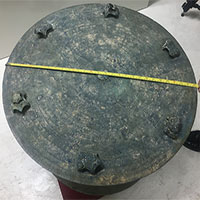
Second ancient bronze drum discovered in Quảng Ninh, Vietnam
A family in Quảng Ninh, northeastern Vietnam, unearthed a 14th–15th-century bronze drum buried over 1 m deep while building an embankment.

9,000-year-old grave of a young female hunter could rewrite prehistory
A 9,000-year-old grave in Peru holds a woman aged 17-19, buried with the stone tools she carried on her hunts.

