3,700-year-old ivory comb inscribed with a wish to wipe out lice
The luxury comb served two purposes: one side has six widely spaced teeth for untangling knots, while the other has 14 fine, closely set teeth for removing lice.
Scientists have identified what is believed to be the oldest known complete sentence written in an alphabet, inscribed on an ivory comb: "May this tusk root out the lice of the hair and the beard." The luxury item was unearthed at Lachish, a Canaanite city-state in the second millennium B.C. and later the second most important city of the Kingdom of Judah. The new study was published Nov. 9 in the Jerusalem Journal of Archaeology.
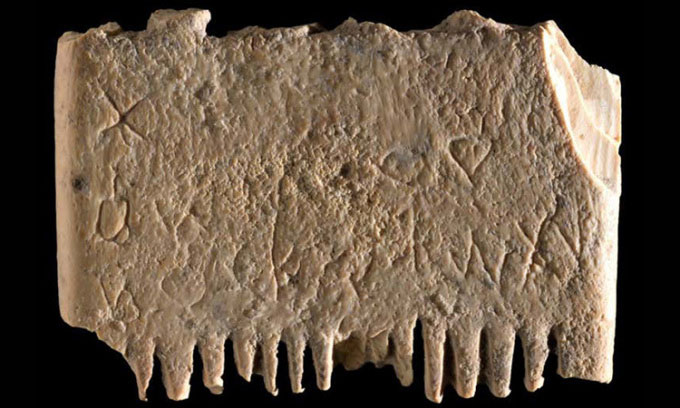
The ivory comb, made around 1700 B.C., had two jobs: removing lice and untangling hair. (Photo: Dafna Gazit/Israel Antiquities Authority)
"The inscription is very human. You have a comb, and on it you write a wish to get rid of the lice in your hair and beard. Today we have all kinds of sprays and modern medicines, but back then they didn't have those things," said Yosef Garfinkel, an archaeologist at the Hebrew University of Jerusalem who co-directed the Lachish excavation.
Ancient combs could be made of wood, bone or ivory, but ivory combs were expensive imported luxuries, since there were no elephants in Canaan at the time. The ivory comb, which measures 3.5 cm by 2.5 cm, was found in 2017. However, the shallow letters etched into its surface were not noticed until December of last year. Analysis confirmed that the inscription is written in Canaanite script, the earliest alphabet, which was invented about 3,800 years ago.
The scientists could not radiocarbon-date the comb, but they estimate it was made around 1700 B.C. The comb is worn and has lost its teeth, but the remaining part shows that one side had six widely spaced teeth for removing tangles, while the other had 14 closely set teeth for removing lice and their eggs. Examining the comb under a microscope, the team also found fragments of the outer shells of head lice nymphs measuring half a millimeter long.
"It's fascinating that the inscription is about ordinary life. Lice have been a constant problem throughout human history. This inscription reveals that even the rich and famous of the ancient world couldn't escape it. We hope this inscribed comb was useful in doing the job it was meant to do: getting rid of those pesky insects," said Christopher Rollston, a professor at George Washington University.
Thousand-year-old jar burials found in irrigation reservoir bed in Vietnam's Quảng Ngãi
Over 20 burials and 3,500-year-old stone tools and jewelry have been restored after more than a decade of excavation at Nước Trong reservoir.
Ancient carved rocks discovered in Mù Cang Chải, northern Vietnam
Ancient sandstone boulders of 1-20 cubic meters lie scattered in a protection forest, carved with rhombuses, concentric circles and terraced fields.
Granite blocks from the era of pharaoh Khufu discovered in eastern Cairo
Archaeologists have found granite blocks dating to the reign of pharaoh Khufu in Ain Shams, eastern Cairo, a first for the area.
130-million-year-old dinosaur belly button scar stuns scientists
An exceptionally preserved Psittacosaurus fossil reveals a long umbilical scar on its belly, similar to those of modern crocodiles.
Second ancient bronze drum discovered in Quảng Ninh, Vietnam
A family in Quảng Ninh, northeastern Vietnam, unearthed a 14th–15th-century bronze drum buried over 1 m deep while building an embankment.
3 ancient mammal species that appeared after the dinosaurs died out
US scientists have described three new archaic mammal species that appeared soon after the mass extinction that wiped out the dinosaurs.