

130-million-year-old dinosaur belly button scar stuns scientists
An exceptionally well-preserved Psittacosaurus fossil reveals a long umbilical scar on the dinosaur's belly, similar to those seen in modern crocodiles.
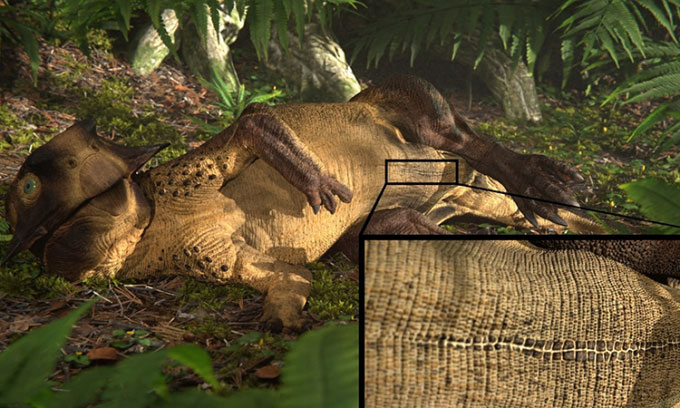
A 3D reconstruction of Psittacosaurus lying on the ground, showing its long umbilical scar. (Photo: Jagged Fang Designs)
Scientists have found the oldest belly button ever recorded in a fossil of Psittacosaurus (the "parrot lizard") that lived about 130 million years ago in what is now China. The new study was published June 7 in the journal BMC Biology. The scar did not come from an umbilical cord, as in mammals, but from the yolk sac of this egg-laying creature.
Today, many snakes and birds lose their umbilical scars within days or weeks of hatching. Other animals, such as adult crocodiles, keep theirs for life. The Psittacosaurus belly button scar was more like a crocodile's: it persisted at least until the dinosaur reached sexual maturity, and possibly long after.
This is the first example of a belly button in a non-avian dinosaur from before the Cenozoic Era (which spans from about 66 million years ago to the present). The discovery does not mean that all land-dwelling dinosaurs had long-lasting umbilical scars, but it remains a possibility.
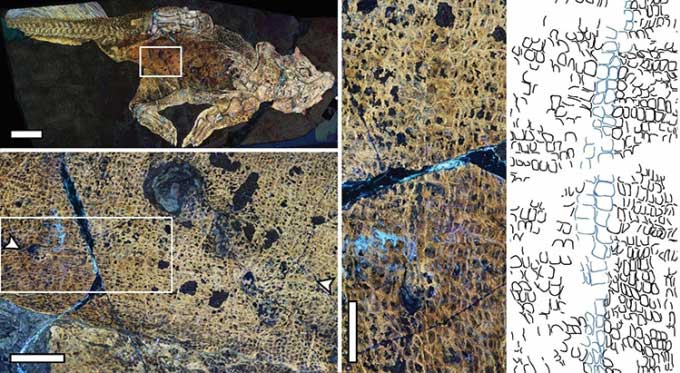
Laser imaging of the Psittacosaurus umbilical scar, with close-ups of its scales. (Photo: BMC Biology/Phil Bell et al.)
"This Psittacosaurus specimen is probably the most important fossil we have for studying dinosaur skin. It keeps delivering surprises that we uncover with new technologies such as laser imaging," said paleontologist Phil Bell of the University of New England in Australia.
The Psittacosaurus fossil, catalogued as SMF R 4970, was described from China in 2002. It is exceptionally well preserved, retaining individual scales, a long tuft of tail bristles and the first cloaca ever found in a non-avian dinosaur. The dinosaur was fossilized lying on its back, exposing every detail to scientists.
Using laser imaging, the researchers identified changes in the skin and scales at the dinosaur's navel, the spot where the hatchling absorbed its yolk sac. Much like an umbilical cord, the yolk sac supplies oxygen and nutrients to the embryo developing inside the egg. Another structure, called the allantois, also connects to the embryo and collects waste inside the egg. Before an animal hatches, these connections seal off, leaving a long scar.
Researchers have long hypothesized that egg-laying dinosaurs would have such a scar, but this is the first evidence to prove it. Fossilized soft tissue in dinosaurs is very rare, and SMF R 4970 offers an unprecedented view of the scar, which looks like a thin column bordered by paired scales on the belly.
The normal size and smooth edges of the scales show that the scar was not caused by injury or disease. Instead, its similarity to crocodiles indicates that it is a belly button.
"We identified distinctive scales surrounding a long scar in the Psittacosaurus specimen, similar to those of some modern lizards and crocodiles. We call this type of scar a belly button, and in humans it is smaller. This specimen is the first dinosaur fossil to preserve a belly button, thanks to its exceptional state of preservation," said paleontologist Michael Pittman of the Chinese University of Hong Kong.
Second ancient bronze drum discovered in Quảng Ninh, Vietnam
A family in Quảng Ninh, northeastern Vietnam, unearthed a 14th–15th-century bronze drum buried over 1 m deep while building an embankment.
3 ancient mammal species that appeared after the dinosaurs died out
US scientists have described three new archaic mammal species that appeared soon after the mass extinction that wiped out the dinosaurs.
Bizarre ancient tomb with stone statues nearly 10m tall in Turkey
Mount Nemrut, one of Turkey's most famous archaeological sites, is strewn with toppled colossal statues that lend it an air of mystery.
Australia's largest pterosaur discovered, with a wingspan of up to 7 meters
A fossil over 100 million years old from Queensland reveals a new giant pterosaur species with an estimated wingspan of up to 7 m.
Cave packed with bones hoarded by hyenas for thousands of years, including prehistoric human remains
Researchers believe a huge pile of bones in a Saudi Arabian lava tube was dragged there by striped hyenas over thousands of years.
9,000-year-old grave of a young female hunter could rewrite prehistory
A 9,000-year-old grave in Peru holds a woman aged 17-19, buried with the stone tools she carried on her hunts.

