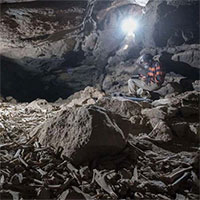
Ancient carved rocks discovered in Mù Cang Chải, northern Vietnam
Hoàng Tiến Long, director of the Yên Bái Provincial Museum (Yên Bái province in northern Vietnam has since been merged into Lào Cai province), said that after receiving reports of ancient rock carvings in Háng Chua Say village (Chế Cu Nha commune, in the former Mù Cang Chải district), museum staff went to the site to study and assess the value of the carved boulders there.
The carved rocks lie within a protection forest and consist of numerous large sandstone blocks (from 1m3 to 20m3) scattered 7-80m apart; among them is a carved boulder more than 2m long and about 2m wide.
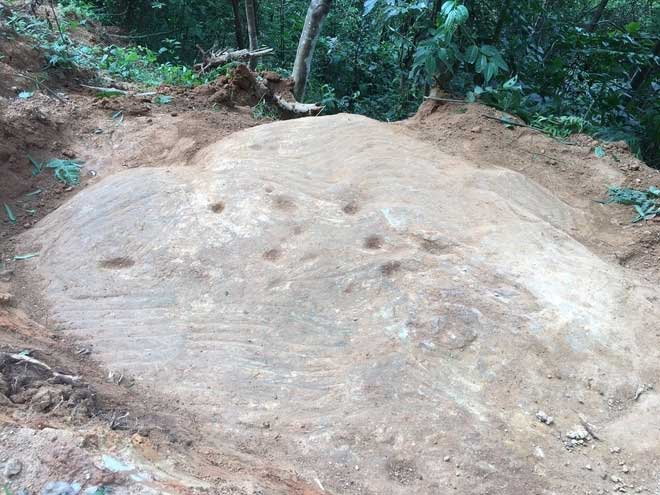
An ancient rock carved with images of terraced rice fields in Mù Cang Chải.
The boulder has a slightly convex flat face whose surface is entirely covered with motifs: sunken circles (7), a sunken rhombus (1), a large raised concentric circle (1), geometric shapes and layer upon layer of terraced fields decorating the edges of the rock, creating a strange and unique work.
Lù A Trư, a commune official and local resident, said that about 20m east of the carved boulder lies a large rock of about 20m3 (which locals call the "father rock"). This is where Hmong people often come to make offerings to the "rock spirit" and pray for good health. The carved boulder is the "mother rock", as local Hmong people call it.
Initial observations show that the carvings are quite detailed and painstaking, curving gracefully along the uneven surface of the rock. Their main subject is terraced fields, similar to carvings found in Lao Chải commune (also in Mù Cang Chải) in 2015, 2020 and 2021.
What sets the Chế Cu Nha rock apart is a raised concentric circle, embossed like the face of a drum, and a sunken rhombus. These motifs differ from those on the 14 ancient rocks previously discovered in Lao Chải commune.
According to specialists at the Yên Bái Provincial Museum, from an ethnological perspective these may be carvings made by the indigenous Hmong people. Dating to around the 16th-17th centuries, they may be "terraced field designs" or depictions of terraced fields, made when the owners of the fields came to appreciate the beauty of what they themselves had built.
According to Lý Kim Khoa, deputy director of the Yên Bái Provincial Museum, the carvings are not boundary markers, and even less the maps many people had speculated, but may be "an ancient people's message about designing terraced fields, or a depiction of terraced fields on stone" by the indigenous inhabitants...
From this, it can be inferred that the Hmong people generally favor cool, temperate highland climates and live by shifting cultivation, hunting, gathering and migration; they are a highly intelligent and creative people who make all their own tools for farming and hunting, as well as their own spiritual culture.
By comparison, the carvings closely resemble the terraced fields this people farm and have gradually expanded, inscribing them into nature as a beautiful landscape.
Only by following this line of research can these messages be understood, and scientists need to continue studying and decoding them to establish their age and their ethnological significance for the ancient carved-rock field in Mù Cang Chải.
The new discoveries of carved rocks in Chế Cu Nha and Lao Chải communes open up the potential for research and a full inventory of ancient carved rocks across the Mù Cang Chải area... They also provide a scientific basis for planners to develop exploration tourism linked to the terraced fields and the Mù Cang Chải Species and Habitat Conservation Area.
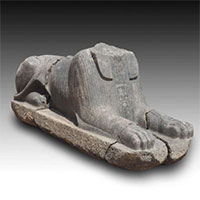
Granite blocks from the era of pharaoh Khufu discovered in eastern Cairo
Archaeologists have found granite blocks dating to the reign of pharaoh Khufu in Ain Shams, eastern Cairo, a first for the area.
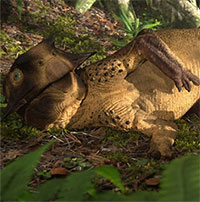
130-million-year-old dinosaur belly button scar stuns scientists
An exceptionally preserved Psittacosaurus fossil reveals a long umbilical scar on its belly, similar to those of modern crocodiles.
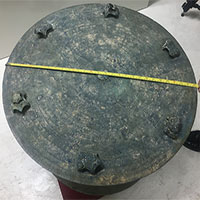
Second ancient bronze drum discovered in Quảng Ninh, Vietnam
A family in Quảng Ninh, northeastern Vietnam, unearthed a 14th–15th-century bronze drum buried over 1 m deep while building an embankment.
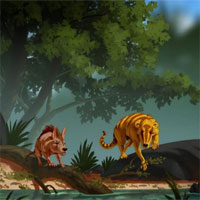
3 ancient mammal species that appeared after the dinosaurs died out
US scientists have described three new archaic mammal species that appeared soon after the mass extinction that wiped out the dinosaurs.
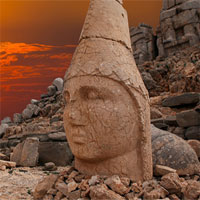
Bizarre ancient tomb with stone statues nearly 10m tall in Turkey
Mount Nemrut, one of Turkey's most famous archaeological sites, is strewn with toppled colossal statues that lend it an air of mystery.
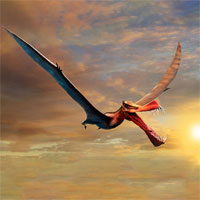
Australia's largest pterosaur discovered, with a wingspan of up to 7 meters
A fossil over 100 million years old from Queensland reveals a new giant pterosaur species with an estimated wingspan of up to 7 m.