Deer antler found in Vietnam may be a 2,000-year-old musical instrument
The 35-cm antler fragment most likely came from a sambar deer or a hog deer and was found along the Mekong River.
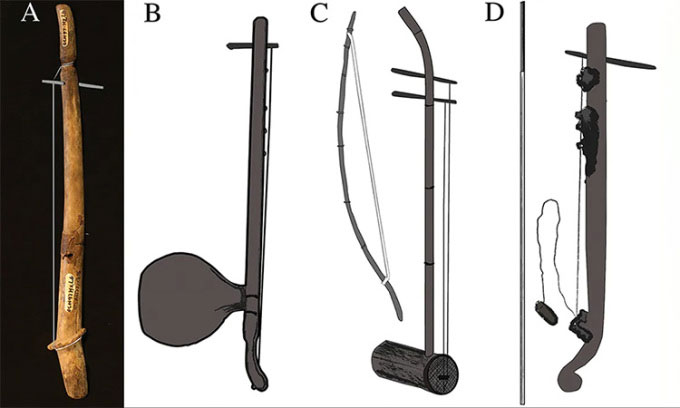
Reconstruction of the artifact (A) compared with other Vietnamese instruments such as the Bro JoRai (B), the cò ke fiddle (C) and the K'ný (D). (Photo: F Z Campos/Antiquity Journal)
Scientists have found an unusual piece of deer antler at a site along the Mekong River in Vietnam, which may be one of the oldest stringed instruments ever excavated in Southeast Asia. It resembles a single-stringed harp and may be a forerunner of the complex instruments still played in Vietnam today. The new study was published Feb. 21 in the journal Antiquity .
The artifact consists of a 35-cm-long piece of antler with a hole at one end for a peg, which could have been used to adjust the string, much like the tuning pegs on a guitar. The string itself has long since worn away, but the artifact still has a bridge, which probably once supported the string.
Archaeologists from the Australian National University (ANU) and the Long An Museum (in the former Long An province, now part of Tây Ninh province in southern Vietnam) describe the artifact in the new study and conclude that it is almost certainly a stringed instrument that was plucked to make music. "There is no other plausible explanation for how it was used", said lead researcher Fredeliza Campos, a doctoral candidate at ANU.
The antler most likely belonged to a sambar deer or a hog deer, two species native to Southeast Asia. The team dated the artifact to 2,000 years ago, to Vietnam's pre-Óc Eo culture along the Mekong River.
"This is one of the oldest examples of this type of stringed instrument in Southeast Asia. It fills the gap between the oldest recorded instruments in the region, lithophones or stone percussion instruments, and more modern instruments", Campos added.

An illustration of how people may have played the 2,000-year-old instrument. (Photo: F Z Campos)
To better understand the musical culture of ancient Vietnam, the team examined a catalog of more than 600 bone artifacts found in the region. Their analysis showed that the unusual antler fits within this catalog, and also pointed to the presence of other ancient Vietnamese instruments, such as the K'ný.
"The K'ný is a single-stringed bowed instrument controlled by the player's mouth. It can play many different sounds and tones, more than the chromatic scale you usually hear on a piano", Campos explained.
Silver wedding dress found in 17th-century shipwreck
A silver wedding dress embroidered with heart motifs may have belonged to a woman from the very top of 17th-century European society.
Prehistoric sperm whale skull unearthed in Peru's Ocucaje Desert
The complete skull, with teeth and jaws intact, had lain in the Peruvian desert for around 7 million years.
Thousand-year-old jar burials found in irrigation reservoir bed in Vietnam's Quảng Ngãi
Over 20 burials and 3,500-year-old stone tools and jewelry have been restored after more than a decade of excavation at Nước Trong reservoir.
Second ancient bronze drum discovered in Quảng Ninh, Vietnam
A family in Quảng Ninh, northeastern Vietnam, unearthed a 14th–15th-century bronze drum buried over 1 m deep while building an embankment.

9,000-year-old grave of a young female hunter could rewrite prehistory
A 9,000-year-old grave in Peru holds a woman aged 17-19, buried with the stone tools she carried on her hunts.

Stunning discovery behind secret doors inside Egypt's Great Pyramid
Two secret "doors" inside the Great Pyramid of Giza may conceal a hidden chamber of the pharaoh Khufu, but their true purpose remains a mystery.