New bent-toed gecko species discovered in Lào Cai, northern Vietnam
The new bent-toed gecko has yellow tubercles scattered across its back and limbs, and the toes on each limb bend in the middle.
Researchers from the Institute of Ecology and Biological Resources (Viện Sinh thái và Tài nguyên sinh vật) under the Vietnam Academy of Science and Technology, together with colleagues, have discovered a new species of bent-toed gecko that has so far been recorded only in Bắc Hà, a former district of Lào Cai province in northern Vietnam (Lào Cai has since merged with Yên Bái, keeping the Lào Cai name). The species belongs to the genus Cyrtodactylus, and is the 53rd member of this genus recorded in Vietnam. The findings were recently published in the journal ZooKeys.
The scientists named the new species Luc's bent-toed gecko (Cyrtodactylus luci), in honor of Associate Professor Phạm Văn Lực, former director of the Vietnam National Museum of Nature (Bảo tàng Thiên nhiên Việt Nam) and a zoologist who has made major contributions to biodiversity research in Vietnam. Notably, it is the first bent-toed gecko species known to occur in Lào Cai province.
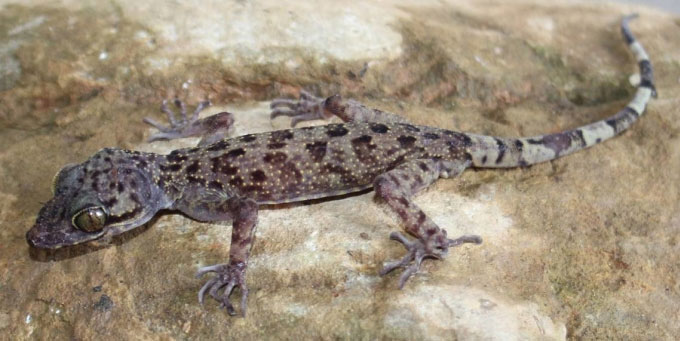
A male Luc's bent-toed gecko photographed in the wild. (Photo: Research team).
Luc's bent-toed gecko measures about 89.5 mm. It has copper-colored eyes ringed with yellow, eyelid-like spots, and a row of tubercles around the middle of its body. Its back, nape and the top of its head are marked with dark brown blotches. DNA analysis showed the new species differs genetically from other bent-toed geckos by at least 9%.
Professor Nguyễn Quảng Trường, speaking for the research team, said the gecko was found during wildlife field surveys in the limestone karst forests of Lào Cai province. The new species was identified based on morphological and genetic differences from other members of the genus Cyrtodactylus in Vietnam and around the world.
He explained that bent-toed geckos are nocturnal and usually cling to rock faces or trees. The scientists therefore carried out surveys in the forest at night to collect specimens for analysis and research.
Luc's bent-toed geckos typically live in secondary limestone forest made up of small and medium-sized hardwood trees mixed with shrubs and climbing vines.
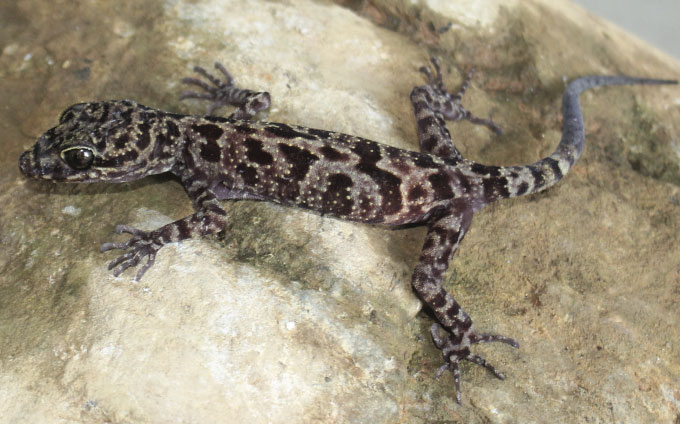
The bent-toed gecko has 12–15 enlarged scales on the underside of each thigh, with 9–12 femoral pores in males and 5–10 in females; pictured is a female. (Photo: Research team).
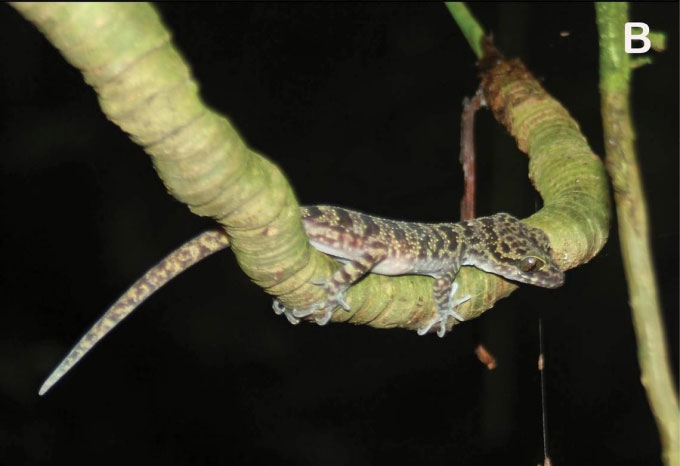
The new gecko lives on rock faces or in trees and is active at night. (Photo: Research team).
According to Professor Trường, discovering and describing new species is a first step in showcasing Vietnam's biodiversity potential and adding to scientific knowledge about living organisms. The team will continue to assess the species' population status, look for it in neighboring areas, and study its biology and ecology.
"This research will help assess the species' conservation status so it can be classified in the Vietnam Red Data Book or the IUCN Red List, allowing us to propose effective conservation measures for it", he said.
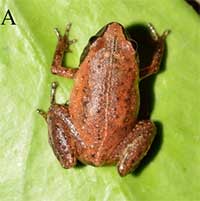
New tree frog and orange-brown dwarf frog discovered in Vietnam
Scientists have described two new amphibians from northern Vietnam: Zhangixalus thaoae and Vietnamophryne aurantifusca.
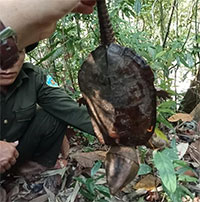
Critically endangered big-headed turtle found in central Vietnam
Forest rangers in central Vietnam rescued a rare big-headed turtle, a strictly protected species, tangled in vines in a forest stream.

Rarely seen seal sports a "fashionable" zebra-like striped coat
Spotted off the coast of Washington state, the ribbon seal is a rarely seen seal with striking stripes across its entire body.
New freshwater crab species discovered in Quảng Ninh, Vietnam
A new freshwater crab species, Chinapotamon insulare, has been found on islands in Quảng Ninh during a provincial biodiversity survey.
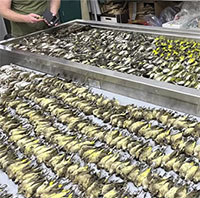
Nearly 1,000 migrating birds die after crashing into a Chicago building
Nearly 1,000 birds died overnight after flying into the windows of Chicago's McCormick Place Lakeside Center.
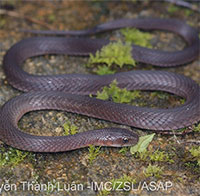
New snake species discovered on Vietnam's Mount Fansipan
Scientists have described a new keelback snake, Rhabdophis hmongorum, found at 2,600 meters on Mount Fansipan in Vietnam's Hoàng Liên National Park.