Stunning, rare crocodile newt discovered on Vietnam's Mount Ngọc Linh
Besides its striking appearance, the Ngọc Linh crocodile newt has surprised scientists by living at an elevation of 1,800 m, whereas newts had previously been found only at elevations of 250 m to 1,740 m.
Vietnamese and German herpetologists have discovered and described a new species of crocodile newt in the highlands of central Vietnam.
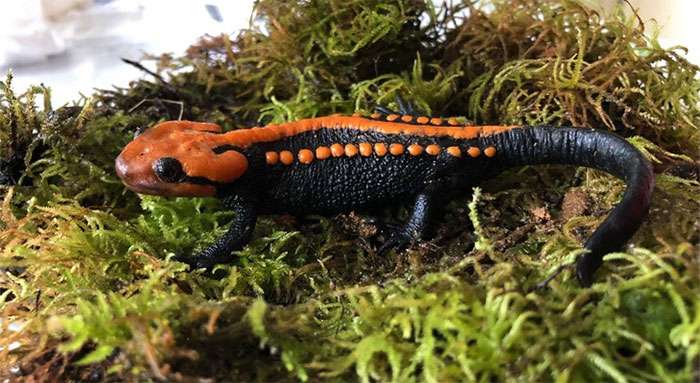
The Ngọc Linh crocodile newt. (Photo: PHÙNG MỸ TRUNG)
The new species has been given the scientific name Tylototriton ngoclinhensis - the Ngọc Linh crocodile newt. It is a highly unexpected and exciting discovery of an amphibian belonging to the order of tailed amphibians, Caudata, in Vietnam.
Until now, six newt species had been found in Vietnam, all of them only in the north, as far south as Nghệ An province. The new description suggests that herpetologists may find further new newt species along the central region, from Quảng Bình (now part of Quảng Trị province) to Kon Tum (now part of Quảng Ngãi province).
Writing in the journal ZooKeys, the researchers said the new species was confirmed on the basis of distinct morphological and molecular evidence. The find is remarkable because it is one of the most brightly colored species in the genus Tylototriton and also the first newt ever recorded in Tây Nguyên, Vietnam's Central Highlands, at an elevation of 1,800 m.
The discovery sets an elevation record for newts found in Vietnam. Previously, known newt species were distributed only at elevations between 250 m and 1,740 m.
The new species lives about 370 km from the nearest Tylototriton population, making it an important discovery for evolution and zoogeography as well.
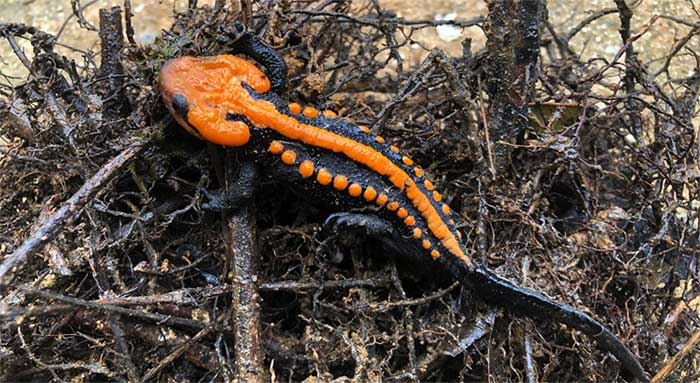
It is one of the most brightly colored species in the genus Tylototriton. (Photo: PHÙNG MỸ TRUNG)
The Ngọc Linh crocodile newt was first found in 2018. Herpetologist Phùng Mỹ Trung said he knew at the time that it was certainly a new species and would be the most exciting description for the tailed amphibians (Caudata) of Vietnam.
But it took him more than four years, after many solo surveys in deep ravines and on high mountains, to collect enough specimens for study and prepare the description of a newt he calls "extremely beautiful and extremely rare."
"I discovered an ecological niche of the Ngọc Linh crocodile newt after a research trip to the highlands of central Vietnam. I waited until the rainy season the following year, hoping to find adults pairing up and laying eggs.
What surprised me most was the sight of an adult: it was so beautiful that my hands trembled as I held the specimen, and I could not believe my eyes.
Over those years, besides time, effort and money, I had to sacrifice many things to find this beautiful and rare amphibian. I dedicate this exciting discovery to the people who stood by me through the hard times during the whole journey of searching for the new species," he said.
According to Phùng Mỹ Trung, salamanders and newts belong to the order of tailed amphibians, Caudata, and are ancient creatures that have survived on Earth. Their genome is about eight times larger than the human genome (roughly 24 billion base pairs).
Researchers have found that assembling these genome sequences requires extremely powerful computer systems. Analyzing the genes takes about six months, and fully understanding and completing the genome sequence of the species for research takes about two years, at a very large cost.
New slender gecko species discovered in Vietnam's Cát Tiên National Park
Scientists have described the Cát Tiên slender gecko, a new species with dark brown and white spots and an ash-gray tail, found in southern Vietnam.
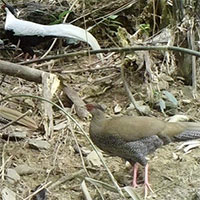
Endangered, rare pheasants found in Vietnam's Pù Hu special-use forest
Five silver pheasants and grey peacock-pheasants, rare and endangered birds, have been found in the Pù Hu special-use forest in Thanh Hóa, Vietnam.
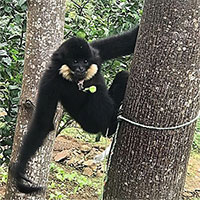
Rare yellow-cheeked gibbon turns up in a residential area in Đà Nẵng
Forest rangers in Đà Nẵng, central Vietnam, have captured a yellow-cheeked gibbon, a rare species that does not naturally occur in the city.
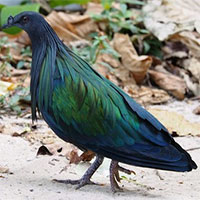
Rare Nicobar pigeon spotted in Vietnam's Côn Đảo National Park
The Nicobar pigeon, listed in Vietnam's Red Data Book and the global Red List, is a strikingly beautiful bird of great scientific value.
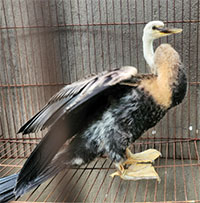
Rare Oriental darter lands on a roof in Ho Chi Minh City, refuses to fly even as residents climb up to catch it
A rare Oriental darter perched on a house roof in Gò Vấp, Ho Chi Minh City, and did not fly away; the homeowner handed it to forest rangers.
Chickens were domesticated thanks to the rice fields of Southeast Asia, new research suggests
Chickens may have been domesticated far later than thought, only after people began farming rice near forests where wild junglefowl lived.