Rare Nicobar pigeon spotted in Vietnam's Côn Đảo National Park
The Nicobar pigeon is listed in both Vietnam's Red Data Book and the global Red List; it is a strikingly beautiful, rare bird of both scientific and aesthetic value.
In Vietnam, the Nicobar pigeon lives only on Côn Đảo
On 3 November, while patrolling a forest trail on Bảy Cạnh island in Côn Đảo National Park, an island park off southern Vietnam (Côn Đảo, formerly part of Bà Rịa–Vũng Tàu province, is now a special zone of Ho Chi Minh City), the park's forest rangers spotted a Nicobar pigeon.
Lê Hồng Sơn, head of the Department of Conservation and International Cooperation at Côn Đảo National Park, said the species is rare both in Vietnam and worldwide and is valuable scientifically and aesthetically, yet little research has been done on it apart from an earlier institution-level survey.
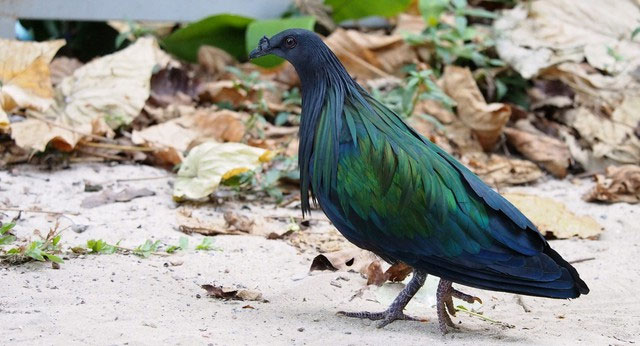
The Nicobar pigeon is a rare species listed in the Red Data Books of Vietnam and the world.
To protect and conserve the bird, Côn Đảo National Park has drawn up specific plans to carry out in the coming period, including stronger protection, monitoring and research, and outreach to help local people understand the species and join hands in protecting this rare and beautiful bird.
Côn Đảo National Park will step up patrols and inspections where Nicobar pigeons live; issue rules strictly banning damage to their habitat and promptly intervene against any activities by organizations or individuals that affect the habitat of the birds and other animals; and severely penalize the hunting of birds, egg collecting and similar activities...
Hunting, trading or consuming protected species such as the Nicobar pigeon is illegal in Vietnam.
In Vietnam, the species occurs only on Côn Đảo, where the national park is planning to protect and help this rare bird thrive. The Nicobar pigeon belongs to the order Columbiformes, family Columbidae, genus Caloenas; its scientific name is Caloenas nicobarica. In Vietnam it is also known by other names, such as the "neck-feathered pigeon", the "white-tailed pigeon" and the "vulture pigeon".
Adults measure about 34 cm long, with beautiful body plumage of metallic green blended with clear coppery tones. The neck feathers are elongated, forming a layered hackle (like a rooster's).
The tertiary, secondary and primary flight feathers are blackish with an iridescent blue-violet sheen, especially striking on the tertials. The bird has a very short white tail, hidden beneath the wings and visible almost only in flight. The feathers on the belly are entirely glossy black.
The species has an easily recognizable head, with a small black knob sitting atop the base of its black, hooked bill (near the forehead). The knob is usually larger in males.
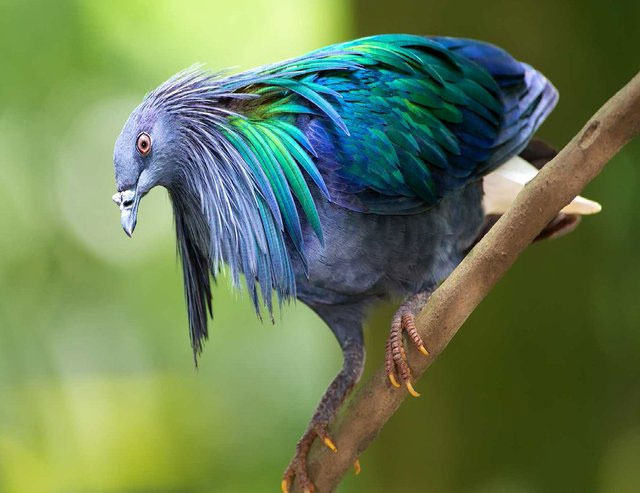
The rare beauty of the Nicobar pigeon.
The iris is a fairly dark brown (ranging from dark gray to whitish gray), and the inner part of the eye is black. The strong, large legs are a deep grayish red, with long pale-yellow claws.
Immature birds have glossy black plumage. By the time the chicks are about to leave the nest, their plumage becomes as glossy as an adult's, except that the tail may be partly black and the legs brownish.
Nicobar pigeons forage on the ground, in relatively flat areas covered with fallen leaves. They search for food by flicking leaves aside and probing with their bills. Their diet consists mainly of forest fruits, especially very hard seeds, along with some ground-dwelling invertebrates. The birds are usually seen foraging alone, sometimes in pairs or threes.
Very difficult to breed in captivity
On Côn Đảo, most of these birds are concentrated on Bảy Cạnh island. According to collected information and records, Nicobar pigeons are also found in areas such as Bến Đầm and Rađa.
The appearance of this rare pigeon is evidence that its population is still thriving in the wild. Notably, in 2009, engineer Phạm Thành Đúng, head of the Science Management Department at Côn Đảo National Park, successfully raised the rare Nicobar pigeon (Caloenas nicobarica). He reared chicks caught in the wild to adulthood, and they went on to lay eggs. However, for unknown reasons, the eggs never hatched. Afterwards, all the Nicobar pigeons he had raised were released back into the wild.
Only now has Côn Đảo National Park again recorded a Nicobar pigeon in the wild. The park will carry out outreach and environmental education to raise awareness in the local community, especially among students, soldiers and fishermen, as well as visiting tourists, about the importance of conserving and developing the Nicobar pigeon population.
In particular, Côn Đảo National Park plans to work with partner organizations to develop ecotourism routes, such as the trail from the Bảy Cạnh ranger station to the lighthouse, introducing visitors to the harmonious blend of forest plants and animals. In doing so, it aims to spread awareness, bring people closer to nature and strengthen their appreciation so that everyone contributes to conserving biodiversity.
Rare Oriental darter lands on a roof in Ho Chi Minh City, refuses to fly even as residents climb up to catch it
A rare Oriental darter perched on a house roof in Gò Vấp, Ho Chi Minh City, and did not fly away; the homeowner handed it to forest rangers.
Chickens were domesticated thanks to the rice fields of Southeast Asia, new research suggests
Chickens may have been domesticated far later than thought, only after people began farming rice near forests where wild junglefowl lived.
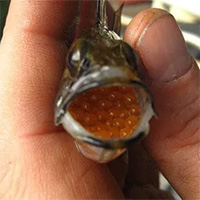
This fish starves itself and raises other males' young, just to win over females
Male mouth almighty fish brood young in their mouths without eating, and a new study shows some carry offspring that aren't even their own.
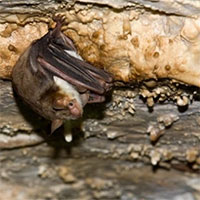
Bats imitate hornets to avoid being eaten by owls
When caught by an owl, the greater mouse-eared bat (Myotis myotis) mimics the buzzing of hornets to fool the predator.
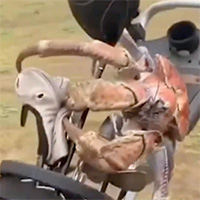
Giant coconut crab attacks golfer on Christmas Island
A golfer was stunned when one of the world's largest crabs attacked and snapped his sturdy club 'like a chainsaw.'
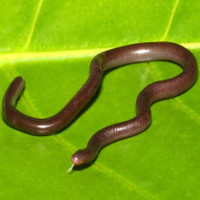
The little-known tiny worm snake of Vietnam
The worm snake looks much like an earthworm, but it is a true snake with all the anatomical features of one.