The little-known tiny worm snake of Vietnam
The worm snake shares many traits with the earthworm, but it is a true snake with all the anatomical features of one.
This tiny snake, known scientifically as Indotyphlops braminus, is a reptile in the blind snake family (Typhlopidae). With its rounded head and glossy brown body, it looks remarkably like a common earthworm.
Look closely, however, and you will see that the worm snake's body is covered in scales and is not segmented. It has a pair of tiny eyes on its head and, most tellingly, the forked tongue that snakes are known for, constantly flicking in and out.
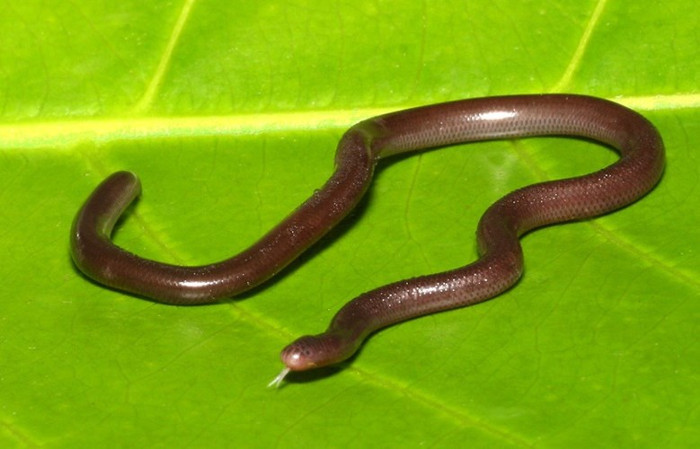
Worm snakes can reproduce without males.
The worm snake is small, reaching only about 20 cm in length. Its body is covered in glossy brown scales, with a rounded head and a pointed tail, and it is not venomous. Its forked tongue is a typical snake trait. Because it lives underground, its eyes have degenerated into tiny dots that provide almost no vision.
Worm snakes can reproduce without males. Each time, a female lays about eight eggs. In this form of reproduction without fertilization, all the hatchlings are female. The snakes mainly live in moist areas near ant and termite nests, and feed mostly on the larvae and eggs of ants and termites.
This strange, ultra-tiny snake is also called the blind snake because it lives underground, under rubble or in rotting wood. Although it does have eyes, they have degenerated into tiny dots that offer almost no vision but can still sense light intensity.
This snake is rarely seen.
Worm snakes can be found in many parts of Vietnam, from the north to the south, even in big cities such as Hà Nội and Hồ Chí Minh City.
Beyond Vietnam, this ultra-tiny snake also occurs in Thailand, Peninsular Malaysia and Singapore. It has also been found in Africa, the Middle East, the rest of tropical Asia and some temperate parts of Asia.
This snake is rarely seen, though it is not actually scarce. According to scientists, this is probably due to its particular survival traits and all-female reproduction rather than to human activity.

New mole species discovered in Vietnam's Central Highlands
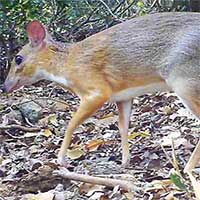
A new mole, Euroscaptor ngoclinhensis, has been identified on Mount Ngọc Linh and in the Central Annamite range of Vietnam.
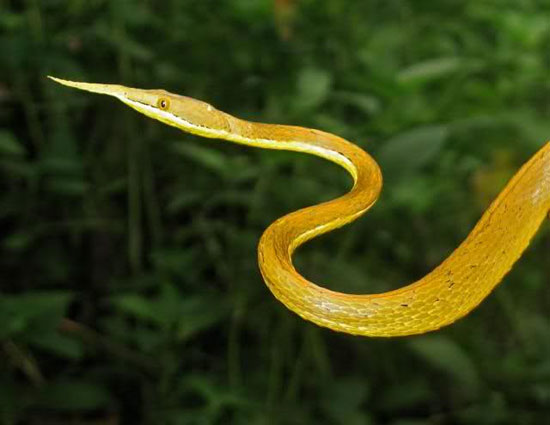
The rhinoceros ratsnake: a Vietnamese snake with a horn on its nose
The rhinoceros ratsnake of Vietnam looks bizarre and intimidating, yet this horned-nose snake is harmless, non-venomous and docile.
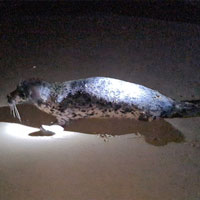
Rare seal unexpectedly turns up off Vietnam's Quảng Nam coast
A rare seal, an animal of cold climates, was caught in fishermen's nets off the former Quảng Nam province in central Vietnam and released.
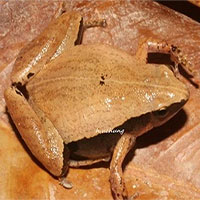
Two cryptic frog species discovered in Vietnam
Scientists from Vietnam, Russia, Germany and China have described two cryptic frog species from Ninh Thuận and Đắk Lắk in southern Vietnam.
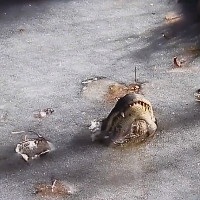
How alligators survive in freezing water
Alligators use a hibernation-like strategy called brumation to survive freezing weather in the US.
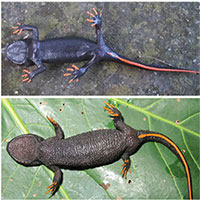
Super-cute new crocodile newts discovered in Vietnam
Scientists have described two new species and one new subspecies of crocodile newt from northern Vietnam, already threatened by trade and habitat loss.