Two cryptic frog species discovered in Vietnam
Scientists from Vietnam, working with colleagues from Russia, Germany and China, have described two cryptic frog species from Ninh Thuận (a former province in south-central Vietnam, now part of Khánh Hòa) and Đắk Lắk, a province in Vietnam's Central Highlands.
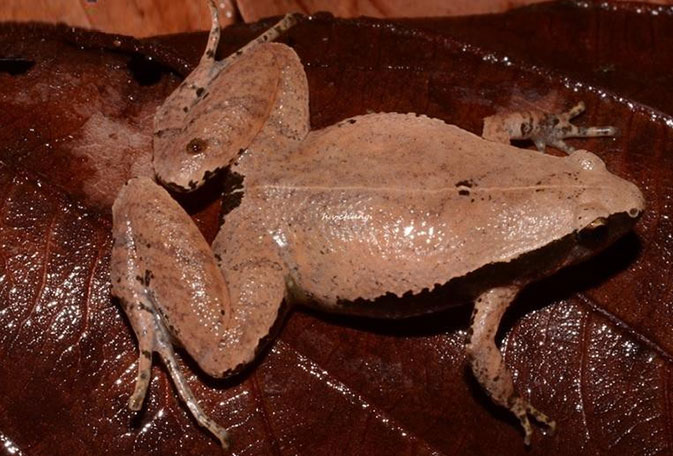
The new narrow-mouthed frog species discovered in Ninh Thuận, Vietnam. (Photo: Vast.gov.vn).
According to scientists at the Vietnam National Museum of Nature (Bảo tàng Thiên nhiên Việt Nam), part of the Vietnam Academy of Science and Technology (Viện Hàn lâm Khoa học và Công nghệ Việt Nam), the two newly discovered narrow-mouthed frogs are named after the places where they naturally occur: the Ninh Thuận narrow-mouthed frog (Microhyla ninhthuanensis) and the Đắk Lắk narrow-mouthed frog (Microhyla daklakensis).
Both belong to the Heymons' narrow-mouthed frog (Microhyla heymonsi) group. They are tiny: adult females measure just 2.26–2.36 cm, while males are smaller, at 1.73–1.88 cm.
Because both are cryptic species within a complex group of look-alike frogs, the researchers told them apart by combining molecular genetic data with statistical analysis of differences in body measurements. The results confirmed that the two are distinct species, and both are new to science.
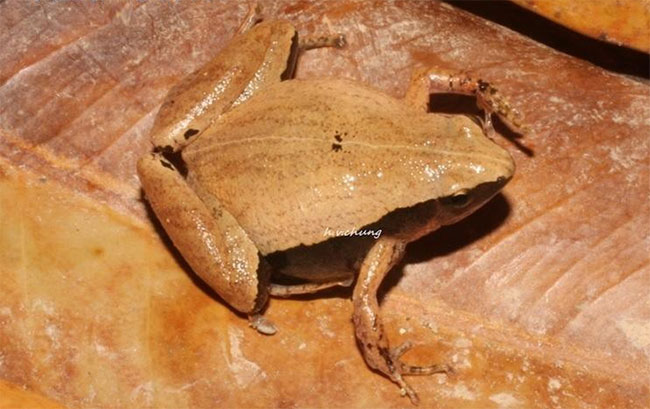
The new narrow-mouthed frog species discovered in Đắk Lắk. (Photo: Vast.gov.vn).
Even so, the scientists say much remains unknown about these two frogs and about the Heymons' narrow-mouthed frog group as a whole. Even the species' distribution ranges are unclear and require further study.
The discovery of the two cryptic frogs in Ninh Thuận and Đắk Lắk adds to the number of frog species known from Vietnam. The findings by the team of Vietnamese, Russian, German and Chinese scientists were published in the international journal ZooKeys on 5 May 2021.
No head, no heart, no bones: this "fish" has survived for 500 million years
The lancelet, or amphioxus, has no head, heart or bones, yet this living fossil has survived for 500 million years.
How alligators survive in freezing water
Alligators use a hibernation-like strategy called brumation to survive freezing weather in the US.
The mystery of birds' "quantum sense"
University of Tokyo scientists have directly observed a quantum reaction thought to let birds and other animals sense Earth's magnetic field.
Super-cute new crocodile newts discovered in Vietnam
Scientists have described two new species and one new subspecies of crocodile newt from northern Vietnam, already threatened by trade and habitat loss.
Half-deer, half-mouse creature resurfaces in Vietnam after nearly 30 years
The silver-backed chevrotain, a tiny mouse-deer feared lost for nearly three decades, has been photographed by camera traps in southern Vietnam.
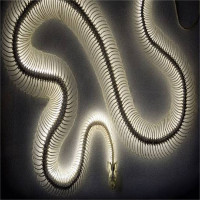
New bizarre "ghost snake" species discovered in Madagascar
Experts believe the pale grey snake, named Madagascarophis lolo, is a new species of cat-eyed snake.