New mole species discovered in Vietnam's Central Highlands
A mole species discovered on Mount Ngọc Linh, in the former Kon Tum province (now part of Quảng Ngãi) in Vietnam's Central Highlands, and elsewhere in the Central Annamite range is about the same size as the Vietnamese mole, but significantly smaller than the Pakho mole.
Scientists from the Vietnam National Museum of Nature, Kyoto University, Japan's National Museum of Nature and Science and the Institute of Ecology and Biological Resources (IEBR) in Hanoi have identified a new mole species, provisionally called the Ngoc Linh mole (Euroscaptor ngoclinhensis), which is distributed on Mount Ngọc Linh and across the Central Annamites.
The finding came from comparing differences between populations of the small-toothed mole (Euroscaptor parvidens) in the Central Annamites (the Kon Tum, Măng Đen, Kon Hà Nừng and Pleiku plateaus) and the Southern Annamites (the M'Đrắk, Đắk Lắk, Mơ Nông, Lâm Viên and Di Linh plateaus).
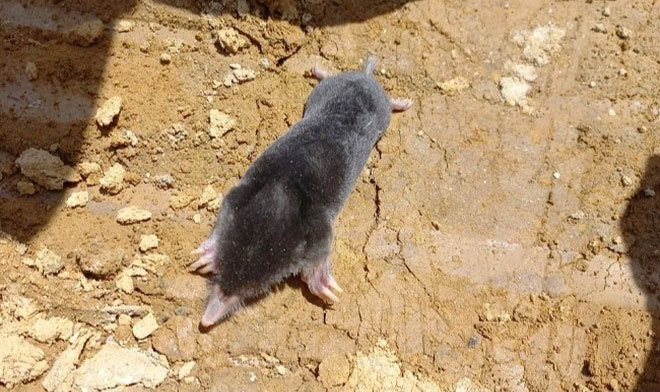
The Ngoc Linh mole, newly discovered in Vietnam.
The study also drew on a multivariate statistical analysis of 140 mole specimens collected at 18 different sites, most of them belonging to the four Euroscaptor mole species found in Vietnam. These included specimens from Chư Yang Sin National Park in Đắk Lắk province and Nam Nung Nature Reserve in the former Đắk Nông province (now part of Lâm Đồng).
The Ngoc Linh mole measures on average 12.0 to 12.3 centimeters long, with a tail about 1.5 cm long, accounting for only 5.8% to 6.1% of its body length. The species is about the same size as the Vietnamese mole (Euroscaptor subanura), but significantly smaller than the Pakho mole (Euroscaptor parvidens).
Combining genetic evidence with the geological uplift of the two plateau blocks, the researchers hypothesize that the ancestors of the small-toothed mole and Ngoc Linh mole groups were once widespread across south-central Vietnam and the Central Highlands. The small-toothed mole itself, however, was found to live only in the Southern Annamites.
Later, as the Central and Southern Annamite plateau blocks were pushed upward, the two subspecies (or species) began to diverge, a process that started in the Miocene epoch and continues to the present day.
Most members of the mole family (Talpidae) get around by burrowing entirely underground, a lifestyle known as fossorial. Adapted to this way of life, they have thick, elongated bodies and soft, silky fur that is dark blackish-brown or deep grayish-brown; most have orange or pale chest fur caused by glandular secretions, small ears that usually lack an external ear flap, and tiny, nearly vestigial eyes.
Moles' forelimbs are built for digging, with broad, outward-facing paws that can move backward and large claws. Their hind legs, by contrast, show far fewer adaptations than the front ones. Moles feed mainly on earthworms, insects and larvae in the soil.
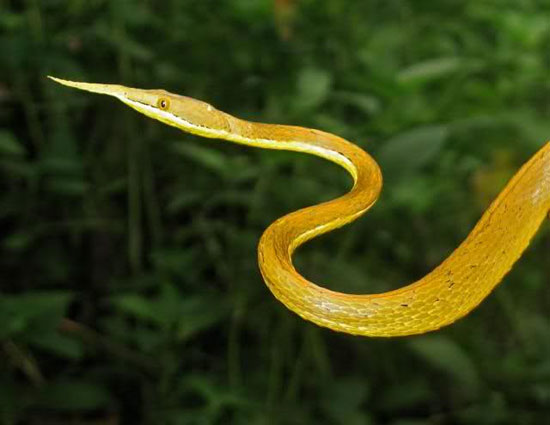
The rhinoceros ratsnake: a Vietnamese snake with a horn on its nose
The rhinoceros ratsnake of Vietnam looks bizarre and intimidating, yet this horned-nose snake is harmless, non-venomous and docile.
Rare seal unexpectedly turns up off Vietnam's Quảng Nam coast
A rare seal, an animal of cold climates, was caught in fishermen's nets off the former Quảng Nam province in central Vietnam and released.
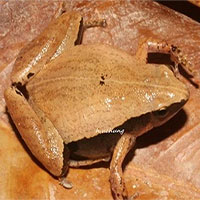
Two cryptic frog species discovered in Vietnam
Scientists from Vietnam, Russia, Germany and China have described two cryptic frog species from Ninh Thuận and Đắk Lắk in southern Vietnam.
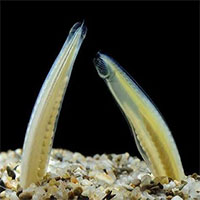
No head, no heart, no bones: this "fish" has survived for 500 million years
The lancelet, or amphioxus, has no head, heart or bones, yet this living fossil has survived for 500 million years.
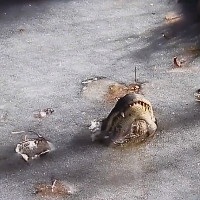
How alligators survive in freezing water
Alligators use a hibernation-like strategy called brumation to survive freezing weather in the US.

The mystery of birds' "quantum sense"
University of Tokyo scientists have directly observed a quantum reaction thought to let birds and other animals sense Earth's magnetic field.