Bats imitate hornets to avoid being eaten by owls
When a greater mouse-eared bat (Myotis myotis) is caught by an owl, it mimics the buzzing of hornets to fool the predator.
The buzzing call of the mouse-eared bat may lead an owl to think it is a stinging insect, buying the bat enough time to escape. The researchers say this is the first documented case of Batesian mimicry in a mammal. In this type of mimicry, a harmless species imitates a harmful one to avoid being hunted by predators. Danilo Russo of the University of Naples Federico II in Portici, Italy, and colleagues reported the finding on May 9 in the journal Current Biology.
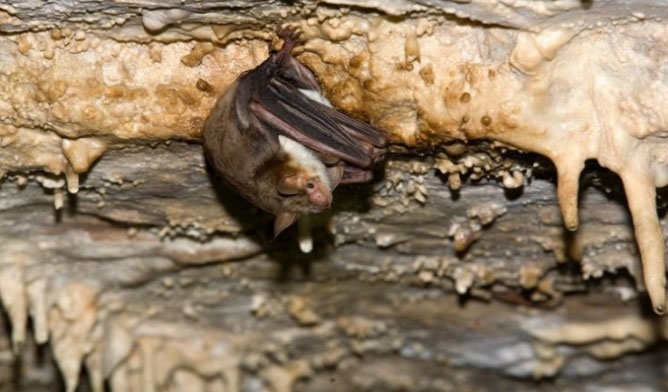
The greater mouse-eared bat mimics the sound of hornets to fool predatory owls. (Photo: Marco Scalisi)
Russo observed the behavior of mouse-eared bats while conducting field research. "When we removed the bats from nets or handled them, they kept buzzing like hornets," Russo said.
The team thought that the buzzing sound was an unusual kind of distress call. They suspected the bats had another reason for making the sound, perhaps to warn others of their kind or to deter predators. Russo's group set the question aside and moved on to other research. Years later, they decided to design a careful experiment to test their hypothesis about the mouse-eared bat's buzzing.
In the study, Russo and colleagues first examined the acoustic similarities between the bats' calls and those of stinging insects. Next, they played the sounds to captive owls to observe how they reacted.
Different owl species responded in a variety of ways, depending on their previous experience. However, they all reacted to the buzzing of both bats and insects by moving away from the source of the sound. In contrast, the calls of potential prey drew them closer. The team says the finding provides the first example of mimicry between a mammal and an insect.
The team's analysis of the sounds revealed that the buzzing of the bats and the insects became even more similar when heard the way owls hear them. The researchers suspect that hornets do sting owls, but they have no data to prove it. Other evidence shows that birds tend to avoid venomous insects. For example, when hornets move into a nest box or tree hole, birds will not nest there.
Giant coconut crab attacks golfer on Christmas Island
A golfer was stunned when one of the world's largest crabs attacked and snapped his sturdy club 'like a chainsaw.'
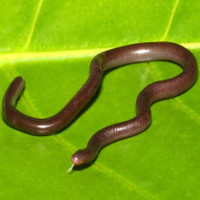
The little-known tiny worm snake of Vietnam
The worm snake looks much like an earthworm, but it is a true snake with all the anatomical features of one.

New mole species discovered in Vietnam's Central Highlands
A new mole, Euroscaptor ngoclinhensis, has been identified on Mount Ngọc Linh and in the Central Annamite range of Vietnam.
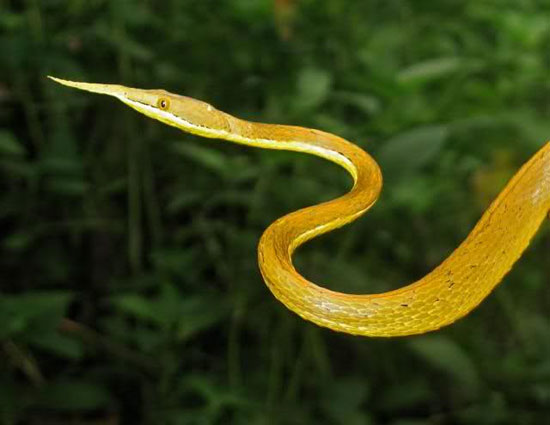
The rhinoceros ratsnake: a Vietnamese snake with a horn on its nose
The rhinoceros ratsnake of Vietnam looks bizarre and intimidating, yet this horned-nose snake is harmless, non-venomous and docile.
Rare seal unexpectedly turns up off Vietnam's Quảng Nam coast
A rare seal, an animal of cold climates, was caught in fishermen's nets off the former Quảng Nam province in central Vietnam and released.
Two cryptic frog species discovered in Vietnam
Scientists from Vietnam, Russia, Germany and China have described two cryptic frog species from Ninh Thuận and Đắk Lắk in southern Vietnam.