Unraveling the mystery of the "Confucius Cup"
This unusual cup, known as the "Confucius Cup," carries an intriguing story about moderation and wisdom. Thanks to its ingenious design, the cup holds liquid only up to a certain level, and it has become a symbol of self-restraint.
At first glance the cup looks rather ordinary, much like any cup used for tea or rice wine. Its only distinctive feature lies inside: the figure of an immortal sage rising from the center of the bowl. Pour in too much water, and the water drains out of the cup on its own, producing a curious effect.
The artifact is currently on display at the Tấn Ký Ancient House (101 Nguyễn Thái Học Street, Hội An city, Quảng Nam province, central Vietnam). The renowned antiquarian Vương Hồng Sển once owned a similar cup, but after he donated it to the Museum of Vietnamese History in Ho Chi Minh City, it mysteriously disappeared.
The "Confucius Cup": mystery and history at the Tấn Ký house
The Tấn Ký Ancient House has become a popular tourist attraction in Hội An, not only for its classical architecture, preserved intact for 200 years, but also for the large and varied collection of antique bowls, plates, vases, cabinets, daybeds and other pieces displayed and introduced by the Lê family.
Unless you look closely, you might never guess that the "Confucius Cup" is one of the family's treasures. Its shape is unremarkable, and it is no older than the other antiques. Yet according to Tân Xuân, the family's sixth daughter-in-law, once visitors learn about the history and workings of the little cup, they all want to see its marvel and mystery with their own eyes.
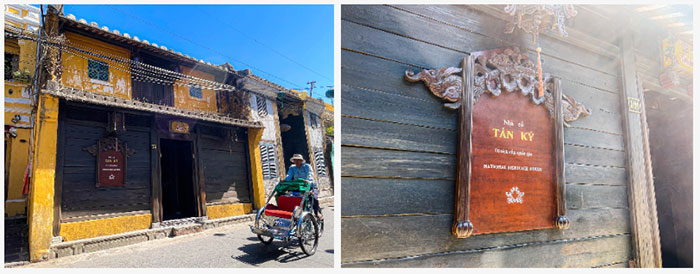
The Tấn Ký Ancient House
The cup is small enough to fit in the palm of a hand. It is made of fired clay with a white glaze and simple decorative patterns. In the middle stands a human figure that rises slightly above the rim. The bottom of the cup has a tiny hole about the width of a matchstick. When water is poured in partway, none leaks out, but add just a little more and the water immediately "spills" out.
Many people wonder why the cup can be filled to "eight-tenths" without overflowing, yet a tiny bit more makes all the water drain away instead of simply filling the cup further. According to records kept by the family, their prized cup was bought from Chinese merchants who came to trade. It is an object associated with the famous philosopher Confucius.
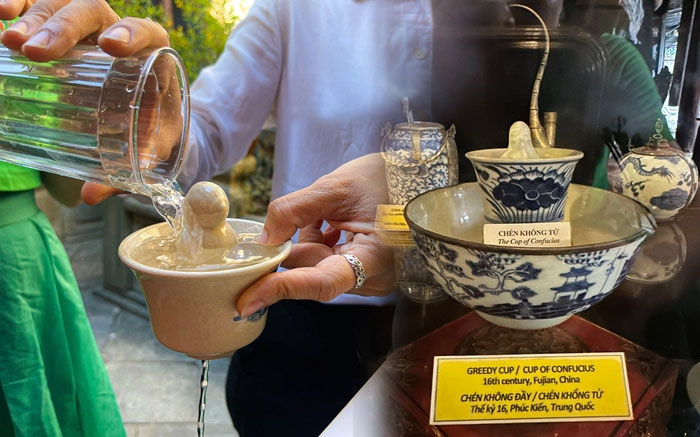
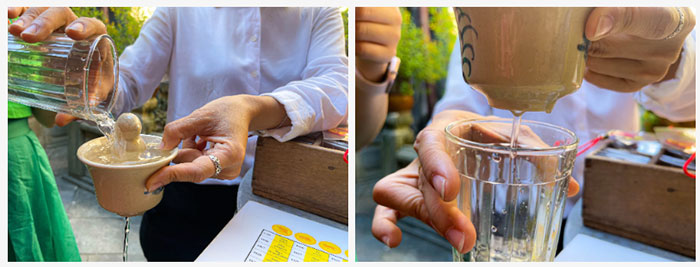

The bottomless Confucius Cup
According to legend, Confucius was once crossing a wilderness, hungry and thirsty, when he met an old man who led him to a pond of cool water and handed him a cup. Confucius scooped up water to drink, but each time he filled the cup to the brim, the water vanished completely. Eventually, he discovered a small hole in the bottom of the cup: whenever the cup was too full, the water escaped through it.
After repeatedly trying and failing to plug the hole, Confucius understood that to keep water in the cup, he must not fill it to the top. It was from this experience, the story goes, that Confucius put forward the philosophy of the Doctrine of the Mean, about keeping one's mind in a state of balance, and living by benevolence, righteousness, propriety, wisdom and trustworthiness to become a person of noble character.
The cup saved Confucius from hunger and thirst and became a symbol of him; it later came to be called the "Confucius Cup" and passed into legend.
Part of Vietnam's cultural heritage
Visitors curious about the "Confucius Cup" are often captivated by its marvel. The cup is not merely a passive antique; it embodies a profound story about philosophy and ethics. Visitors are often curious about how the cup puts the principle of moderation into practice.
The cup is usually stored with great care to protect its cultural and historical value. It is typically kept in a special place in museums or old houses, away from the effects of weather and strong sunlight. It is also kept out of the public's reach to avoid the risk of damage or loss.
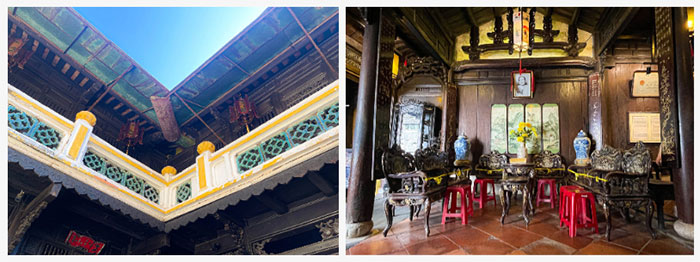
The cup is usually kept in a special place in museums or old houses.
Researchers and conservators often take special preservation measures to ensure the cup is conserved as well as possible. These may include regular inspection and cleaning, stable environmental conditions, and monitoring of changes in the cup's structure and color.
Over time, this careful preservation allows visitors and researchers to keep exploring the wonder and philosophy behind the "Confucius Cup", an important part of Vietnam's cultural heritage.

Decoding Vietnam's “ma đưa” ghost-led phenomenon and how to survive when lost in the forest
Vietnamese folklore abounds with eerie tales of “ma đưa,” being led astray by ghosts. Psychology explains it, and these skills help you get out alive.