Wildfires 13,000 years ago drove saber-toothed cats, dire wolves and other species to extinction
Humans and fire drove out prehistoric animals, much as is happening in the modern world.
If you traveled back in time 140 centuries to what is now California, you would encounter some of the most iconic creatures of prehistory. Giant animals such assaber-toothed cats and dire wolves roamed the land, and humans were only just beginning to arrive. Within the next 1,000 years, however, everything changed. All of these animals vanished, and the landscape was utterly transformed.
Researchers have long known about this mass extinction from the fossil record, but exactly why it happened has never been clearly explained. Now, a new study offers a compelling answer: The extinction was driven by fire.
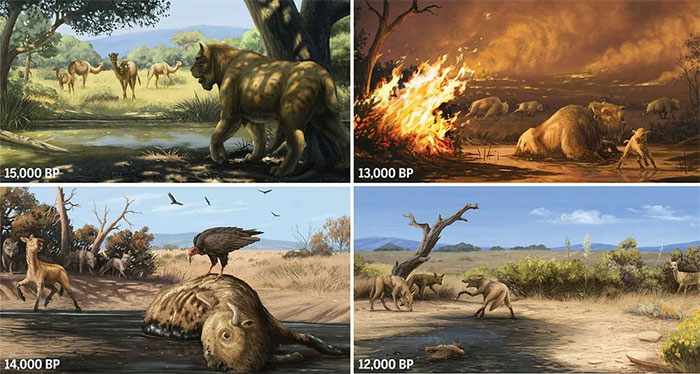
The chain of ecological events recorded at Rancho La Brea, California.
A team of researchers examined archaeological and biological evidence from the region, looking for clues to what caused the die-off. They found that around the time of the extinction, large-scale wildfires ravaged an ecosystem that was already under stress from climate change and human pressure.
About 14,000 years ago, temperatures in the Northern Hemisphere began to rise. That was also around the time humans arrived in North America.
In fact, the situation closely resembles what is happening today.
The authors wrote: "The conditions that led to the state shift in Southern California are occurring today across the western United States and in many other ecosystems around the world." "Understanding the interplay between climate change and humans in driving this past extinction event could be useful.".
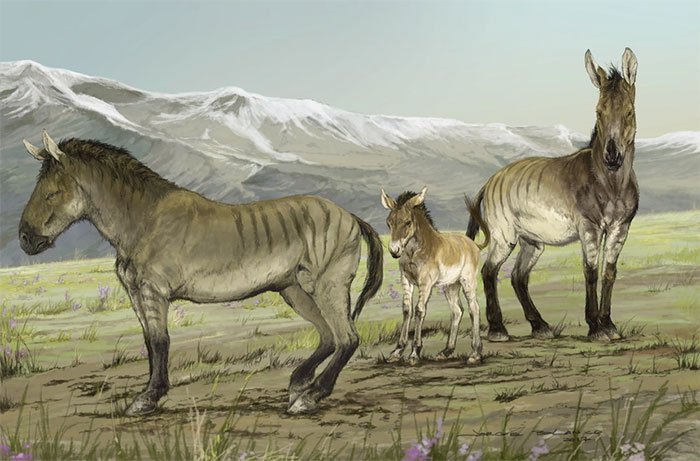
The North American continent is a vast, wild land, home to large mammals such as brown bears, gray wolves, bison and moose... In fact, tens of thousands of years ago it was home to many far larger animals, such as mammoths and saber-toothed cats, which lived and roamed across the continent.
Roughly two-thirds of the planet's large mammal species, from mammoths to mastodons, went extinct in North America at the end of the last ice age. This coincided with climatic changes as well as the growth and spread of human populations. Yet while researchers understand what happened, they still don't know exactly how it unfolded.
Much of what we know comes from the fossil record. But fossil evidence from this period is sparse and imprecise. So the researchers looked for another source of information — and found it at the La Brea Tar Pits near Los Angeles, California.
Tar pits are unusually effective at preserving the remains of living things, often yielding well-preserved fossils. La Brea holds a nearly continuous record of large animals from more than 55,000 years ago to the Holocene, 12,000 years ago. Using more than 160 bones from seven different species, the researchers examined when and why the animals trapped in the tar went extinct and compared this with the charcoal record.

At the end of the Pleistocene, although Earth was in an ice age, North America was still considered a paradise for giant animals.
They found that mammal populations in Southern California were stable from 15,000 to about 13,250 years ago. After that, the populations declined abruptly, and all of them had disappeared by about 13,000 years ago. The extinction event matches a shift in the environment marked by warming and fire.
Radiocarbon-dated records show that wildfires began to increase around 13,500 years ago and peaked between 13,200 and 12,900 years ago.
Humans reached the Pacific coast of the United States between 16,000 and 15,000 years ago and lived alongside the large animals for 2,000 to 3,000 years until those animals went extinct — and it is very likely no coincidence: humans probably played a major role in the mass extinction.
Aided by a changing climate that dried out vegetation, humans may have set some of the fires themselves to drive animals out and make them easier to hunt.
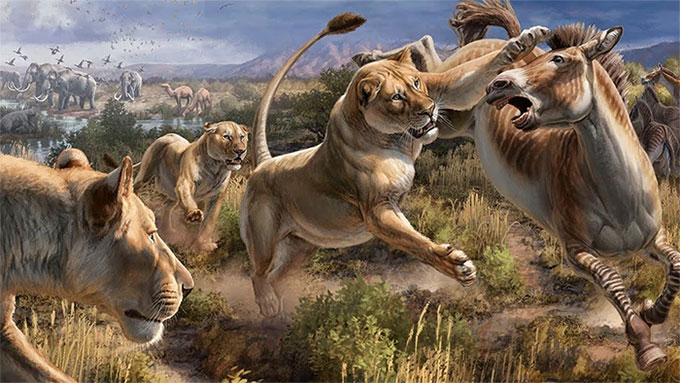
Indiscriminate killing by humans, combined with climate change, wiped out North America's large mammals and brought the age of giant creatures on the continent to an end.
Michael Waters, one of the study's authors, said in a press release: "Fire is how a small number of people can have a big impact over a large area." "This study has implications for the changes we see in Southern California today. Temperatures are rising and the region is drying out. We are also seeing a dramatic increase in fires."
The researchers argue that the findings suggest history may be repeating itself. The challenges large animals faced during the last ice age are similar to what is happening across ecosystems today: average global temperatures have risen by 1.1 degrees Celsius, combined with large-scale landscape changes driven by human activity.
The study was published in the journal Science.
Why tar pits matter to paleontology Tar pits are pools of heavy, sticky asphalt that can trap animals, plants and other organic material. When an animal gets stuck in a tar pit, it can attract predators and scavengers, which may become trapped as well. This leads to the accumulation of many different organisms in one place. The thick, sticky nature of tar keeps out oxygen. This anaerobic environment slows or prevents bacterial decomposition of organic matter. Many fossilization processes preserve only hard parts such as bones, teeth and shells. In tar pits, however, the lack of oxygen and the encasing nature of the tar can sometimes lead to the preservation of soft tissue. Once an organism is encased in tar, it is protected from scavengers that might scatter or consume the rest of the carcass. The asphalt also provides a physical barrier that shields the remains from weather and erosion. Over time, layers of sediment can build up over the tar, enclosing the organisms in a stable environment. This additional layer further aids preservation by adding pressure and protection. Tar pits can trap organisms over long periods. This means they can provide a continuous or semi-continuous record of the organisms that lived in an area over time, which can be invaluable to paleontologists seeking to understand ecosystems and the evolution of past environments. The nature of asphalt pits makes them relatively easy to find. Bones and other remains may partly protrude from the pit or be found near the surface. This can make discovering fossils simpler than in other geological settings, where deep excavation and careful extraction are needed. |

Nearly 200 prehistoric artifacts unearthed in caves in northern Vietnam
Stone tools, bones and pottery up to 10,000 years old were found in caves in the former Bắc Kạn province, now part of Thái Nguyên.

Deer antler found in Vietnam may be a 2,000-year-old musical instrument
A 35-cm antler fragment, likely from a sambar or hog deer, found along the Mekong River may be one of Southeast Asia's oldest stringed instruments.
Silver wedding dress found in 17th-century shipwreck
A silver wedding dress embroidered with heart motifs may have belonged to a woman from the very top of 17th-century European society.
Prehistoric sperm whale skull unearthed in Peru's Ocucaje Desert
The complete skull, with teeth and jaws intact, had lain in the Peruvian desert for around 7 million years.

Thousand-year-old jar burials found in irrigation reservoir bed in Vietnam's Quảng Ngãi
Over 20 burials and 3,500-year-old stone tools and jewelry have been restored after more than a decade of excavation at Nước Trong reservoir.

Second ancient bronze drum discovered in Quảng Ninh, Vietnam
A family in Quảng Ninh, northeastern Vietnam, unearthed a 14th–15th-century bronze drum buried over 1 m deep while building an embankment.