Teeth of prehistoric giant ape discovered in Vietnam's Thanh Hóa province
Scientists have discovered two teeth of a giant ape, the only such specimens from the Pleistocene epoch in Vietnam.
The study was carried out by experts from the Paleontological Institute of the Russian Academy of Sciences and the Vietnam-Russia Tropical Centre (Trung tâm Nhiệt đới Việt - Nga), including Dr. Lê Xuân Đắc, Dr. E.N. Mashchenko and their colleagues.
From 2020 to 2022, the scientists surveyed Làng Tráng Cave, in the former Cành Nàng township of the former Bá Thước district, Thanh Hóa province, in north-central Vietnam. Analyzing the fossil remains they collected, the team identified two teeth of the giant ape (Gigantopithecus blacki). These are the only such specimens from the Pleistocene of Vietnam and among the youngest teeth ever recorded for this extinct species (about 125,000 years old).
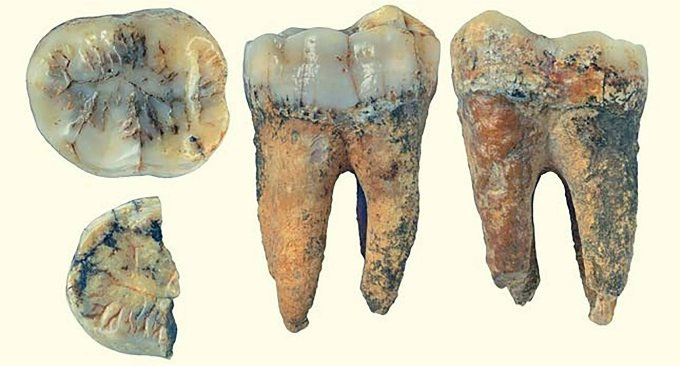
A lower molar of the giant ape from Làng Tráng Cave. (Photo: Russian Academy of Sciences).
According to the Vietnam-Russia Tropical Centre, the scientists analyzed the morphology and crown dimensions of the teeth found at Làng Tráng Cave and found that they match those of the giant ape G. blacki , with similarities in enamel thickness and in the size and shape of the roots. The enamel surface bears tiny scratches and micro-pits, a characteristic feature of primate teeth.
G. blacki was closely related to orangutans and was the largest primate ever to have lived, reaching a body mass of 200-300 kg. The giant ape roamed the forests of Southeast Asia before going extinct hundreds of thousands of years ago. Even so, its fossils are very rare and hard to find. Previously, known remains of the giant ape consisted of tooth fragments and jawbones collected from Pleistocene sediments in limestone caves in southern China. Isolated teeth have also been found in northern Vietnam and northern Thailand. Several fragments of the lower jaw of a giant ape of unknown geological age were found on the island of Java (Indonesia); matching G. blacki in size, they are regarded as Gigantopithecus sp.
Based on the geographic and stratigraphic distribution of Gigantopithecus, the scientists believe the fossil remains from Làng Tráng Cave are among the youngest known records of the giant ape found to date.
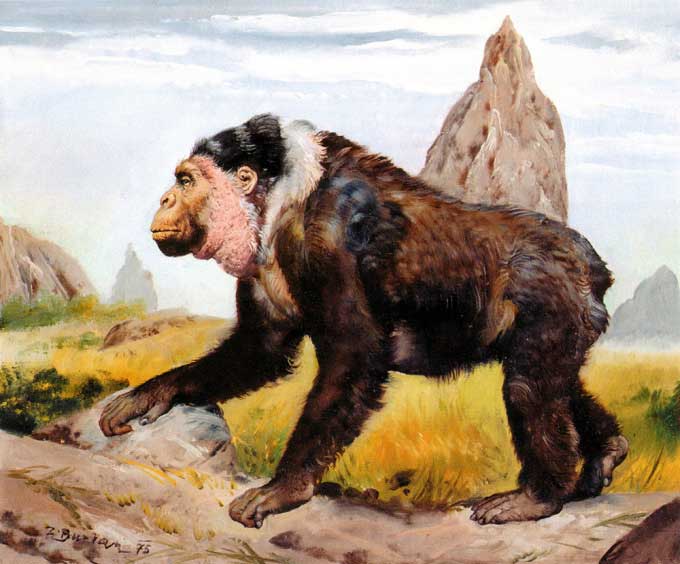
An artist's reconstruction of the giant ape. (Photo: Artist Z. Burian)
In their study at Làng Tráng Cave, the scientists also identified 41 species belonging to various taxonomic groups and put forward a hypothesis about the ancient environment during this period. Species identified for the first time in the Làng Tráng fauna include the giant ape (Gigantopithecus blacki), the long-tailed macaque (Macaca cf. fascicularis), the rhesus macaque (M. cf. mulatta), the clouded leopard (Neofelis nebulosa), a shrew (Chodsigoa hoffmanni), a bat (Ia io), Neill's long-tailed giant rat (Leopoldamys neilli), the black rat (Rattus rattus), the Indian rhinoceros (Rhinoceros unicornis), the Bornean bearded pig (Sus barbatus), the lesser mouse-deer (Tragulus kanchil), the water deer (Hydropotes inermis), the hog deer (Axis porcinus), crocodiles, turtles and several land snails.
In Vietnam, since before the 2000s, several paleontological teams have surveyed Làng Tráng Cave and the surrounding area. The Làng Tráng limestone cave is a famous paleontological site, known for fossils of prehistoric humans and more than 30 other species belonging to the Stegodon-Ailuropoda fauna, animals characteristic of the latter half of the Middle to Late Pleistocene. Studies of the Pleistocene fauna at Làng Tráng Cave have shed light on ecological adaptation, the distribution dynamics of ancient and modern animal species, and past changes in fauna and paleoenvironmental conditions. The new paleontological data provide a scientific basis for analyzing and forecasting biodiversity trends in Vietnam's modern fauna.

Wildfires 13,000 years ago drove saber-toothed cats, dire wolves and other species to extinction
Humans and fire drove out prehistoric animals in California 13,000 years ago, a pattern that echoes what is happening today.
Nearly 200 prehistoric artifacts unearthed in caves in northern Vietnam
Stone tools, bones and pottery up to 10,000 years old were found in caves in the former Bắc Kạn province, now part of Thái Nguyên.
Deer antler found in Vietnam may be a 2,000-year-old musical instrument
A 35-cm antler fragment, likely from a sambar or hog deer, found along the Mekong River may be one of Southeast Asia's oldest stringed instruments.
Silver wedding dress found in 17th-century shipwreck
A silver wedding dress embroidered with heart motifs may have belonged to a woman from the very top of 17th-century European society.
Prehistoric sperm whale skull unearthed in Peru's Ocucaje Desert
The complete skull, with teeth and jaws intact, had lain in the Peruvian desert for around 7 million years.
Thousand-year-old jar burials found in irrigation reservoir bed in Vietnam's Quảng Ngãi
Over 20 burials and 3,500-year-old stone tools and jewelry have been restored after more than a decade of excavation at Nước Trong reservoir.