Why do bulls "go mad" at the color red?
What did the color red ever do to bulls to make them go wild every time they see it?
Cattle are mammals we all know well, and their behavior and emotions have long fascinated people. Many believe that bulls become enraged at the sight of red and then charge, which is why matadors use red capes to provoke them. So how does red actually affect a bull's behavior and emotions?
A common misconception
Almost everyone seems to think bulls hate red. Television and the internet are full of footage of bullfights. When the matador flourishes the red cloth, the bull reacts at its most ferocious, charging headlong at the cloth as if fighting an enemy... The powerful animal, weighing more than 800 kilograms, becomes agitated, rams the cape like a mad thing and attacks the fighter. With its huge horns and tremendous strength, a bull can toss a man a dozen meters or more, and can even kill him. These images are etched into nearly everyone's mind and leave us with one idea: bulls hate red.
But is it true that bulls hate red? Has the color somehow "made enemies" of them?
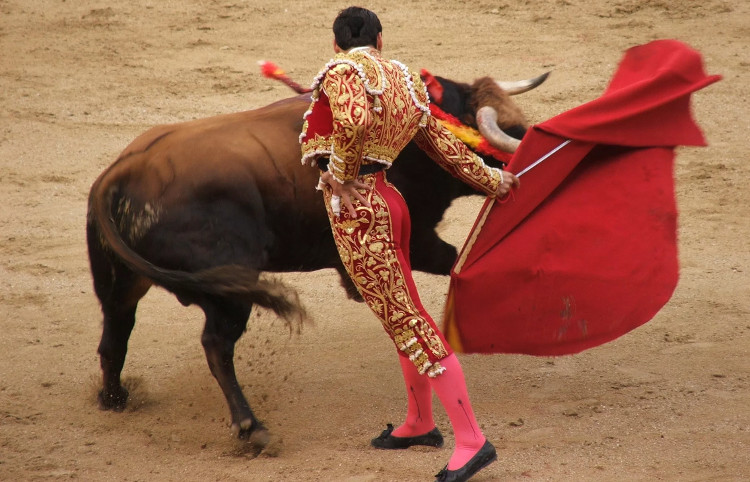
A bullfight.
In fact, that is not the case...
How cattle see
To better understand how color affects cattle, we first need to understand their visual system. There is a big difference between a cow's eye and a human eye.
The human eye can perceive a wide range of colors, including differences in brightness, hue and saturation, under varying lighting conditions. The truth is that bulls do not hate red at all; they cannot even tell what red is. You should know that scientists have studied this and concluded that bulls are red-green colorblind. The red we see appears to them as a dull grayish tone. Because of how their eyes are built, bulls cannot "scan" the full range of colors in the spectrum. The most vivid color they can see is orange.
So does that mean bulls must hate gray instead? That is not true either.
The bovine retina contains rod cells and two types of cone cells: rods work mainly in dim light, while cones work in daylight, helping the animal see color and detail. Cattle have a much wider field of view than humans, but they are less sensitive to detail.
What really provokes a bull is the matador's waving of the cape; it would be more accurate to say the animal feels taunted. Bulls are instinctively agitated, especially when the roaring and shouting of the crowd combine with the constant "jabbing" of the blades in the bullfighter's hands, which drives the bull... "berserk". It fights out of anger and to defend its territory, nothing more.
To test this idea, the Discovery Channel show MythBusters ran an experiment with bulls. The team used cloths in three different colors, red, white and blue, and held them in front of a bull. At first the bull showed no reaction, but once they started waving the cloths, sure enough, the bull became agitated and charged.
A little-known fact about bulls is that their eyes can take in a field of view of about 330 degrees, whereas human eyes can see at most about 170 degrees. So although a bull's eyes sit on the sides of its head, it can still perceive everything happening in front of it.
So if you don't want to be attacked by a bull, the best thing is not to tease it. As for what color you wear, it doesn't matter; the bull doesn't care much about color.
So if bulls can't see red, why do matadors always use red capes? The answer is that red helps bullfighters hide the blood of the wounded animal during the fight, and possibly their own blood as well.
In short, the effect of color on cattle should be understood from a scientific point of view. We need to respect animals and, through careful observation and research, understand their behavior and emotions so that we can live in better harmony with them.

Why is Hà Nội's Thê Húc Bridge painted red and facing the sun?
The Thê Húc Bridge in Hà Nội is painted red because the color symbolizes the sun, life, good fortune and happiness.

Why do Pitbulls, the "king of fighting dogs," so often lose to venomous snakes?
Other dogs can often overpower venomous snakes, but Pitbulls frequently pay a heavy price in such fights. Their aggressive nature is to blame.