Rufous-necked hornbill: One of Vietnam's most endangered birds
This is a large bird, measuring 90-120 cm in length and weighing 2.2-2.5 kg. The Vietnam Red Data Book lists this remarkable species as Critically Endangered, as it is hunted by local people for meat and its habitat has been fragmented by the destruction of primary forests.

Found in Vietnam's Northwest and North Central regions, the rufous-necked hornbill (Aceros nipalensis) is one of the most striking-looking birds in the country, and one of its most endangered

It is a large bird: adults measure 90-120 cm in length and weigh 2.2-2.5 kg. Its most distinctive feature is its large yellow bill, with black ridges at the base of the upper mandible

Rufous-necked hornbills have an orange pouch of bare skin under the chin and a ring of blue skin around the eye

The species is a resident of evergreen broadleaf forests at elevations of roughly 600-1,800 meters, though it is occasionally seen as low as 150 meters or as high as 2,200 meters

Some populations move seasonally between different forests and areas, feeding on berries

They nest in tree cavities 10-30 meters above the ground

In Vietnam, rufous-necked hornbills have been recorded in forests in Lào Cai, Lai Châu, the former Yên Bái province (now part of Lào Cai) and Nghệ An. Globally, the species ranges across South Asia, southern China and Southeast Asia

The bird's numbers are declining rapidly in Vietnam. The Vietnam Red Data Book lists this remarkable species as Critically Endangered


The main threats to the rufous-necked hornbill are hunting by local people for meat, the loss of nesting and foraging grounds, and habitat fragmentation as primary forests are destroyed. The species is protected in Vietnam, and hunting, trading or consuming it is illegal and can lead to criminal prosecution

Teeth of prehistoric giant ape discovered in Vietnam's Thanh Hóa province
Scientists have found two teeth of the extinct giant ape Gigantopithecus blacki in a cave in Thanh Hóa, the only such Pleistocene specimens in Vietnam.

Wildfires 13,000 years ago drove saber-toothed cats, dire wolves and other species to extinction
Humans and fire drove out prehistoric animals in California 13,000 years ago, a pattern that echoes what is happening today.

Nearly 200 prehistoric artifacts unearthed in caves in northern Vietnam
Stone tools, bones and pottery up to 10,000 years old were found in caves in the former Bắc Kạn province, now part of Thái Nguyên.

Intact 3,000-year-old grave discovered in Siberia
Archaeologists in Siberia have found an intact 3,000-year-old grave whose goods show chariots were used in the region over 3,000 years ago.

Deer antler found in Vietnam may be a 2,000-year-old musical instrument
A 35-cm antler fragment, likely from a sambar or hog deer, found along the Mekong River may be one of Southeast Asia's oldest stringed instruments.
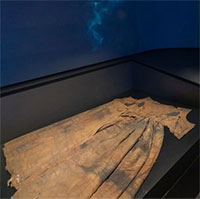
Silver wedding dress found in 17th-century shipwreck
A silver wedding dress embroidered with heart motifs may have belonged to a woman from the very top of 17th-century European society.