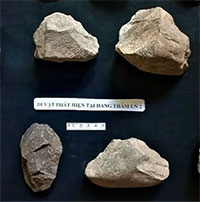
Ancient mammal fossil discovered in a cave in Ha Long Bay
The mammal, estimated at just over 1 m long, is thought to be no more than about 10,000 years old.
According to the Management Board of Vịnh Hạ Long (Ha Long Bay, a UNESCO World Heritage Site in northern Vietnam), caves hold far more than just rock and groundwater. Their stalactites and other formations also preserve traces of animals that once lived in the area and, for one reason or another, became trapped inside.
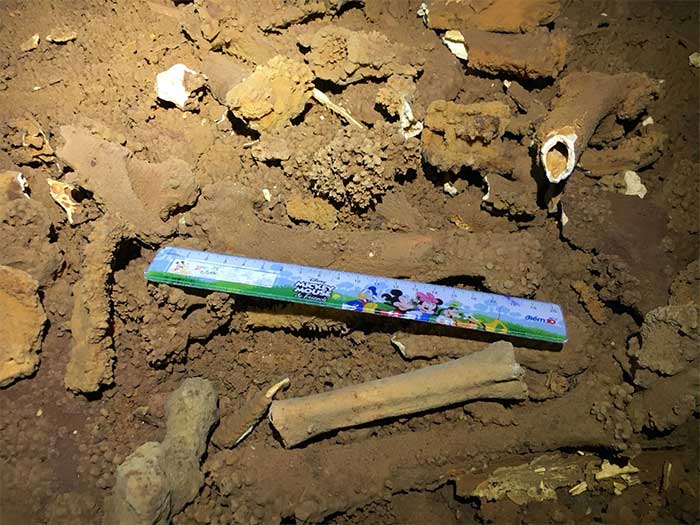
The skeleton of the ancient mammal found in the cave.
One such fossilized animal skeleton has been discovered in a cave in Ha Long Bay. The skeleton of the mammal, estimated at just over 1 m long, is almost completely intact, with its shoulder blades, limb bones, ribs and vertebrae still preserved.
Lying in a relatively enclosed cave chamber with abundant water flow, the skeleton has been encased and preserved over time by layer upon layer of calcite. Experts estimate that the skeleton is no more than about 10,000 years old.
It is also the only fossilized animal skeleton found in a cave in Ha Long Bay to date. This unique fossil is very important evidence for paleontologists studying the region's ancient environment and ancient life.
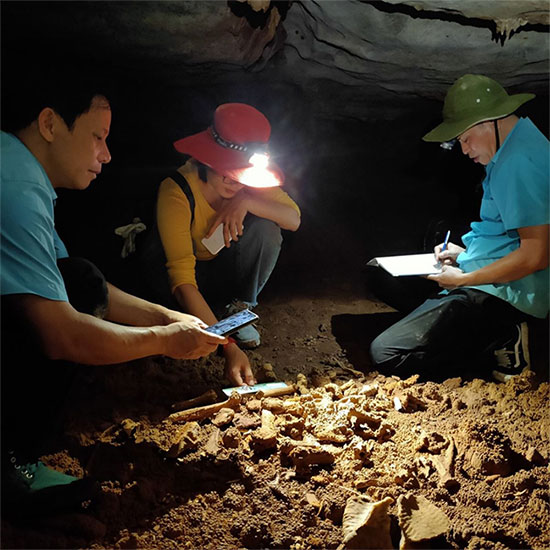
The scientists studying the fossilized bones.
Ha Long Bay's caves are known for their great beauty and their diverse origins. They range from 500,000 to 5,000 years old and feature spectacular stalactites and stalagmites, sculpted and built up by groundwater flowing through the limestone.
AI helps young man read 2,000-year-old scroll and win a hefty prize
A 21-year-old student won US$40,000 after using AI to read the first word hidden inside a charred 2,000-year-old Herculaneum scroll.
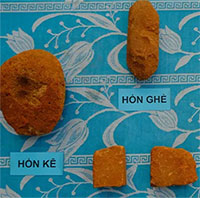
Over 1,000 artifacts more than 4,000 years old unearthed in Vietnam's Đắk Nông
Excavations at the Thôn 8 site in Vietnam's former Đắk Nông province uncovered 939 stone tools and 150 pottery sherds dating back some 4,500 years.
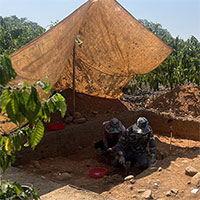
Prehistoric traces uncovered in archaeological dig in Vietnam's Đắk Nông
Archaeologists in Vietnam's Central Highlands have unearthed quartz artifacts left by prehistoric people thousands of years ago.
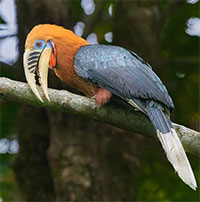
Rufous-necked hornbill: One of Vietnam's most endangered birds
Listed as Critically Endangered in the Vietnam Red Data Book, this striking hornbill is hunted for meat and losing its primary forest habitat.
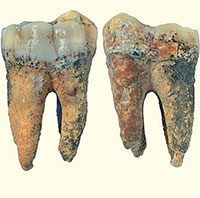
Teeth of prehistoric giant ape discovered in Vietnam's Thanh Hóa province
Scientists have found two teeth of the extinct giant ape Gigantopithecus blacki in a cave in Thanh Hóa, the only such Pleistocene specimens in Vietnam.

Wildfires 13,000 years ago drove saber-toothed cats, dire wolves and other species to extinction
Humans and fire drove out prehistoric animals in California 13,000 years ago, a pattern that echoes what is happening today.