Giant ancient turtle as big as a rhino, which lived around 80 million years ago, unearthed in Spain
The fossil of one of the largest turtles ever known, measuring nearly 4 meters long, has been found in Spain.
Paleontologists have recently uncovered the remains of Leviathanochelys, an extinct ancient sea turtle from the Late Cretaceous, a lineage that is thought to have vanished by the end of the period, around 66 million years ago.
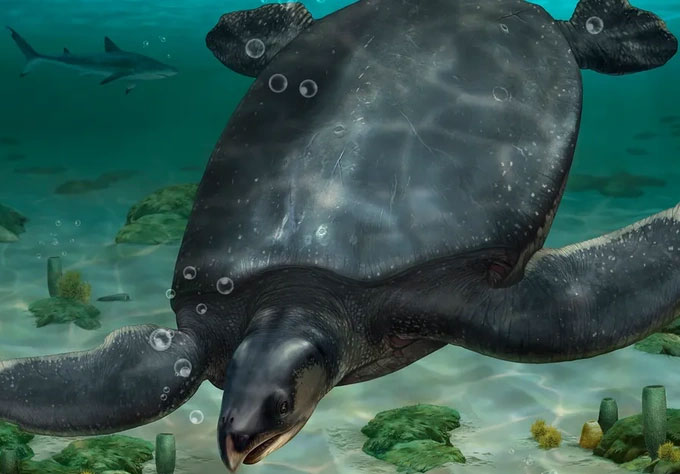
A giant ancient turtle as big as a rhinoceros went extinct 66 million years ago. (Photo: IFLScience).
It is considered one of the largest turtles ever known on Earth, and bears the scientific name Leviathanochelys aenigmatica. Its name comes from "Leviathan", the sea monster of the Bible, a fitting reference for a sea turtle of such enormous size.
According to the study, the specimen reveals that the turtle could reach nearly 4 meters in length, roughly the size of a rhinoceros. The fossil was recovered at the Cal Torrades site in northeastern Spain and is estimated to be about 80 million years old.
Beyond its astonishing size, the researchers also found a number of unusual anatomical features on the specimen's pelvis and shell, which took them by surprise. Some even suggested they were looking at a new species, and possibly a new group of turtles altogether.
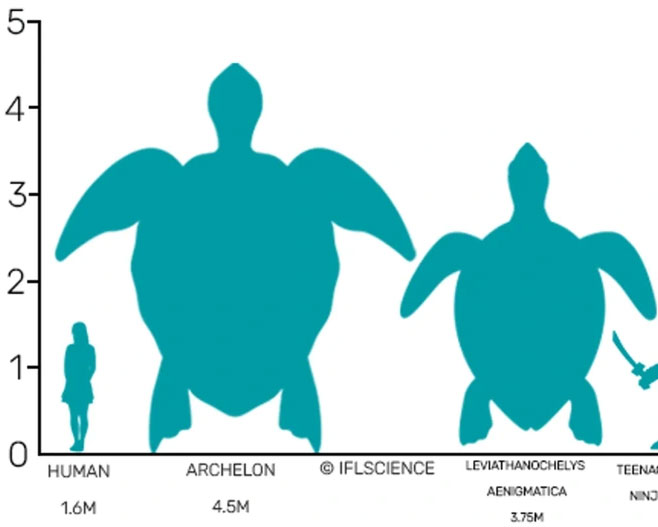
The size of the ancient turtle Leviathanochelys compared with a human. (Photo: IFLScience).
The turtle's gigantic size is an example of convergent evolution. In fact, similar traits have so far been found in other giant turtles from North and South America.
According to the study's authors, the discovery of the largest sea turtle ever found in Europe sheds light on the diversity of sea turtles and on the evolutionary trend toward "gigantism" among sea turtle groups in Europe in particular, and during the Cretaceous in general.

"Swan vase": a national treasure recovered from the sea
The blue-and-white "swan vase," a Vietnamese National Treasure, was recovered from a 15th-century shipwreck off Cù Lao Chàm.
Over 1,000 artifacts more than 4,000 years old unearthed in Vietnam's Đắk Nông
Excavations at the Thôn 8 site in Vietnam's former Đắk Nông province uncovered 939 stone tools and 150 pottery sherds dating back some 4,500 years.

Prehistoric traces uncovered in archaeological dig in Vietnam's Đắk Nông
Archaeologists in Vietnam's Central Highlands have unearthed quartz artifacts left by prehistoric people thousands of years ago.

Rufous-necked hornbill: One of Vietnam's most endangered birds
Listed as Critically Endangered in the Vietnam Red Data Book, this striking hornbill is hunted for meat and losing its primary forest habitat.
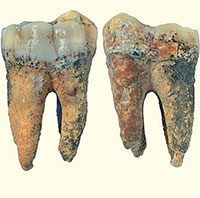
Teeth of prehistoric giant ape discovered in Vietnam's Thanh Hóa province
Scientists have found two teeth of the extinct giant ape Gigantopithecus blacki in a cave in Thanh Hóa, the only such Pleistocene specimens in Vietnam.

Wildfires 13,000 years ago drove saber-toothed cats, dire wolves and other species to extinction
Humans and fire drove out prehistoric animals in California 13,000 years ago, a pattern that echoes what is happening today.