"Swan vase": a national treasure recovered from the sea
The "blue-and-white swan vase," a National Treasure of Vietnam, was recovered during the excavation of an ancient shipwreck in the waters off Cù Lao Chàm.
Recognized as a National Treasure in 2012, the vase is displayed alongside the 15th-century Cù Lao Chàm shipwreck ceramics collection in the "Lê–Mạc Dynasties (1427-1788)" section on the second floor of the National Museum of Vietnamese History in Hanoi. According to the heritage dossier of Vietnam's Department of Cultural Heritage, it is the largest ceramic piece in the collection of one-of-a-kind objects excavated from the shipwreck off Cù Lao Chàm, an island cluster off Hội An (formerly Quảng Nam province, now part of Đà Nẵng city), in 1997-2000. The piece represents the pinnacle of ceramic technique and artistry in the Early Lê period and is emblematic of Vietnam's export ceramics.
The vase is tall, with swelling shoulders and a slender body that tapers toward the base, giving it a graceful, elegant silhouette characteristic of Early Lê glazed ceramics. On the white glaze, the decoration is painted in subtle light and dark shades of blue. The neck bears bands of trailing chrysanthemums, followed by bands of lotus petals enclosing stylized cloud scrolls. The body depicts a landscape typical of the Red River Delta in northern Vietnam, with fields, bamboo and grasses, followed by bands of waves and clouds.
What makes the vase special is its four swans, each shown in a different activity: flying, calling, sleeping and foraging. Together they symbolize Phi – Minh – Túc – Thực (flying, calling, resting, eating), a familiar theme in old ceramic decoration. The swan with outstretched wings in flight (phi) expresses freedom and advancement. The one stretching its neck to call (minh) suggests a bright future and wide-open prospects. The bird sleeping with its head tucked in (túc) symbolizes rest and abundance. The one feeding (thực) stands for plenty and prosperity. This was a form of wordplay used by people of the past, borrowing images and homophones to convey wishes for a brilliant future and a prosperous, well-provided life.

The vase measures 23.8 cm across the mouth and 25.8 cm across the base, and stands 56.5 cm tall. (Photo: Hiểu Nhân)
According to the National Museum of Vietnamese History, the vase is a prime example of white-glazed ware painted in blue, commonly known as blue-and-white ceramics, which emerged under the Trần dynasty in the 14th century and has been produced continuously ever since.
The vase was made in the Chu Đậu pottery village (in Thái Tân commune of the former Nam Sách district, former Hải Dương province, now part of Hải Phòng city), one of the country's largest ceramic production centers, which emerged in the 14th century and flourished in the 15th and 16th centuries. The village specialized in high-end ceramics for the aristocracy and for export. Its decorative themes broke free of classical Chinese models and were rendered in a free, creative style, steeped in folk character and the spirit of the Vietnamese countryside, especially the northern delta.
However, Associate Professor Bùi Minh Trí, director of the Imperial Citadel Research Institute, believes the vase was produced in the royal kilns of Thăng Long (present-day Hanoi). Excavations at the Imperial Citadel of Thăng Long have unearthed many ceramic shards with similar decoration.
Dr. Phạm Quốc Quân, a member of the National Heritage Council and former director of the National Museum of Vietnamese History, noted that besides its courtly character, the vase is the largest known piece of Early Lê ceramics. "It is flawless in its glaze and demonstrates the mastery of firing," he said.
According to him, the artisan showed great skill in observing every posture and movement of the swans. The feathers, eyes and beaks were rendered in the "gongbi" style (detailed and true to life), while the landscape was painted in a free, expressive style. The vase uses cobalt blue (lam hồi), producing distinctive brushwork.
Dr. Nguyễn Đình Chiến, former deputy director of the National Museum of Vietnamese History, said the vase is named for its swans, as the four birds are its most striking decoration. "One of the vase's outstanding values is that it is unique. Under the agreement with foreign experts during the excavation of the Cù Lao Chàm shipwreck, precious and unique objects would belong to Vietnam. This blue-and-white swan vase is one of those unique artifacts."
According to the book 2,000 Years of Vietnamese Ceramics, blue-and-white ware appeared in the 14th century, flourished in the 15th century and was exported across Southeast Asia in many distinctive forms. Early blue-and-white products included teapots, jars, bowls, vases, dishes and boxes decorated with bamboo, lotus and chrysanthemum motifs. Many types of blue-and-white ware have been documented in publications from Thailand, Indonesia, Japan and elsewhere. Notably, the Topkapı Palace Museum in Istanbul, Turkey, displays a blue-and-white vase with an inscription stating its year and place of manufacture: "Đại Hòa bát niên, tượng nhân Nam Sách châu, Bùi thị hý bút" (Painted by an artisan of the Bùi family from Nam Sách prefecture in the 8th year of the Đại Hòa era (1450)).

The blue-and-white swan vase (left) on display with the Cù Lao Chàm shipwreck ceramics collection at the museum. When it was discovered, the ship lay 70-72 m below the sea surface. The surviving hull is 29.4 m long and 7.2 m wide. The excavation took three years (1997-2000), and 240,000 artifacts were recovered. (Photo: Hiểu Nhân)
Over 1,000 artifacts more than 4,000 years old unearthed in Vietnam's Đắk Nông
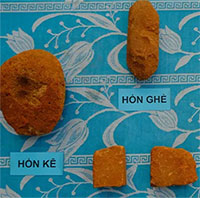
Excavations at the Thôn 8 site in Vietnam's former Đắk Nông province uncovered 939 stone tools and 150 pottery sherds dating back some 4,500 years.
Prehistoric traces uncovered in archaeological dig in Vietnam's Đắk Nông
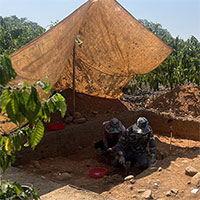
Archaeologists in Vietnam's Central Highlands have unearthed quartz artifacts left by prehistoric people thousands of years ago.
Rufous-necked hornbill: One of Vietnam's most endangered birds
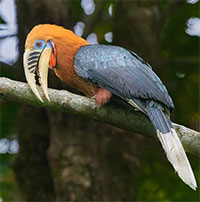
Listed as Critically Endangered in the Vietnam Red Data Book, this striking hornbill is hunted for meat and losing its primary forest habitat.
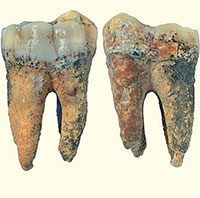
Teeth of prehistoric giant ape discovered in Vietnam's Thanh Hóa province
Scientists have found two teeth of the extinct giant ape Gigantopithecus blacki in a cave in Thanh Hóa, the only such Pleistocene specimens in Vietnam.

Wildfires 13,000 years ago drove saber-toothed cats, dire wolves and other species to extinction
Humans and fire drove out prehistoric animals in California 13,000 years ago, a pattern that echoes what is happening today.
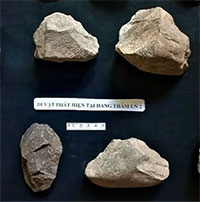
Nearly 200 prehistoric artifacts unearthed in caves in northern Vietnam
Stone tools, bones and pottery up to 10,000 years old were found in caves in the former Bắc Kạn province, now part of Thái Nguyên.