Why did people in the past often carve worship statues from jackfruit wood?
Although many other materials could be used instead, people in the past often chose jackfruit wood to make worship statues. Why?
Jackfruit wood is considered a precious timber in Vietnamese daily life and folk religious culture. In the past, people often used jackfruit wood to carve worship statues, especially Buddha statues and figures of deities in temples, pagodas and shrines. This choice rested on the material's properties, its spiritual value and its cultural importance.
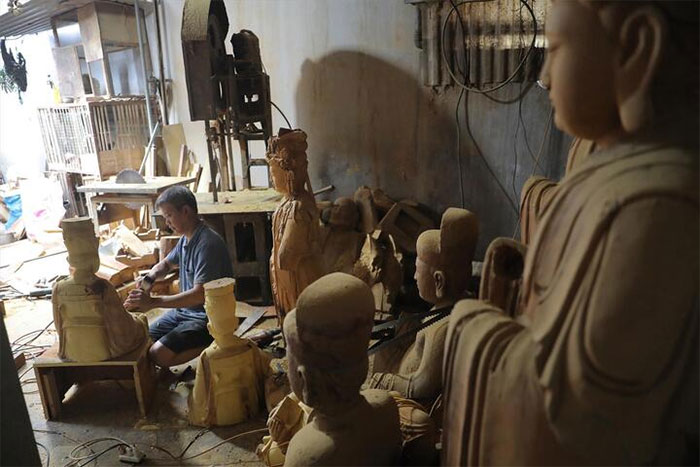
A statue being carved from jackfruit wood. (Illustrative photo).
Below are the reasons why, among countless precious woods, people in the past so often used jackfruit wood for worship statues.
Durable yet easy to carve
Jackfruit wood has a number of outstanding properties that make it an ideal choice for creating worship statues.
Jackfruit wood is durable and resistant to termites, wood borers and warping. This allows statues made from it to last for a long time without deteriorating, preserving their beauty and artistic value. Jackfruit wood can withstand harsh weather and suits Vietnam's varied climate conditions, especially the humid environment inside pagodas and shrines.
Jackfruit wood is not overly hard and has a fine grain, which makes it easier for artisans to carve intricate details. As a result, it became the top choice for worship statues with refined, graceful lines. Carving statues of the Buddha or deities demands great care and precision, which makes jackfruit wood an ideal material.
Freshly cut jackfruit wood is bright yellow, and it darkens to a deep brown over time. Its natural color gives a warm, familiar feel without losing any of its solemnity. In particular, the yellow of jackfruit wood is associated with the color of Buddhism, a symbol of purity and enlightenment. This makes it an ideal wood for crafting Buddha statues and ritual objects.
Spiritual beliefs
Beyond its advantages as a material, jackfruit wood also carries deep spiritual and religious meaning, which made it a favored choice for worship statues.
In many parts of rural Vietnam, jackfruit trees are commonly planted around homes, and especially at pagodas and village communal houses. Vietnamese people believe the jackfruit tree brings good luck, prosperity and peace to the family. For that reason, when jackfruit wood is used to carve a worship statue, people believe the statue absorbs the tree's good spiritual energy, bringing peace and prosperity to those who worship it.
Jackfruit wood has a light, pleasant fragrance that is not overpowering, helping to make worship spaces more solemn and serene. In religious rituals, serenity and solemnity are very important. Using jackfruit wood, with its gentle scent, has therefore helped create a sacred atmosphere during religious ceremonies.
Common and easy to find
Another reason jackfruit wood became a popular choice is that it is fairly easy to find in Vietnam. Jackfruit trees are easy to grow, grow quickly and are found widely across every region. People often plant them in their gardens, not only for the fruit but also so the wood is available when needed. As a result, jackfruit wood is readily available and cheaper than other precious woods such as rosewood (gỗ trắc) and Tonkin rosewood (gỗ sưa).
Thanks to its abundance and availability, jackfruit wood became a familiar material for Vietnamese people, not only in everyday life but also in religious and spiritual practices.
Using jackfruit wood to make worship statues also reflects the bond between people and nature. The jackfruit is an environmentally friendly tree that is easy to grow, rarely affected by pests and diseases, and needs little care. Using its wood has little impact on forest resources, helping to protect the ecosystem.
This reflects the philosophy of life held by people in the past: living in harmony with nature and valuing sustainability in both faith and daily life.
Why do bulls "go mad" at the color red?
Do bulls really hate red? Science shows they are red-green colorblind, and it is the movement of the cape that makes them charge.

Why can't we hear while we're asleep?
While we sleep, the brain filters out surrounding noises, movements and smells so we don't wake up, deciding which sounds deserve our attention.

Why the Lunar New Year has no '30th day of Tết' for 8 straight years from 2025
From 2025, Vietnam sees eight Lunar New Years in a row without a 30th day of Tết. Here is the astronomy behind it.
Why is Hà Nội's Thê Húc Bridge painted red and facing the sun?
The Thê Húc Bridge in Hà Nội is painted red because the color symbolizes the sun, life, good fortune and happiness.

Why do Pitbulls, the "king of fighting dogs," so often lose to venomous snakes?
Other dogs can often overpower venomous snakes, but Pitbulls frequently pay a heavy price in such fights. Their aggressive nature is to blame.
Why is there no beef on the traditional Vietnamese Tết offering tray?
Traditional Tết offering trays feature chicken and pork but no beef. The reason lies in Vietnam's wet-rice farming civilization.